


For most of the past two years, the open question in GP-led secondaries was on the sell side: how many sponsors would get comfortable rolling their best assets into continuation vehicles. PJT Partners’ latest quarterly read suggests that question has been answered. The constraint has moved to the other side of the table.
In its Q3 2026 Secondary Market Insight, PJT estimates that more than 125 continuation vehicles will be competing for capital in the fourth quarter, concentrated in middle-market private equity. “With many processes competing for the same pool of capital, buyers can be highly selective about which deals they prioritize and are raising their cost of capital,” writes David Perdue, Global Head of PJT Private Capital Solutions, in the report’s opening letter.
The headline numbers are still strong. PJT puts Q3 volume at roughly $56bn and year-to-date volume at about $175bn, around 6% ahead of the first three quarters of 2025, and forecasts 2026 at roughly $250bn, against $225bn for 2025. But the arithmetic of that forecast is telling: reaching $250bn requires something like $75bn in Q4 alone, which would make it the busiest quarter of the year by a wide margin. That is exactly the quarter in which PJT expects the CV queue to be at its longest.
What the queue looks like
PJT’s breakdown of the estimated Q4 pipeline describes a very specific kind of crowding. The typical deal waiting for capital is a single-asset CV, under $1bn, sponsored by a North American buyout manager.
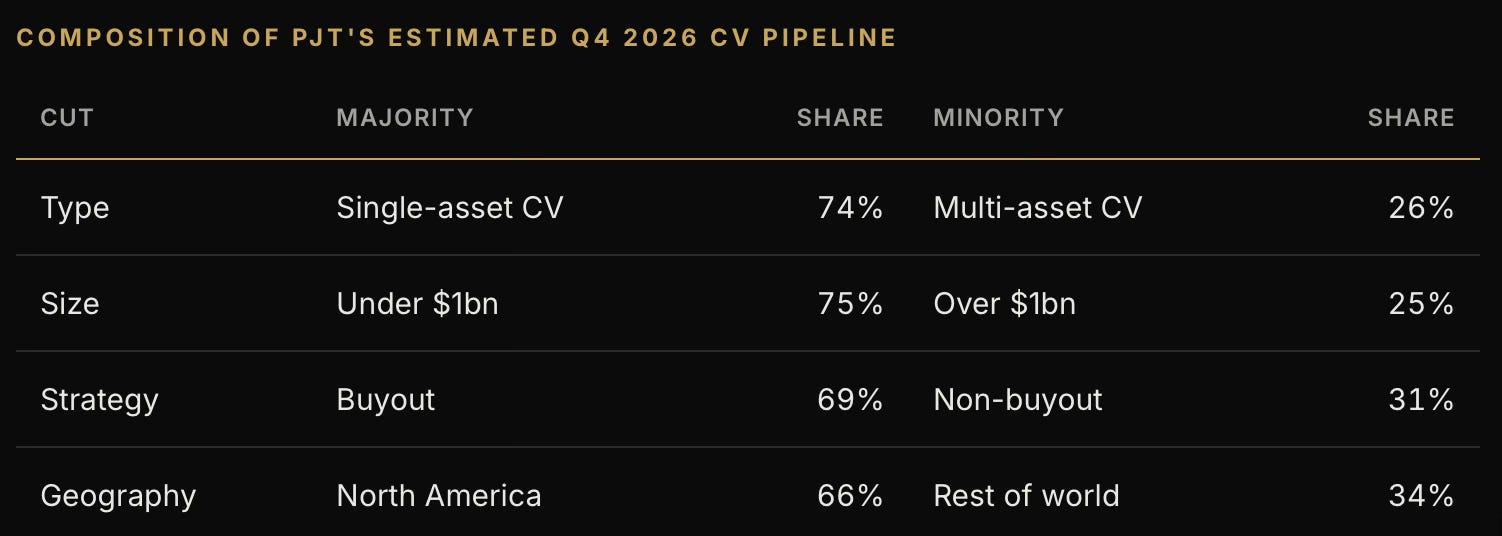
Source: PJT PCS Market Intelligence, Q3 2026 Secondary Market Insight. The deck describes the 125+ figure both as CVs “expected in Q4” and as CVs “currently in market”; we treat it as PJT’s estimate of the Q4 pipeline.
That concentration matters because single-asset CVs have been the GP-led market’s best-performing format. In our August analysis of Campbell Lutyens’ 1H 2026 data, single-asset CVs priced at an average 2.9% discount to NAV, and 69% cleared at par or better, while multi-asset discounts more than doubled. The format that earned buyers’ confidence is now the one in heaviest supply, and the pricing leverage that came with scarcity is shifting toward the buyers.
PJT also notes that “super carry” and other premium GP economics are being “selectively accepted by buyers for the most sought-after CVs.” Read together with the pipeline data, the picture is one of widening dispersion inside the GP-led market: premium terms for the trophy assets, and a longer queue and a higher hurdle for everything else.
More failed processes, and why that is a sign of maturity
“While our market grows, we are seeing more failed transactions.”
David Perdue, Global Head of PJT Private Capital Solutions
According to PJT, the number of continuation fund processes that have been abandoned or put on hold continues to rise, driven by misaligned price expectations between buyers and sellers. PJT reads this as a sign of “a maturing secondary market and sophisticated LPs and LPACs.”
That reading fits the way we have framed CVs at Secondary Scoop. A continuation vehicle is only a credible price signal if it can fail. When buyers under no obligation to participate walk away from a process because the price is wrong, the market is doing the price-discovery work that critics say CVs avoid. A rising failure rate in a record-volume year points to discipline, not distress.
It does, however, change the economics for sponsors. A failed or paused CV costs time, legal fees and LP goodwill, and it leaves the asset’s exit problem unresolved. PJT unsurprisingly concludes that this raises the value of an experienced advisor. We note that conclusion without endorsing it (see disclosure below).
Buyers rotate back to LP portfolios
The clearest behavioral signal in the report is a rotation. PJT says that, amid the crowded CV market, buyers shifted back toward LP-led deals during Q3, which accounted for about 54% of the quarter’s volume against 46% for GP-leds.
PJT’s year-to-date chart shows the two segments almost level, at roughly $88bn LP-led and $87bn GP-led. Backing out Q3 implies the first half leaned GP-led (approximately $61bn versus $58bn), so Q3 marks a flip rather than a continuation (Secondary Scoop calculation from rounded figures; PJT’s letter does not specify whether the 54/46 split refers to Q3 or YTD, but the YTD chart only reconciles with a Q3 reading).
Why a crowded CV market pushes capital toward LP-leds
Underwriting bandwidth is finite. Single-asset CVs need company-level diligence on a concentrated position. When 125 of them arrive in a single quarter, buyer teams have to triage, and the marginal dollar goes to deals they can underwrite at portfolio level.
The relative value has shifted. A diversified buyout LP portfolio priced at around 90% of NAV now competes against concentrated single-asset exposure priced near par. In a market where buyers can set the terms, the discount is easier to take than the concentration.
Sellers are willing. LPs managing portfolios proactively, rather than selling under duress, keep supplying high-quality LP-led flow, giving buyers a deep alternative to the CV queue.
PJT’s own LP-led mandates show the depth on that side of the market. The firm says it advised a Switzerland-based asset manager on a roughly $1.1bn sale of a mostly buyout fund portfolio, approaching 69 potential investors before landing a single buyer for the full portfolio at a price above initial expectations. It also advised a large institutional client on a $1.2bn buyout-weighted LP sale.
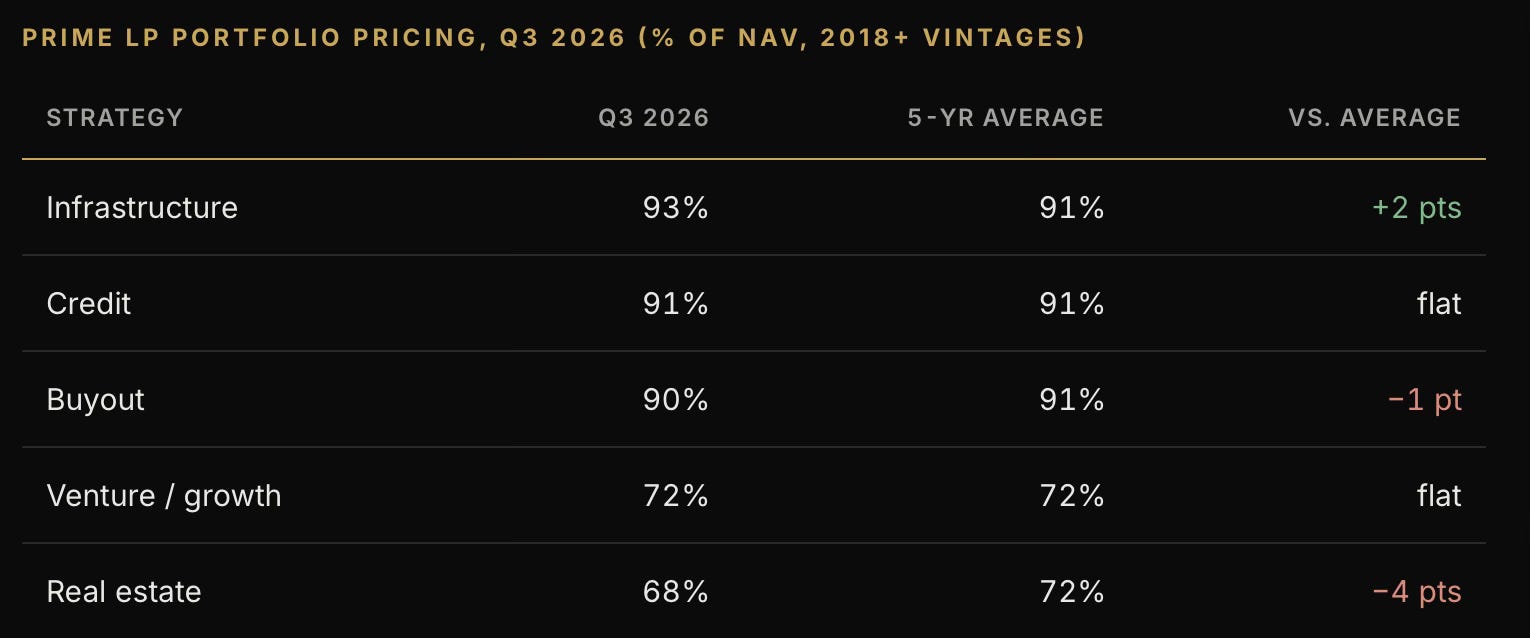
Source: PJT Partners, Q3 2026 Secondary Market Insight; prime portfolios (vintages 2018+) per sub-strategy. PJT says infrastructure pricing rose ~1% and venture/growth ~2% in the quarter, the latter led by top-tier managers holding leading AI companies.
The capital math: tightening, not running out
PJT’s dry powder analysis supports the buyer’s-market reading. It estimates secondary dry powder at $325bn for 2026 against $250bn of expected volume, a capital overhang of about 1.3x, down from 1.4x in 2025 and 2.8x in 2020. Dry powder grew about 3% over the year while volume grew about 11%. PJT frames this as an attractive entry point for new entrants, including sponsors building their own secondary platforms.
The capital that can clear large CVs is also concentrated. PJT highlights Gulf sovereign wealth funds and pensions as a growing source of syndication capital, now writing CV tickets of $250m to $500m-plus and up to $1.0bn to $1.5bn for conviction assets. Jefferies’ H1 2026 review found that only about 15% of secondary investors can write checks above $250m into single-asset CVs. When the queue is long, sponsors who can bring an anchor of that size in early will move ahead of those who cannot.
“Gulf sovereigns are no longer just passively participating in the secondaries market.”
Jawad Qasim, Partner and Head of SWFs Coverage, PJT Partners
Where the repricing bites
The report pairs selectivity with a sector rotation. PJT says buyers are rewarding cash yield and defensibility while repricing software, commodity and long-duration exposure. The median EV/EBITDA multiple on PE-backed SaaS deals fell from 20.4x in FY’25 to 11.7x in H1’26, and PJT notes that average tech single-asset CV sizes have “noticeably decreased” from H2’25 to H1’26. Venture and growth portfolios traded at a 28% discount to NAV in Q3, the second-widest of any strategy, behind real estate.
For a middle-market buyout sponsor holding a software asset and planning a Q4 CV, every one of these trends works against it.
The advisor’s own quarter
PJT’s own results line up with its research. Q3 revenue fell 14% year over year to $385.1m. According to the firm’s earnings release, the decline came from lower strategic advisory, restructuring and private capital solutions revenues, partly offset by higher primary fundraising. In other words, PJT’s secondaries advisory revenue dropped in the same quarter that its research describes as crowded. One quarter of fee timing says little on its own, but the direction is consistent. Over nine months, revenue rose 9% to a record $1.29bn, with private capital solutions among the drivers. On the November 3 call, Chairman and CEO Paul Taubman said PJT Park Hill’s nine-month results reflected “significant growth in private capital solutions and modest declines in primary fundraising,” and that the business remains on track for record 2026 revenues.
“The overall private capital solutions market continues to grow as GPs and LPs pursue alternative liquidity solutions, and the investor base in secondary products continues to expand.”
Paul Taubman, Chairman and CEO, PJT Partners, Q3 2026 earnings call
That line was the only time “secondary” came up on the call. Management did not mention continuation vehicles or GP-leds at all. The CV-crowding story comes from PJT’s research, not its earnings commentary.
In the Q&A, an analyst asked about competition in Park Hill’s market. Taubman answered that, with exits scarce and DPI hard to generate, asset managers are “increasingly looking for alternative means to create liquidity,” while more LPs “want to proactively manage their portfolio of relatively illiquid assets.” He also pointed to “proactive LP reweightings of their portfolio.” That is the same LP-led supply buyers turned to in Q3.
Answering an earlier question about private equity deal activity more broadly, Taubman described the valuation gap behind the failed processes in PJT’s report. Sellers need buyers, he said, and “a lot of assets are marked at levels which make clearing that hurdle by a comfortable margin challenging.” He described a bifurcation: real engagement for the best assets, while for assets that are “nice to have but not must have,” it comes down to price and financing. A CV process puts the same mark gap in front of secondaries buyers.