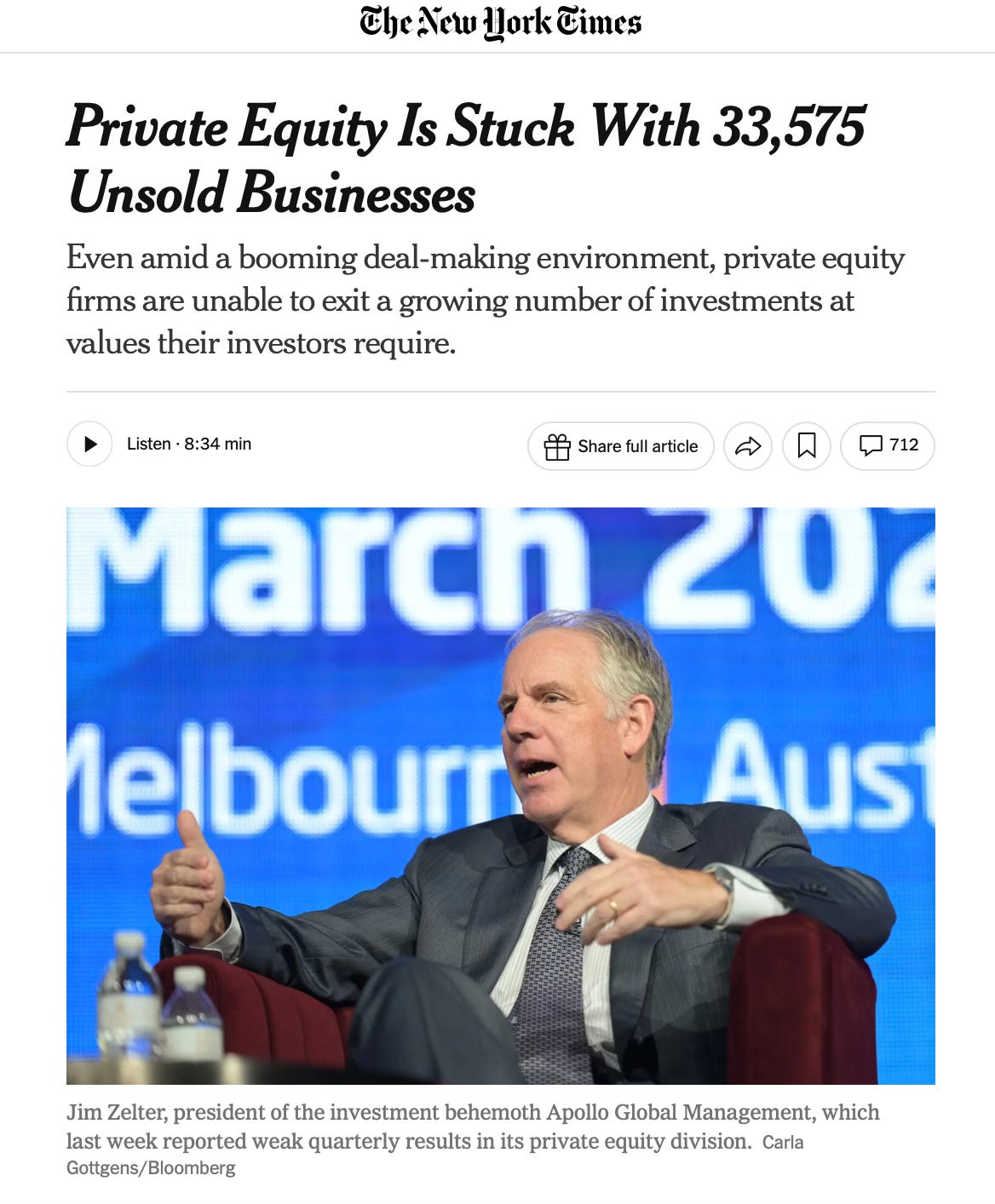
As of June 30, private equity firms had 33,575 unsold companies sitting in their portfolios, according to PitchBook data reported by The New York Times this week under the headline: “Private Equity Is Stuck With 33,575 Unsold Businesses”. This number is up from 32,451 at the end of 2025 and more than double the 15,923 held a decade ago. Worth noting up front: this is a global figure, not a U.S.-only one, though the Times’ framing leans heavily on domestic context.
From a Secondary Scoop perspective, the signal isn’t “private equity is stuck.” It’s that private equity’s original business model: buy, hold five to seven years, sell at a premium, was never built to survive the amount of capital that’s now locked inside it. What’s breaking isn’t the industry. It’s the assumption that illiquidity could stay temporary forever.
The Number Everyone Is Reading as Bad News
The surface-level facts are, in isolation, genuinely troubling for LPs who signed up for a specific promise. The Times cites MSCI data showing U.S. private equity generated annualized returns of just 6.4% from mid-2022 through Q1 2026, trailing the S&P 500’s 15.2% and the Nasdaq’s 19.3% by a wide margin over the same window. Andrew Milgram of Marblegate Asset Management put the diagnosis bluntly: “private equity is stuck because those companies have failed to fulfill their value promise.”
Apollo’s own Q2 2026 results carried the same message from the inside. The firm attributed weak private equity division performance to exits being “prudently delayed.” Higher-for-longer rates killed cheap leverage. Sponsor-to-sponsor demand, historically a major exit channel, thinned out. None of that is in dispute.
What is worth disputing is the implicit conclusion most coverage draws from these facts: that a growing backlog is evidence of an industry in trouble, full stop. That reading only holds if you assume private equity’s job was always supposed to be turning illiquid assets into liquid ones on a fixed five-to-seven-year clock. It wasn’t, that clock was a convention, not a law of physics. And conventions get rebuilt when the volume of capital behind them outgrows what they were designed for.
Every asset class that has ever locked up enough capital for long enough has eventually built a secondary market around it. Bonds did. Private real estate did. Private equity is simply doing it later, and at a scale that makes the transition impossible to ignore.
What Apollo Didn’t Say During its Q2 2026 Earnings Call
Apollo’s Q2 2026 earnings call ran nearly an hour and covered origination, market making, daily NAV rollout, ICE IDs, evergreen products, and a “five new investors” thesis for the future of private capital. What it didn’t cover, in any of roughly twenty analyst questions, was Apollo S3, the firm’s own secondaries and continuation-vehicle platform, built specifically to solve the kind of exit bottleneck the firm’s own earnings release acknowledged the same week. A firm managing $1.05 trillion, publicly framing its PE exits as “prudently delayed,” spent the entire call describing liquidity infrastructure for private credit securities without once naming the liquidity infrastructure it already runs for private equity stakes. That’s not necessarily a strategic omission, earnings calls follow analyst questions, not management’s full playbook, but it’s a useful reminder that the secondaries pitch still isn’t part of how even its most active practitioners talk about their own results.
What the Backlog Actually Signals
Read as a standalone data point, 33,575 unsold companies is a warning. Read as the fourth consecutive year of the same trendline, rising steadily since a decade-ago base of under 16,000, it’s something closer to a market structure problem with a known category of solution. The industry raised an enormous amount of capital during a period of historically cheap debt and elevated entry multiples, deployed nearly all of it into assets with hold periods calibrated to that environment, and is now discovering that the exit environment it was designed around no longer exists in the same form. That’s not collapse. That’s a mismatch between the duration of the assets and the liquidity expectations wrapped around them — and mismatches like that are exactly what secondary markets exist to solve.
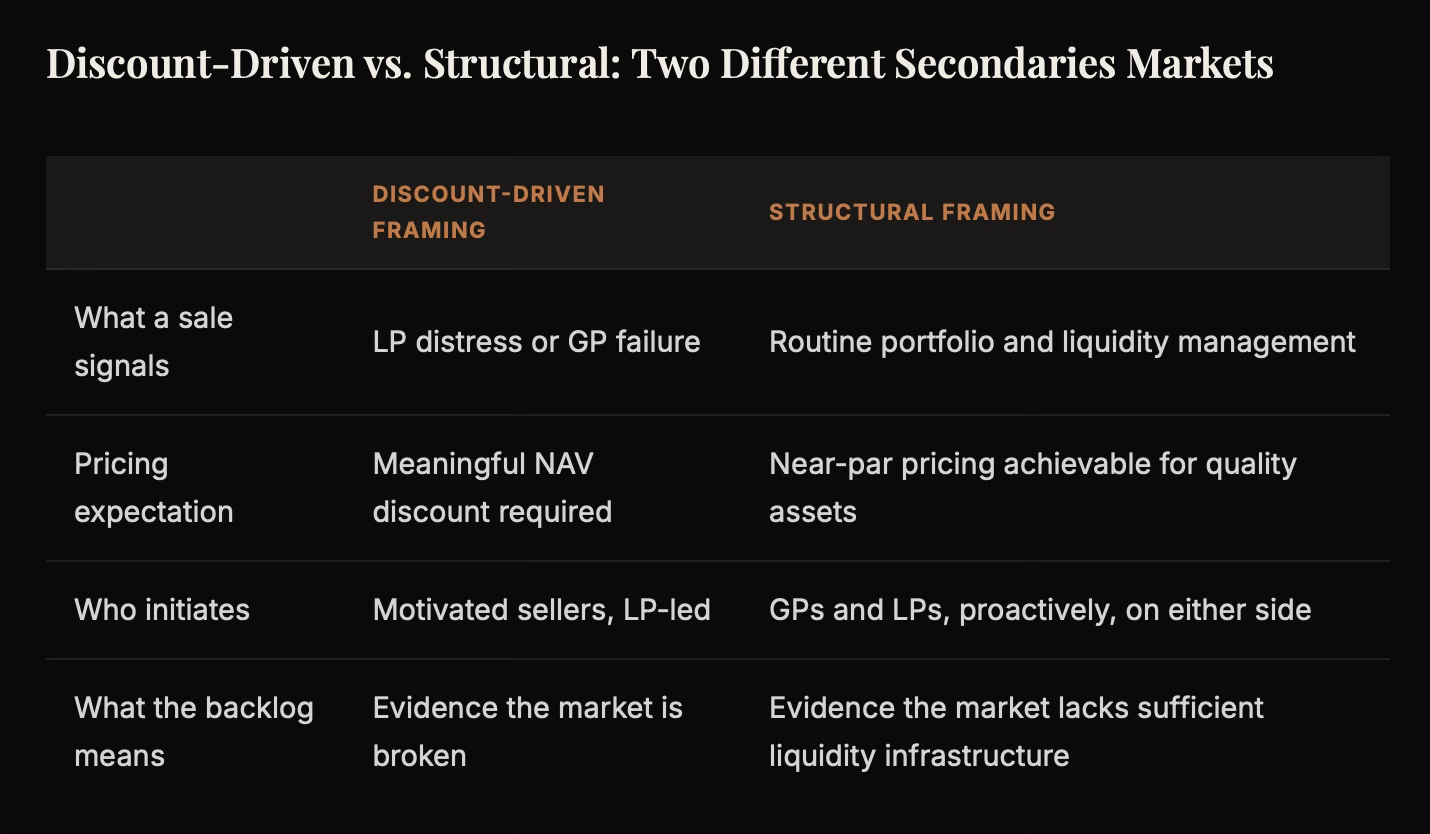
This is where the standard secondaries narrative undersells itself. The dominant framing — secondaries as the place where distressed LPs sell at a discount and opportunistic buyers scoop up cheap NAV — describes a market from five years ago. It doesn’t describe a market where GPs themselves are initiating continuation vehicles specifically to keep high-conviction assets rather than sell them into a weak market, where recent-vintage pricing on quality assets increasingly clears close to par, and where LPs are using secondaries proactively for portfolio construction rather than reactively for liquidity emergencies. The discount was never the product. Liquidity, optionality, and control over timing were — the discount was just how the market priced those things when supply was scarce and undiscovered.
Maturing, Not Failing
The private equity model being “challenged,” to use the Times’ framing, is a real and accurate description, but it’s also what every large asset class looks like partway through building the infrastructure that makes its own scale sustainable. The public bond market didn’t have meaningful secondary trading until institutional holdings outgrew buy-and-hold convention. Private real estate built out secondary and continuation structures once fund lives started colliding with asset lives that didn’t match. Private equity is arriving at the same juncture later than either of those markets, and arriving at a size, trillions in unrealized NAV, a backlog measured in tens of thousands of companies, that makes the transition unusually visible.
Framed that way, the backlog isn’t the disease. It’s the symptom that forces the cure into existence faster. Every one of those 33,575 companies is, in principle, a future GP-led or LP-led transaction candidate. Not all of them will move through secondaries specifically, and not all of them should, some genuinely need more time, some need operational fixes before any transaction makes sense. But the scale of the number is exactly why secondary market volume has grown in a straight line through an environment where almost every other part of private markets has been under pressure. The backlog isn’t competing with the secondaries market’s growth story. It’s the fuel for it.