


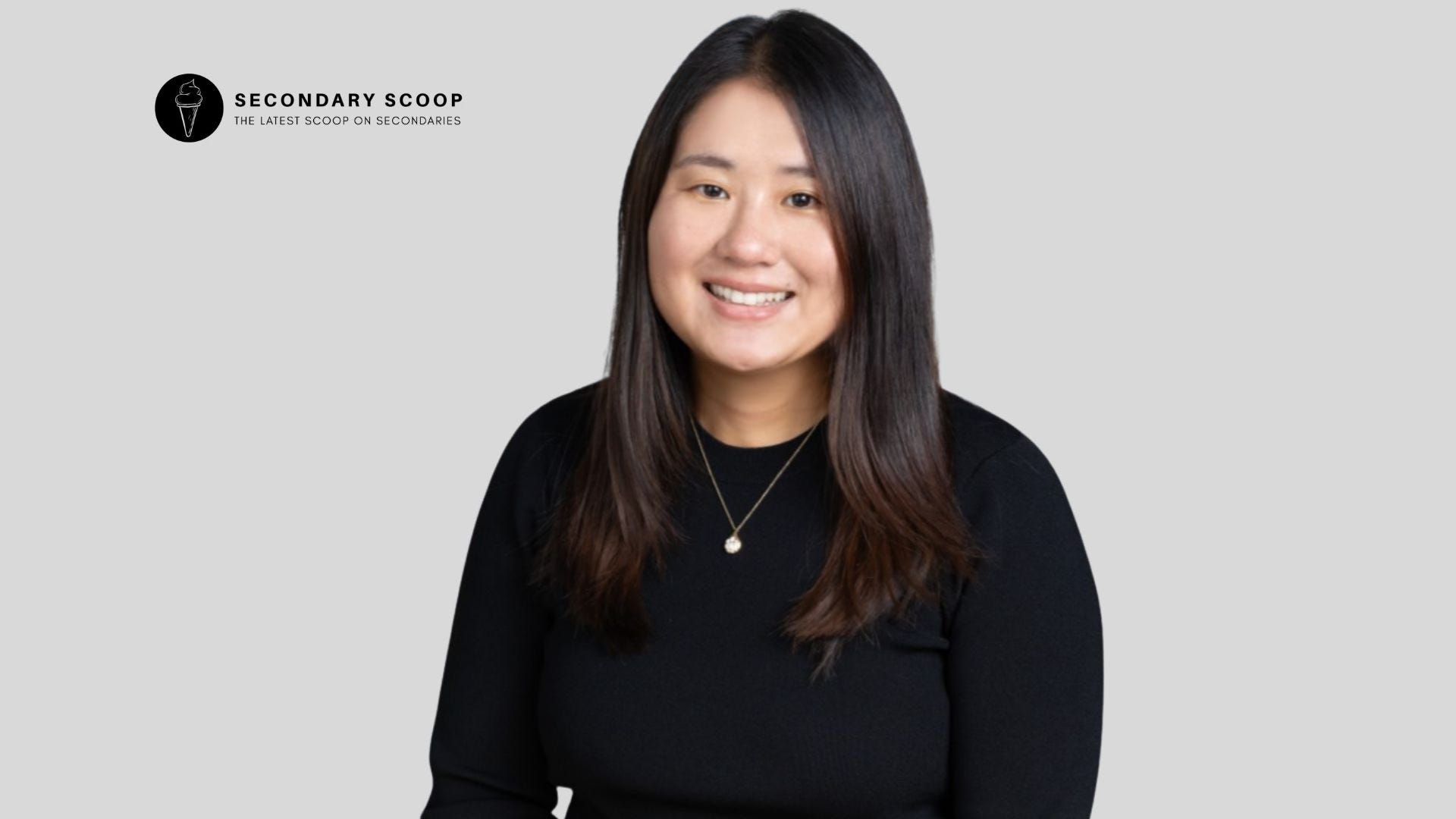
Adams Street Partners has hired Justine Huang Burns as Partner, Secondary Investments, with a mandate to scale the firm’s venture secondaries capabilities. Adams Street’s secondaries program has long bought interests in venture as well as buyout and growth funds, and the release describes the new role as growing that capability within an established team. What is new is a partner dedicated specifically to venture. The Menlo Park-based hire joins from Industry Ventures, the venture secondaries specialist that Goldman Sachs acquired last year.
The appointment follows the firm’s August 3 announcement of more than $5 billion in commitments for its latest Secondaries Investment Program, including a $2.7 billion final close of Global Secondary Fund 8, roughly 50% larger than its previous program. It also turns a view Adams Street has been voicing for months into an organizational commitment: in the firm’s 2026 Global Investor Survey, which we covered in April, Head of Secondary Investments Jeff Akers listed venture secondaries among the areas regaining appeal as valuations stabilize and the IPO window reopens.
The platform she is joining
Adams Street’s secondaries business is one of the oldest in the market, active since 1986, and while it spans buyout, venture and growth fund interests, its center of gravity has been mid-market buyout: the firm’s own description of its 2025 Real Deals “Secondary Investor of the Year” award emphasizes middle-market, private equity-backed transactions. The team pursues three types of deals: traditional purchases of LP interests, structured acquisitions of portfolios of direct company interests, and liquidity solutions for GPs.
Huang Burns becomes the fifth partner listed on the Secondary Investments team page, alongside Jeffrey Akers, Troy Barnett and Joseph Goldrick in Chicago and Pinal Nicum in London. She is the only one of the five based on the West Coast, a detail that matters in a segment where sourcing is driven by proximity to Sand Hill Road GPs. Adams Street does not disclose how much of its secondaries activity has historically been venture, so the scale of the step-up is not yet measurable from public information.
Her Adams Street bio describes a broad remit that spans strategy, investments, fundraising and portfolio construction for the secondaries business, with particular emphasis on venture. The press release is more specific about the deal flow: she will source, underwrite and execute LP interest and continuation vehicle transactions across the venture landscape, working closely with the Primary Investments and Venture Growth teams.
“Venture secondaries are an increasingly important opportunity for our clients.”
Jeff Akers, Partner & Head of Secondary Investments, Adams Street Partners
Akers framed the hire around the combination of Huang Burns’ track record leading venture-focused secondary deals with Adams Street’s longstanding GP relationships and capital base. Huang Burns, for her part, pointed to the firm’s established secondaries platform and its network of venture relationships as the foundation she intends to build the franchise on.
EXPLAINER: WHICH “VENTURE SECONDARIES”?
The term covers two different markets. Direct secondaries, employees and early investors selling shares in private companies such as SpaceX or OpenAI, is where the eye-catching numbers come from: PitchBook put annualized US direct secondary value at $112.2bn in Q1 2026. Fund-level venture secondaries, buying LP interests in venture funds, or backing GP-led continuation vehicles, is far smaller: Evercore sizes it at roughly $5bn in H1 2026.
Huang Burns’ mandate, as described by Adams Street, sits in the second category. Comparing her opportunity set to the headline direct-secondaries figures would overstate it by an order of magnitude.
Hiring into the flat segment
The timing is counter-cyclical. According to Evercore’s H1 2026 Secondary Market Review, total secondaries volume hit a record $121bn in the first half, up about 19% year-over-year. Venture was the exception: volume held flat at around $5bn, split evenly between GP-led and LP-led deals, and dedicated dry powder was also flat at about $10bn, concentrated among a small group of specialists.
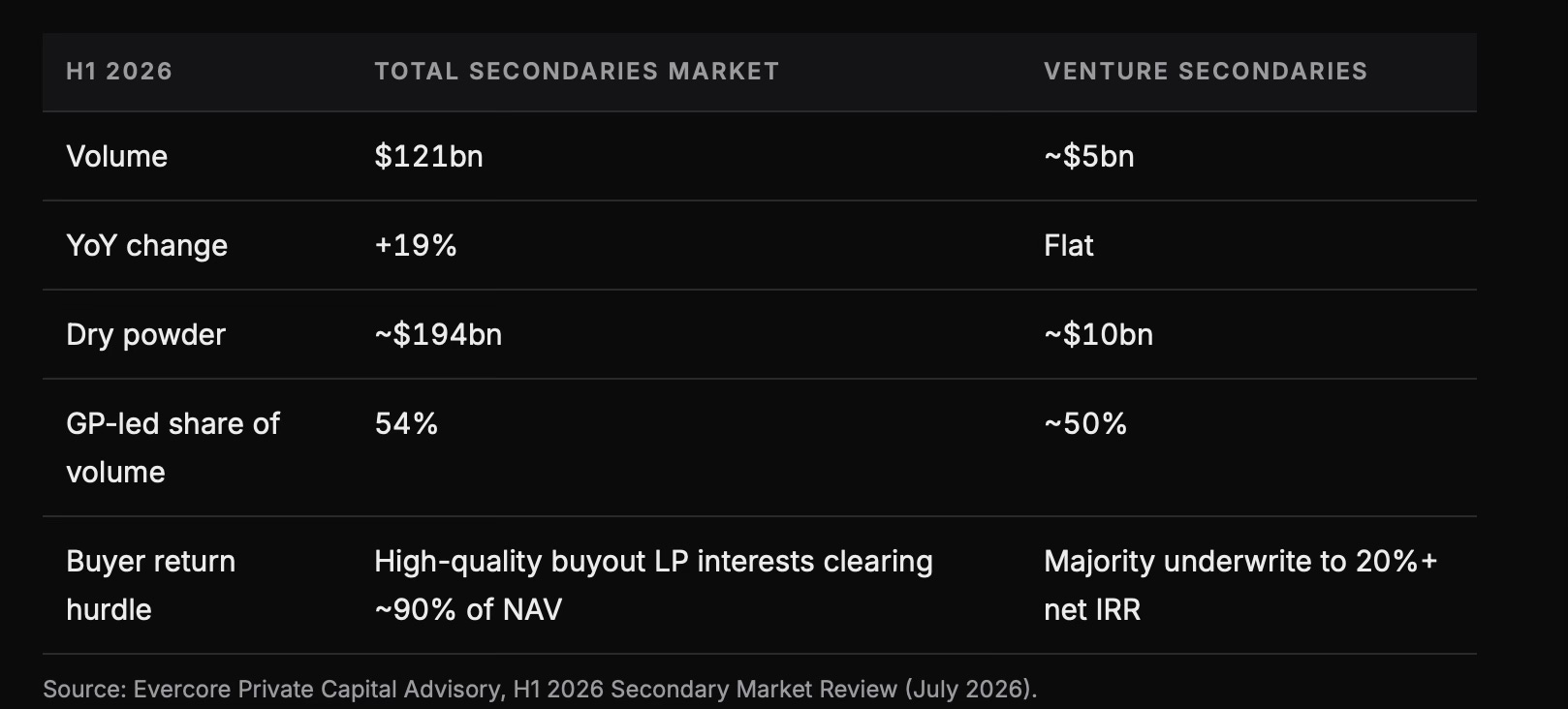
Evercore attributes the stall to two forces. Leading AI and private tech companies are raising capital frequently at rapidly rising marks, which keeps resetting reference valuations. At the same time, the early-2026 sell-off in public software on AI-disruption fears fed into private marks, widening bid-ask spreads and pushing buyers out of processes for much of the half.
The result is a dispersed pricing environment. Evercore describes top-quartile venture franchises clearing at a modest discount or better, while weaker performers trade far lower, a “K-shaped pricing environment with a hollow middle.” Jefferies’ H1 2026 review reaches a similar conclusion from the sell side: venture-focused LP portfolios were a notable source of supply, but most buyers concentrated on portfolios featuring leading companies and top-tier managers, widening the spread of outcomes.
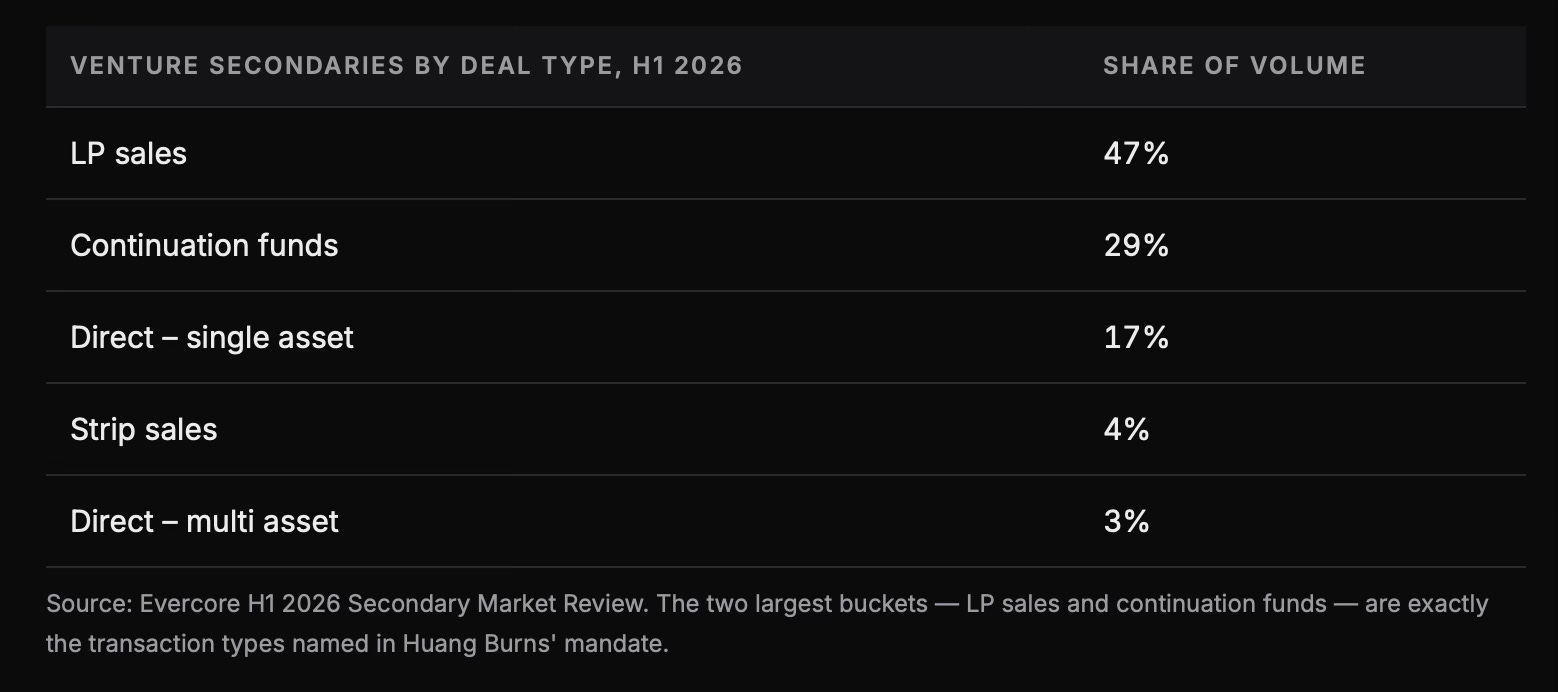
For a buyer, that is not necessarily a bad setup. Evercore characterizes the segment as firmly buyer-favorable, with modest dedicated capital relative to seller supply, and more than 84% of surveyed buyers expect year-over-year growth. Its own outlook is that buyers positioning now will be best placed when IPO and M&A windows reopen.