


Almost eleven months after announcing their alliance, two of Europe’s key asset managers have launched the product that gives it substance. Yesterday, ICG and Amundi unveiled Amundi ICG Global Private Equity Secondaries, the first private markets strategy they have developed together.
It arrives later than planned. When the partnership was announced in November 2025, the two firms said they would build two European evergreen funds during the first half of 2026: one in private equity secondaries and one in private debt. The secondaries fund has landed about a quarter late. Neither the October 6 launch release nor the September 17 completion release mentions the private debt fund, and we found no announcement of its launch.
The new vehicle is evergreen. It gives wealth investors access to ICG’s private equity LP secondaries strategy, buying existing fund interests from limited partners across North America and Europe. According to the release, it has already completed its first investment.
Until now, the partnership existed mainly on paper: a 10-year distribution agreement and an equity stake that was completed only in September. With this launch it becomes a business. A €2.6 trillion traditional asset manager owns part of a listed alternatives firm, holds exclusive rights to sell its evergreen products to wealth clients, and chose LP-led secondaries as the first product to sell.

Oliver Gardey and Ryan Levitt, Co-Portfolio Managers of Amundi ICG Global Private Equity Secondaries, at ICG, commented:
“The product combines ICG’s long-standing expertise in private equity secondaries, supported by its investment platform, underwriting discipline and market access, with Amundi’s structuring capabilities, knowledge of individual investors’ needs, and broad distribution reach”.
What launched, and what was already known
Most of the partnership’s terms were announced months ago. Here is what the October 6 release adds and what it repeats.
NEW ON OCTOBER 6
Product name, evergreen format, and its link to ICG’s private equity LP secondaries strategy, with North American and European exposure.
First investment completed, described only as high-quality, high-growth assets in the US and Europe. No name, size or deal type.
Monthly subscriptions and potential quarterly redemptions, subject to limitations set out in the prospectus.
Oliver Gardey and Ryan Levitt named co-portfolio managers.
Comment from Amundi CIO Vincent Mortier, who called the launch “an important step in the Amundi-ICG partnership.”
PREVIOUSLY ANNOUNCED
Nov. 18, 2025: 10-year agreement making Amundi the exclusive distributor of ICG’s evergreen and certain other products in the wealth channel. Two European evergreens (PE secondaries and private debt) were planned for the first half of 2026.
Sept. 17, 2026: Amundi completed its 9.9% economic stake for about €620m. ICG’s contribution appears in Amundi’s results from Q3 2026.
Sept. 17, 2026: ICG CEO Benoît Durteste said the first product would be an evergreen fund giving access to the LP Secondaries strategy.
What this means for the secondaries market
1. Evergreen capital is now part of the market’s plumbing
Evercore’s H1 2026 review, published in July, reports that 53% of surveyed secondary buyers now operate an evergreen vehicle. Secondary firms manage more than $130bn in semi-liquid evergreen AUM, and roughly 45% of it is allocated to secondaries. Evercore expects a further $25bn of inflows over the next 12 months, about $11bn of which would go into secondaries.
Evercore also notes two limits. Evergreen vehicles typically invest alongside flagship funds and finance a minority of each purchase price. And many managers are capping subscriptions to match the opportunity set. ICG’s product enters a market where this capital is already common, but where its size is still deliberately restrained.
2. LP portfolios have more bidders, and that compresses discounts
The ICG vehicle buys LP stakes only, and that is the segment where evergreen money is most visible. Evercore estimates evergreen and retail vehicles added roughly $40bn to the LP-led buyer universe over the last 12 months. Meanwhile, LP-led dry powder fell 15% in the first half of 2026 to $90bn, and the market-wide capital overhang is close to 1.0x. Pricing for high-quality buyout interests stayed around 90% of NAV.
This creates a tension at the center of every evergreen LP-led product. The discount to NAV at purchase is part of what these funds sell to wealth investors, because it shows up as an early valuation gain. The more evergreen money bids for LP portfolios, the narrower those discounts become. Each new evergreen launch makes the next deal slightly more expensive for all of them.
EXPLAINER
Why LP-led stakes fit an evergreen wrapper
Immediate exposure. The fund buys funded positions in existing buyout funds, so new money is invested in operating companies from day one rather than waiting for capital calls.
Diversification. A single LP portfolio can carry hundreds of underlying companies across many managers and vintages.
Shorter J-curve. Mature funds are closer to distributions, which helps fund redemptions.
Entry discount. Stakes bought below NAV are usually marked up to NAV at the next valuation, the source of the “day-one” gain debate covered in earlier Secondary Scoop pieces.
GP-led continuation vehicles are less suitable: they are concentrated, often priced at or above NAV, and target longer holds. ICG’s GP-led flagship, Strategic Equity V, closed at $11bn in 2025, yet the partners chose the much smaller LP strategy for retail.
3. In Europe, distribution is the scarce asset
Most European secondaries managers have reached wealth clients through distribution agreements or platforms. Coller Capital signed Deutsche Bank in 2025 to sell CollerEquity to private banking clients and later added Titanbay’s platform. Ardian built Ardian Access with iCapital. Eurazeo sells through French insurance wrappers.
ICG and Amundi went further. Amundi holds equity in the manager and has board nomination rights. The exclusivity runs both ways: Amundi distributes ICG’s evergreen products, and ICG is Amundi’s exclusive provider of those products. The product was designed jointly. Amundi says its network serves more than 200 million individual investors, and the deal carves out the US, Australia and New Zealand. Amundi already buys secondaries through its Zurich-based Amundi Alpha Associates platform, but it chose to source this product from ICG.
4. Same team, two pools of capital
Gardey and Levitt led ICG’s debut LP Secondaries I fund, which closed at its $1bn hard cap in 2024 ($1.6bn including co-investment vehicles and SMAs). At ICG’s FY26 results in May, Durteste said LP secondaries would be in market during the year to March 2027. The evergreen therefore launches while the team raises its next institutional vintage.
In the same presentation, Durteste set ICG apart from asset gatherers. He said institutional investors are increasingly wary of managers whose deployment depends on
“the ebbs and flows of wealth capital in evergreen vehicles”
Benoît Durteste, CEO and CIO, ICG, FY26 results presentation, May 21, 2026
He also said those investors worry about conflicts of interest in deal allocation. The October 6 release does not explain how ICG will split LP deals between the evergreen and its next institutional fund. That allocation policy is the most useful disclosure ICG could still make, both for institutional LPs in the closed-end fund and for wealth investors in the evergreen.
5. The liquidity test came before the launch
The partners are launching after a difficult period for European evergreens. In June, Partners Group limited redemptions from its Global Value SICAV to 5% of NAV per quarter after requests reached an estimated 9.8% for the second quarter, according to an investor letter reported by Bloomberg. Partners Group has since said it has no plans to freeze any evergreen vehicle, and that the two funds in question have returned about 5x since inception. Bloomberg later reported that Partners Group plans to split the fund into compounding and distributing sub-portfolios.
ICG’s release describes quarterly redemptions as a “potential” and refers investors to the prospectus for liquidity management tools. That wording reflects the lesson from June: the gate is part of the product.
How many European players are doing the same?
8
European-headquartered managers, by our count, offer evergreen or semi-liquid vehicles that give wealth clients material secondaries exposure. Five run vehicles where secondaries are the core strategy; three hold secondaries as one sleeve of a broader private equity portfolio.
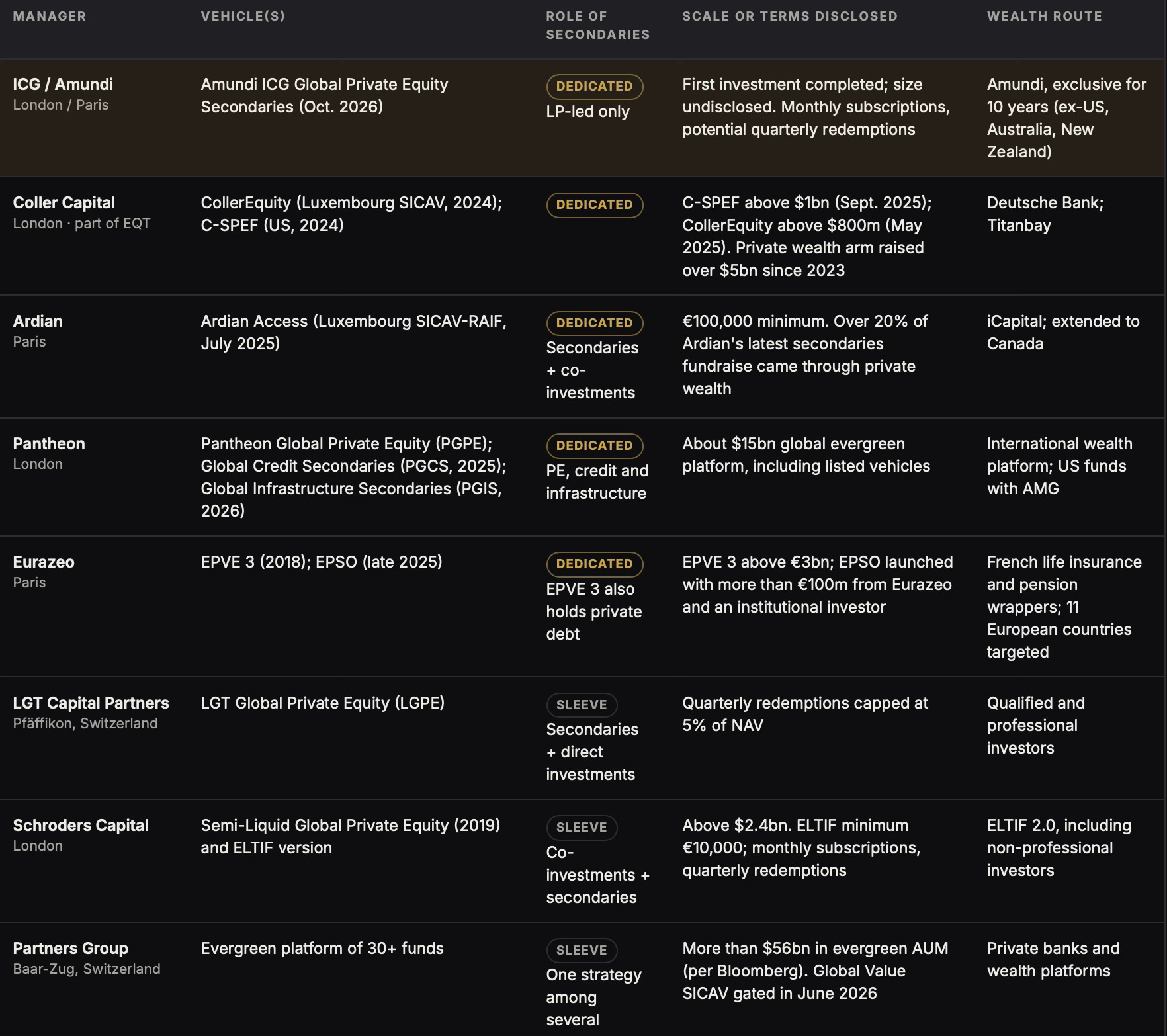
The count leaves out two groups. First, US managers that sell evergreen secondaries products into Europe, such as HarbourVest, Hamilton Lane, StepStone and Blackstone. Second, smaller European boutiques whose vehicles we have not verified. Including either would raise the number. Amundi’s own Alpha Associates buys secondaries for multi-manager mandates, but we found no dedicated evergreen secondaries vehicle from it.
Within this group, ICG’s structure is unusual on two points. The vehicle is defined explicitly as LP-led only. And it is the only one in our table where the distributor owns equity in the manager and co-designed the product.