


Anthropic’s private market didn’t run hot because too many buyers were chasing the stock. It ran hot because hardly anyone would sell. The company’s April tender moved 179.9 million shares for $4.66 billion, about 1.5% of its pre-IPO share count, at the same $25.91 price as February’s Series G. Investors had reportedly lined up $5–6 billion and couldn’t deploy all of it, because employees chose to hold. Seven months later, the stock is public and the tender buyers are up 3.75x. The bigger question is who they are. The S-1 doesn’t name them, and it says nothing about the SPVs and forward contracts that Anthropic tried to block.
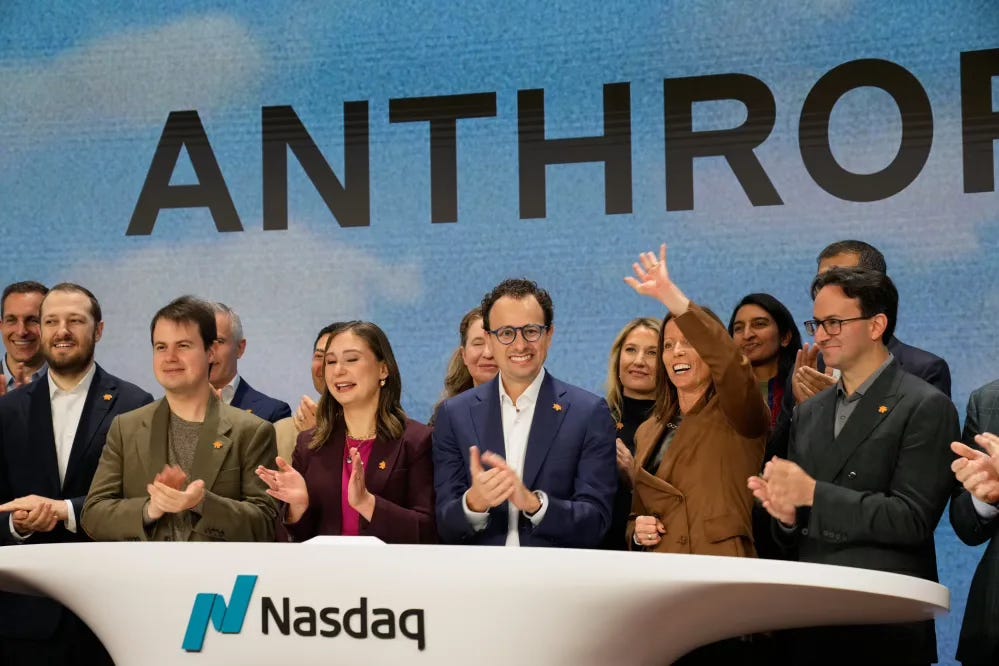
Anthropic priced its IPO on November 18 at $83.00 a share, above the $70 to $78 range set at the November 10 roadshow launch. According to the company’s announcement, the offering grew from 825 million to 980 million Class A shares. Of those, the company sold 956.4 million and selling stockholders sold 23.6 million. The underwriters have a 30-day option on another 147 million shares. By our calculation, gross proceeds come to about $81 billion before the option. Separately, a group of technology companies reportedly agreed to buy about $26 billion of non-voting Class N shares at the IPO price.
ANT started trading on November 19, opening at $111.50 and closing at $97.17. The valuation depends on the share count used. At the IPO price, the Financial Times put the company at about $1.49 trillion fully diluted. At the close, shares outstanding were worth about $1.27 trillion, based on the roughly 13.1 billion shares reported.
Secondary Scoop’s take on the Anthropic frenzy
Anthropic’s April tender moved 179.9 million shares for $4.66 billion, about 1.5% of the company’s pre-IPO share count. That is small next to Anthropic’s valuation, but it is 7.6 times the 23.6 million shares insiders sold in the IPO itself. Buyers had reportedly arranged $5–6 billion and couldn’t deploy all of it, because employees chose to hold. Anthropic’s frenzy wasn’t driven by an excess of buyers. It was driven by a shortage of sellers. How much of the company ended up with secondary buyers is still unknown. The S-1 doesn’t name the tender buyers, and SPV and forward-contract holdings, which Anthropic tried to block, appear nowhere in the filing.
What Lexington is arguing
Lexington’s November Secondary Spotlight, “The Next Frontier: Venture & Growth Secondaries,” makes the case for buying venture and growth exposure through secondaries. The supply data comes from Preqin. Global venture and growth NAV is at an all-time high of about $4.6 trillion, roughly 30% of all private equity NAV. In the US, NAV has risen from $337 billion in 2015 to $1.94 trillion in 2025. Over the same period, annual distributions fell from 16% of NAV to 9%, with a low of 5% in 2023. At the past decade’s average distribution pace, Lexington estimates it would take about 16 years to return today’s US NAV. That’s before any further gains and before $450 billion of dry powder is invested.
The report includes an interview with Matt Hodan, a partner in Lexington’s Menlo Park office. Lexington opened that office in 1995, and its venture and growth team says it has completed more than 160 transactions in the segment. Hodan’s main point is that the secondaries market is now a standard part of how venture works:
“In that sense, the secondary market has increasingly become part of the infrastructure of the innovation ecosystem rather than a niche solution used in unusual circumstances.”
Matt Hodan, Partner, Lexington Partners, Secondary Spotlight, November 2026
He also says where he thinks a secondaries buyer should enter:
“Secondaries can provide access to what can be the Goldilocks zone of value creation—3-5 years before an exit event but after companies have found product-market fit and are now focused on scaling.”
Matt Hodan, Partner, Lexington Partners
The question mark
The report includes a chart of large US tech IPOs grouped into three eras, using PitchBook data. For each era it shows the companies’ average age at IPO. The internet era averages 7.5 years and the mobile era 9.4. For the “AI era,” starting in 2023, the chart shows a question mark. Its examples are Databricks, OpenAI and SpaceX, with latest private valuations of $190 billion, $852 billion and $1.77 trillion. Anthropic isn’t on the chart. The valuations are as of February 2026 and the IPO data as of March, before Anthropic had filed.
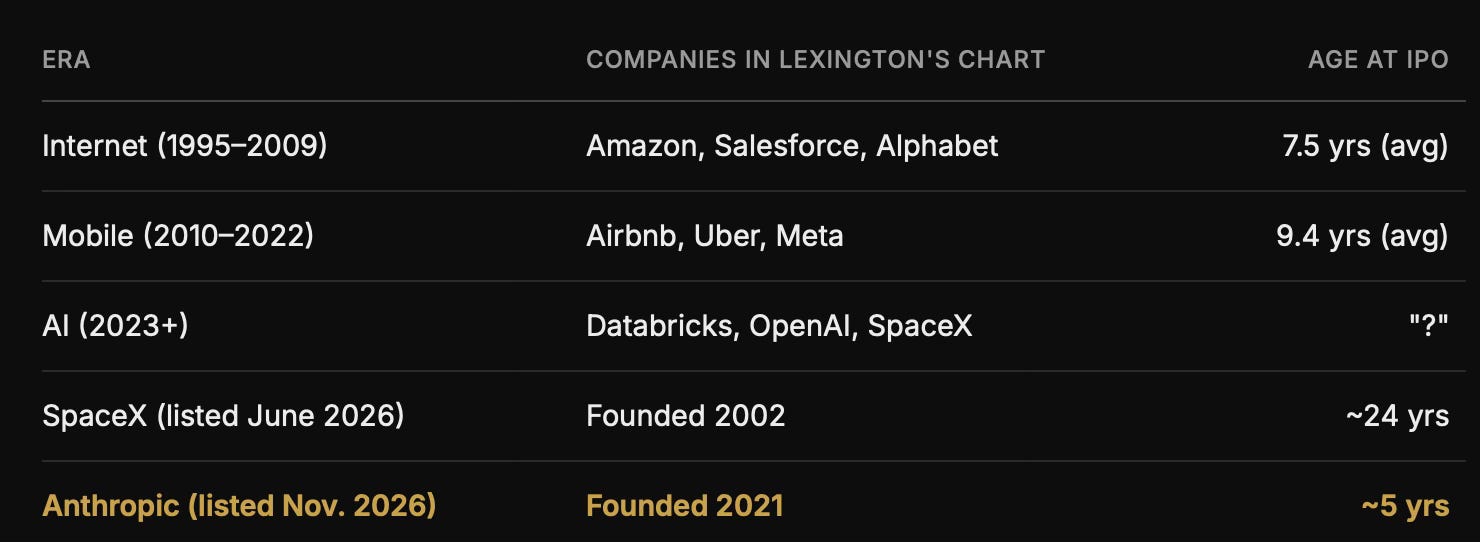
Sources: Lexington Partners, Secondary Spotlight, November 2026 (PitchBook data). Ages for SpaceX and Anthropic are Secondary Scoop’s calculation using Lexington’s method (IPO year minus year founded). Two companies are not an average.
The first two AI-era listings point in opposite directions. SpaceX took more than two decades. Anthropic took about five years, faster than any era average in Lexington’s chart. So the first frontier AI lab to go public doesn’t support the “staying private longer” part of the thesis.
It does support the other part: that more of the value is created before the listing. Anthropic didn’t stay private long, but it raised a great deal of money privately. Its last private rounds were sized like IPOs: $30 billion at $380 billion post-money in February, and $65 billion at $965 billion in May. By the time it listed, most of the share-price gain had already happened:
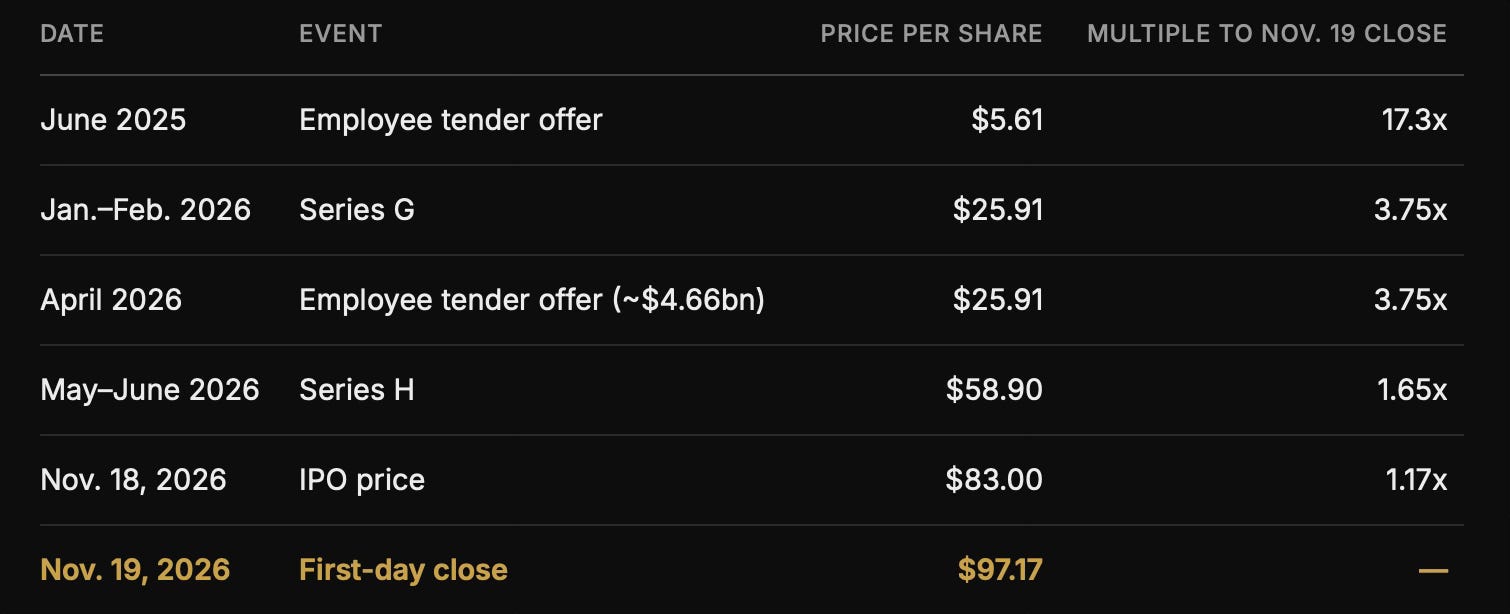
Sources: Anthropic Form S-1 (tender and round prices, adjusted for the September 17, 2026 ten-for-one split, as summarized by The Secondary Brief); Anthropic pricing announcement; reported first-day close. Multiples are Secondary Scoop’s calculations.
The table shows a 17x gain in the private market and a 1.17x gain on the first day of trading.
Access, not discount
Lexington lists purchase discounts first among the benefits of a venture and growth secondaries strategy. It says liquidity needs among existing holders can create chances to buy fund interests or company exposure below NAV. Anthropic’s two tenders didn’t work that way. According to the S-1, each one was priced at the preceding round. In April, a syndicate of stockholders bought about 179.9 million shares at $25.9136, about $4.66 billion in total. The sellers were current and former employees, service providers and donor-advised funds, and the S-1 doesn’t name the buyers. Bloomberg reported that some investors got fewer shares than they wanted because employees sold less than expected.
So the buyers in Anthropic’s private market didn’t make money by buying cheaply. They made it by getting an allocation at all. That fits another part of Lexington’s report better than the discount section does:
“The highest-quality venture managers and companies do not necessarily transact broadly.”
Matt Hodan, Partner, Lexington Partners
Anthropic also controlled who could hold its shares. The company had a right of first refusal on transfers, which ends with the offering, and as we reported earlier it voided transfers it hadn’t approved. For the best-performing companies, the bottleneck in venture secondaries is access, not price.
The April tender also fits Hodan’s timing almost exactly. It came about seven months before the IPO, not three to five years, but well after product-market fit and during the scale-up. The employees who sold gave up the gain from $25.91 to $97.17. Most chose to keep their shares.
THE CV ROUTE
Lexington’s report describes a range of ways to buy venture exposure, from LP interests in funds to “more concentrated transactions with direct company interests in continuation vehicles.” Anthropic was in one of those. In August we covered Lightspeed’s roughly $600 million Project Mercury vehicle, led by Coller, which held OpenAI and new money into Anthropic at the $965 billion round. The CV’s entry price wasn’t disclosed, so we can’t calculate its return. On the Series H share price, the Anthropic piece of it was up about 1.65x at the first-day close.
Does one IPO fix the distribution problem?
Not quickly. Lexington’s 16-year estimate is about the whole US venture and growth NAV, and Anthropic’s shares are released into the market slowly. The S-1 sets out more than 20 separate release dates instead of a single 180-day expiry. Employees can sell 10% of their shares from the first trading day. The founders can sell 29% at day 180, and holders above 0.5% of fully diluted shares aren’t fully released until day 365 or the third-quarter 2027 results. For VC funds holding the stock, distributions will come in stages through 2027, not in one payout.
In the meantime, the IPO increases these funds’ NAV much faster than it increases their cash distributions. The Equable Institute counts at least 18 US public pensions with Anthropic exposure, mostly through VC funds, as reported by Alternatives Watch. For those LPs, a large mark-up in a single name means more concentration in their venture books. Lexington’s report gives rebalancing as one of the reasons LPs sell, even when it means “selling assets with the potential for additional value creation.” Funds with large Anthropic positions may come to the LP-led market sooner than expected. They will most likely be priced at or above NAV, not at a discount.
Hodan's line about the highest-quality names not transacting broadly does more work in that report than the discount section gets credit for. Anthropic's April tender priced at the round and still left buyers short, which suggests the scarce thing in late-stage venture secondaries is sellers rather than a markdown. Funds sitting on Anthropic marks through 2027 will most likely be priced at or above NAV when they reach the market.