


One of the most anticipated IPO filings in years is here. Beyond the tone of the founders’ letter: Amodei pairing upside (medicine, growth) with catastrophic-risk disclosures. Secondary Scoop takes a secondaries-focused look at Anthropic’s S-1, examining how the company managed shareholder liquidity, priced its $4.66bn tender and structured its post-IPO share releases.
Anthropic filed its S-1 yesterday to list Class A shares on the Nasdaq Global Select Market under the ticker ANT, with Goldman Sachs and Morgan Stanley leading the offering. The filing leaves the price range, share count and offering size undetermined. Press reports have put the potential valuation as high as $1.8tn–$2tn and suggested the company could raise up to $100bn. Neither figure is established in the prospectus.
The headline numbers have attracted plenty of attention: $16.3bn in first-half revenue, an $80.7bn net loss driven largely by accounting adjustments to convertible financing instruments, and a governance structure giving the seven co-founders 50.1% of shareholder voting power through a special class of stock.
For secondaries investors, however, the more revealing disclosures sit elsewhere: in the April employee tender, the private financing prices that followed, and a staggered lock-up schedule designed to avoid a single 180-day release of shares.
Together, they offer an unusually detailed account of how one of the world’s most valuable private technology companies managed liquidity on its own terms before entering the public market.
The tender: what we knew, and what the S-1 adds
Anthropic’s employee tender was already known to the market. In February, reports indicated that the company had launched a liquidity program at a $350bn pre-money valuation, matching the valuation reference established by its Series G financing.
Investor demand was reportedly between $5bn and $6bn. But when the tender closed in April, the amount sold fell short of that demand, with some employees choosing to retain their shares ahead of an anticipated IPO.
The S-1 provides a clearer picture of the transaction.
Approximately 179.9 million shares changed hands at $25.9136 per share, representing roughly $4.66bn in secondary liquidity. The sellers included employees and the company’s two most prominent co-founders, Dario and Daniela Amodei.
That distinction is relevant because the tender was not simply an employee compensation mechanism. It also provided a structured liquidity opportunity for senior insiders, with the company overseeing the process rather than leaving shareholders to find buyers in the private secondary market.
The price ladder
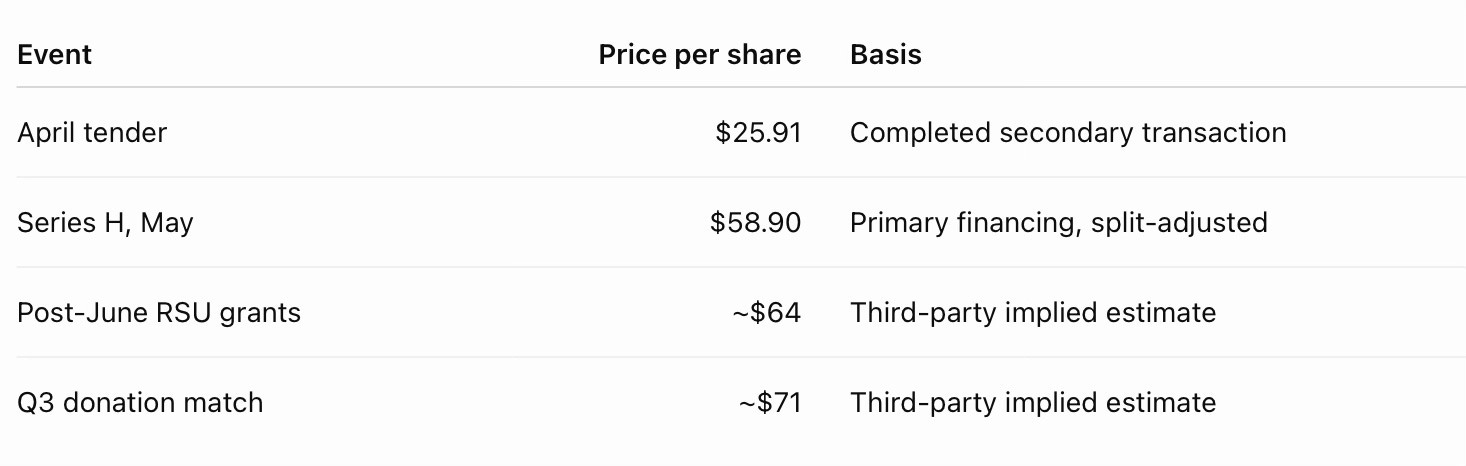
Anthropic insiders sold shares at $25.91 in April, less than half the $58.90 split-adjusted price of the company’s Series H financing just a month later.
That does not mean buyers realized a 2.27x return: the transactions involved different share classes, and the ultimate return depends on future prices and liquidity. But the gap illustrates the trade-off at the heart of late-stage secondaries: certainty today versus potential upside tomorrow.
The reported $1.8tn–$2tn IPO valuation could push Anthropic’s valuation higher still, although the final offering price remains undetermined
Anthropic’s private share-price references, 2026
Project Mercury gets its first public test
Anthropic’s IPO also creates a new valuation reference for Lightspeed’s Project Mercury, a roughly $600m GP-led transaction involving positions from Select V, Opportunity II and a separately managed account.
Coller Capital, now part of EQT, led the buyer group, with UBS advising. The continuation vehicle included OpenAI, Verkada, Rippling, Reflection AI and Glean, alongside fresh capital for Anthropic.
Mercury’s Anthropic entry price was never disclosed, so its return cannot be calculated. But if the reported $1.8tn–$2tn IPO valuation materializes, an investment made near the $965bn Series H valuation would have a substantially higher public-market reference.
The bigger test comes after listing: whether Mercury holds through the lock-ups, sells when permitted or distributes shares to its LPs. The IPO will offer an early indication of how venture continuation vehicles manage concentrated AI exposure as private valuations become public prices.
Anthropic replaces one lock-up cliff with a series of unlocks
Anthropic has designed a staggered post-IPO resale schedule rather than relying on a single 180-day expiry. Reports describe more than 20 unlock windows over the first year, with different rules for employees, executives and founders.
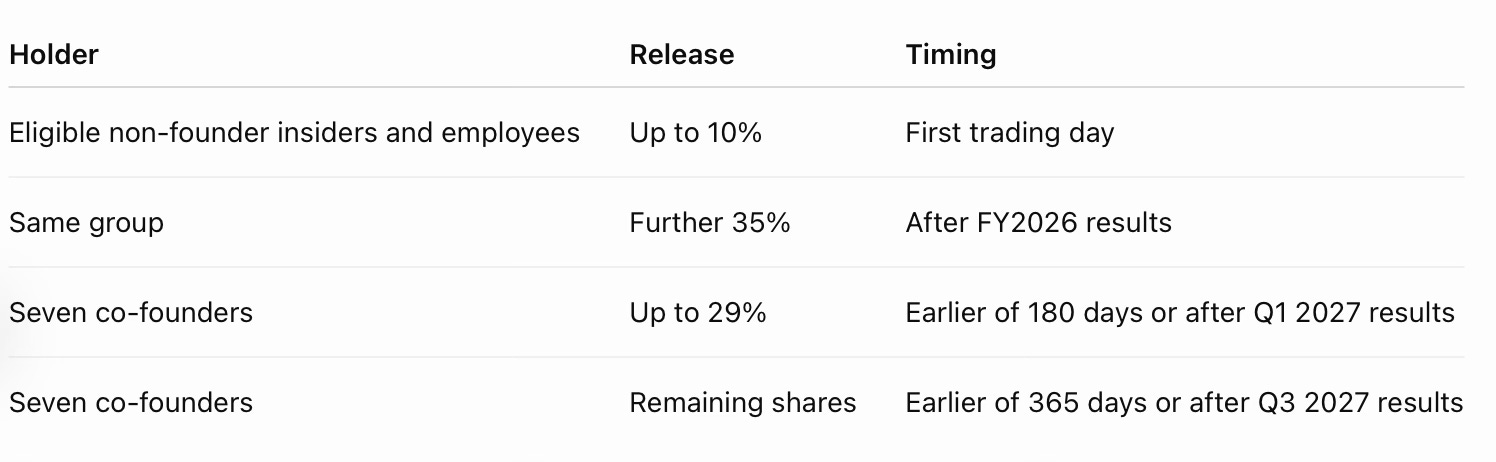
Selected provisions only. Releases remain subject to applicable conditions and agreements.
For pre-IPO secondary buyers, this matters almost as much as valuation. Lock-ups determine when paper gains can become cash. Staggered releases could spread potential selling pressure across multiple dates, although they do not eliminate it.
With approximately 5,300 employees and substantial philanthropic share commitments, Anthropic has several potential sources of future supply. Third-party estimates put co-founder giving pledges at roughly 9% of fully diluted shares and employee donation-matching commitments at another 8%. These are commitments, not confirmed future sales.
A company that controls its own liquidity
In May, Secondary Scoop reported on Anthropic’s restrictions on unauthorized secondary transfers. The S-1 completes the picture: the company restricted informal trading, organized a $4.66bn tender on approved terms, and established a detailed post-IPO release calendar.
The approach illustrates how secondaries have evolved into a shareholder management tool rather than simply a response to distress.
Anthropic determined when liquidity was available, who could participate and under what conditions. The prospectus now reveals the price early sellers accepted for that certainty, weeks before a significant valuation reset.