


Apollo’s earnings call was one of the more relevant calls of the season for the secondaries market. Chairman and CEO Marc Rowan used his closing remarks to put a budget, a timeline and a product roadmap behind the idea he outlined at Bank of America’s 31st Annual Financials CEO Conference in London in September 2026. Apollo wants private assets to have a daily price, a standard identifier, a market maker, a custodian and a lender. Most of those jobs are done today, more slowly and at a discount, by secondaries buyers and NAV lenders.
“Our goal is to make buying and selling of private assets as easy and familiar as possible.”
Marc Rowan, Chairman and CEO, Apollo
A budget and a timeline for the private markets plumbing
Rowan confirmed that Apollo moved its entire credit business to estimated daily value on September 30, three months after its investment-grade suite. He set out the next steps in order: standardized identifiers (CUSIPs or ICE IDs), market-making, then custody and settlement. He said Apollo will build custody and settlement with partners rather than alone. “We will start with credit, and we will get after this in 2027,” he said, adding that deadlines and specifics would follow.
For the first time, the plan has a cost attached. “Over the next 24 months, we will incur roughly $350 million of planned expenses to make this happen,” Rowan said. He added that Apollo will write off existing software and retire legacy systems along the way.
On trading volumes, Rowan said Apollo “will trade north of $40 billion by year-end.” President Jim Zelter said later that the firm has “traded plus or minus $40 billion a year to date.”
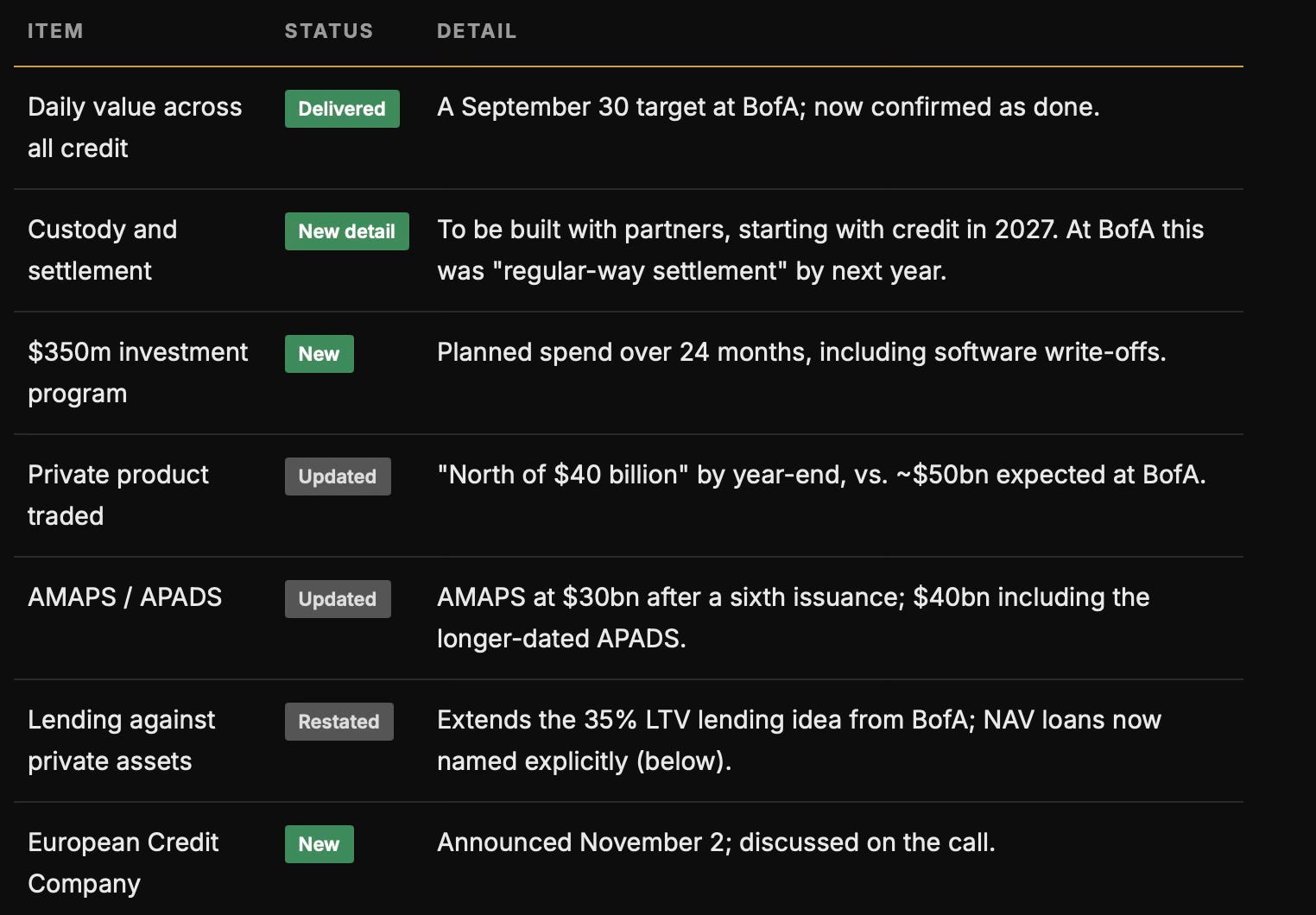
Measured against Secondary Scoop’s coverage of Rowan at BofA’s Financials CEO Conference (September 2026) and Apollo’s Q2 2026 call.
“A bulky way called NAV loans”
In the Q&A, an analyst asked whether the $350 million spend meant Apollo was trading margin for top-line growth. Rowan said the infrastructure opens up businesses beyond raising assets: market-making, and lending against private assets, which he called “a relatively small piece of everyone’s pie today.” He then named the product that does this job now:
“Once you have liquidity, you have price, you have custody and security and data, you have the makings of a pretty good private markets lending business. We do that today in a bulky way called NAV loans.”
Marc Rowan, Chairman and CEO, Apollo
That says a lot about where Apollo thinks portfolio finance is going. If an asset has a daily mark and a standard identifier and sits with a custodian, lending against it starts to look like margin lending, not a negotiated facility against a fund’s whole NAV. Zelter added that the firm thinks of future economics as a series of “toll booths” across origination, trading and custody.
Another analyst asked whether daily pricing would solve the liquidity problem in private credit. In his answer, Zelter, who took the question before Rowan, said the word “secondary” for the only time on the call:
“I think the more transparency will bring a bit more secondary market activity and it will also bring confidence to investors to allocate to asset classes.”
Jim Zelter, President, Apollo
He also lowered expectations on near-term economics. Trading “is yet to be a massive contributor of ACS,” he said, referring to Apollo’s capital solutions fees, which hit a fourth consecutive quarterly record of $290 million.
WHY THIS MATTERS FOR CREDIT SECONDARIES
Credit secondaries pricing today depends on information gaps: stale quarterly marks, bespoke documentation, and few buyers able to underwrite a portfolio quickly. A daily mark, a CUSIP and a bank market-maker each narrow those gaps.
If Apollo’s model spreads, credit secondaries could move closer to a flow business, with smaller discounts and more competition from dealers. Specialist buyers would then compete on size and complexity, not on access to price information. For now this applies only to Apollo’s own credit product, and it starts in 2027.
European Credit Company: “not a fund”
On November 2, Apollo launched European Credit Company (ECC), a platform focused only on European performing credit, both corporate and asset-backed. It launches with more than €10 billion of lending capacity. Apollo funds and affiliates lead the investor group, alongside Abu Dhabi Investment Council, Athora, Norinchukin Bank, Standard Chartered and Aranda Principal Strategies. Giacomo Petrobelli is CEO and Christian Meissner is Chairman. ECC has a presence in Frankfurt, Jersey, London, Luxembourg City and Milan.
The release says ECC will source assets through three channels: its own origination, strategic partnerships with European financial institutions, and Apollo’s European credit platform. In the release, Zelter said Apollo is pleased “to extend our toolbox in Europe through a dedicated platform and localised approach.”
Patrick Davitt of Autonomous Research asked about ECC on the call. The structural point in Apollo’s answer was the one most relevant to secondaries: the platform was designed to offer investment-grade, asset-based and non-investment-grade lending “in one vehicle, not a fund, it would have the scale, the permanence, and the partnership approach that would be the measure of success.” Apollo also said ECC is “negligibly in our plans going forward. So it’s a lot of upside for us.”
ECC isn’t a secondaries story. Its design still matters for our market. A permanent-capital vehicle has no fund term, no end-of-life deadline and no need for a GP-led restructuring when the clock runs out. The bank-partnership channel is a different matter. In a market where European lenders are under pressure to free up balance sheet, that channel is how loan portfolios could move from banks to ECC. We’ll be watching for evidence of that.
The private equity book still runs on the old clock
Apollo’s market-building plans apply to credit. Its $204 billion equity book still sits in fund structures, and the numbers show why secondaries remain relevant there.
Equity realizations totaled $2.7 billion in the quarter and $18.6 billion over the last twelve months, on a total AUM basis. That is less than a tenth of the equity book. CFO Martin Kelly said quarter-on-quarter management fee growth was “partially offset by realization activity in equity.” Exits are coming through. Realized performance fees rose 80% year on year to $362 million, driven by private equity realizations including Fund X. Fund X, a 2023 vintage, has already returned $4.2 billion of gross realized value.
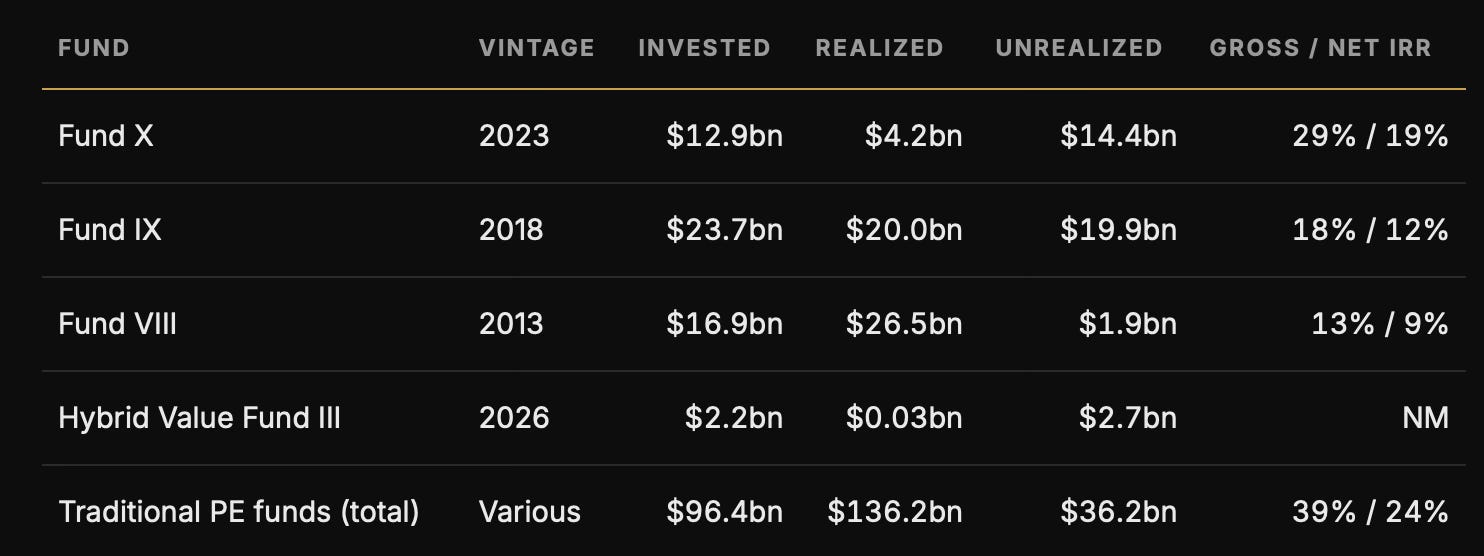
Source: Apollo 3Q 2026 earnings release, investment record as of September 30, 2026. Gross fund-level figures, not LP-level DPI.
Fund IX is the number to watch. Eight years after its vintage, the 2018 fund has realized $20.0 billion against $23.7 billion invested, and $19.9 billion is still unrealized. Its total value is about 1.7x invested capital on a gross basis. Older-vintage remaining value like this is what drives LP portfolio sales and GP-led deals across the industry. Nothing in the release or on the call says Apollo plans either for Fund IX. Next year Fund XI also replaces Fund X as the fee-paying flagship. Kelly said he expects the switchover around mid-2027, which is why equity management fee growth is back-weighted in Apollo’s 2027 guidance.
Apollo’s investment stance points the same way. Rowan said valuations look high across markets and risk looks elevated, so the firm is de-risking: “In the equity business, the way we take risk down, we reduce leverage, we move toward hybrid structures.” The returns support that shift. Flagship private equity returned -2.6% gross in the quarter and 2.0% over twelve months. Hybrid Value returned 4.7% and 18.0%. Hybrid Value Fund III has $6.5 billion of committed capital. Its structured equity and solutions mandate sits next to GP-led secondaries but isn’t the same thing.
What it adds up to
Rowan summarized his argument in one sentence during the Q&A:
“Private markets have grown notwithstanding the fact that there is not transparency, not a lot of liquidity, and not good visibility on pricing.”
Marc Rowan, Chairman and CEO, Apollo
The secondaries market grew to serve exactly those gaps. Apollo’s position is that the gaps will close, starting in credit, starting in 2027, and with Apollo collecting fees on the way. That fits our core thesis that liquidity in private markets is becoming a normal portfolio-management tool rather than a sign of distress. The difference is that Apollo wants to deliver that liquidity through a market rather than through a negotiated transaction.
For now, Apollo’s own numbers still show two speeds. The credit platform is being rebuilt to look like a public market. The private equity book still depends on exits, mid-life funds with large unrealized balances and a flagship changeover next year. And for the third Apollo appearance in a row, after the Q2 call and BofA, a firm with $1.07 trillion of AUM had nothing to say about Apollo S3, its own secondaries platform. The question is whether S3 is simply not a priority for public messaging, or whether Apollo sees the liquidity business going somewhere else.