


Marc Rowan never said “secondaries” in the sense this publication uses the word. There was no mention of continuation vehicles, LP portfolio sales or Apollo S3, the firm’s own secondaries platform.
Yet across roughly half an hour on stage in London, Apollo’s chairman and CEO laid out the most explicit version yet of an idea with direct consequences for the secondaries market. Apollo does not only want to manufacture private assets. It wants to be the place where those assets are priced, traded, financed and exited.
“In our industry, 95% of the firms literally want the world to stop changing until they retire.”
Marc Rowan, Apollo
From funds to infrastructure
Rowan’s starting point is familiar to anyone who followed Apollo’s Q1 and Q2 calls. The industry has historically served one client, the alternatives bucket of institutions, through funds. Apollo now counts five additional client types: individuals, insurers, the debt and equity buckets of institutions, traditional asset managers, and 401(k)/DC retirement plans. None of them, he argued, is a natural fund investor.
His conclusion is that Apollo must go to them rather than wait for them. In his words, the firm will “become part of their operating infrastructure as opposed to asking them to come to us.”
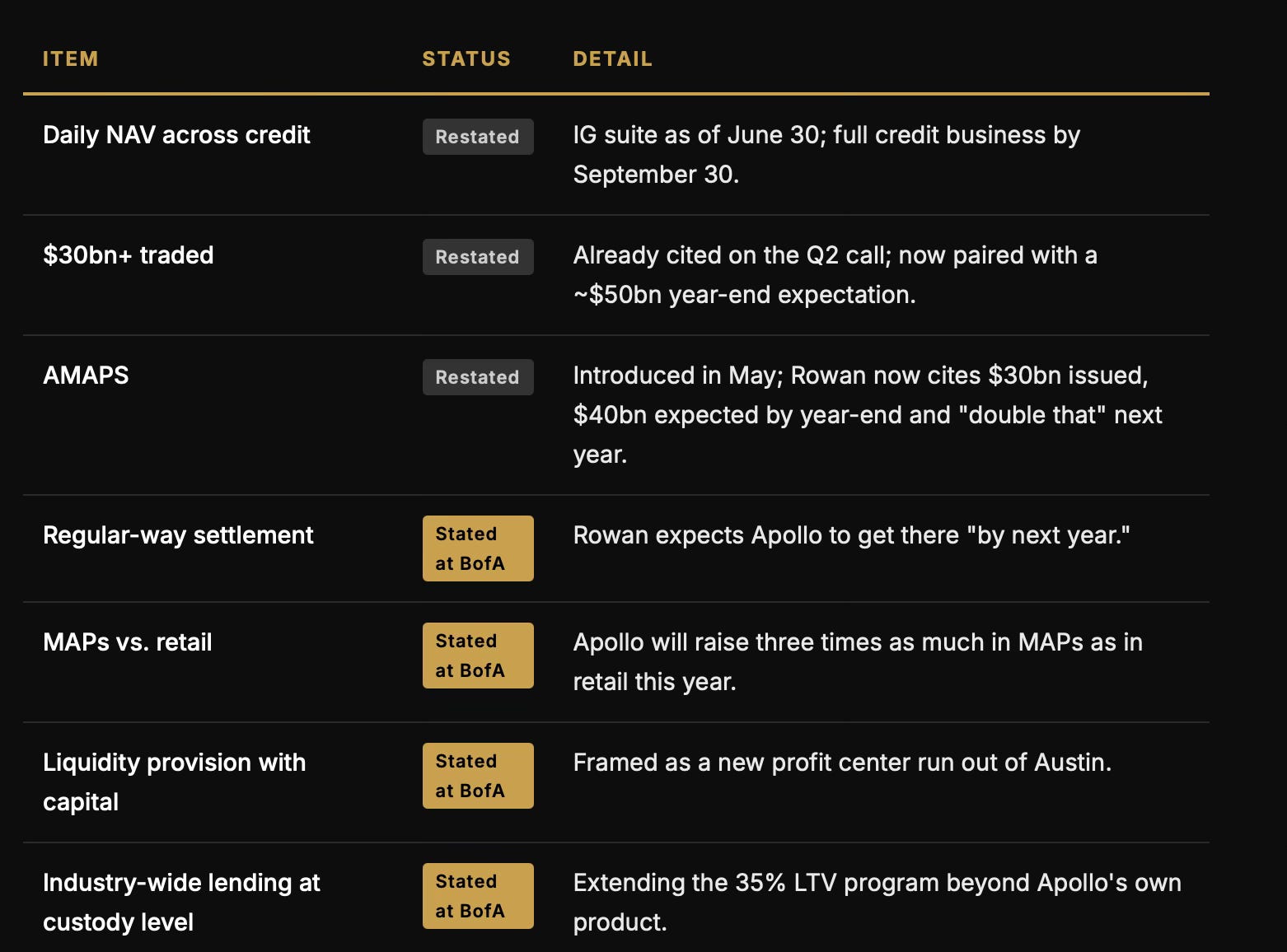
In practice, that means daily NAV across the whole credit business by September 30 and CUSIPs or ICE IDs on everything. It also means secondary trading, with Rowan citing more than $30 billion traded so far this year and a target of about $50 billion by year-end, and regular-way settlement, which he expects Apollo to reach next year.
The product expression of this is AMAPS (Apollo Multi-Asset Prime Securities), which Apollo introduced in May. Rowan described it as taking the firm’s $850 billion credit business and slicing it “horizontally instead of vertically”: an investment-grade piece, a below-investment-grade piece and an equity piece. In combination, he said, these can replicate the firm’s 16 vertical credit strategies. The result is rated, transparent securities with a daily price. And, as Rowan put it, “if they change their mind on Tuesday, they can sell it.”
WHY VERTICAL VERSUS HORIZONTAL MATTERS FOR LIQUIDITY
Rowan’s point is that investors who buy a single strategy, whether as a semi-liquid fund, a drawdown fund or a managed account, inherit that strategy’s liquidity terms. He contrasted core IG, where investors can get 100% of their money every 30 days, with levered lending, where they can get 5% a quarter.
A horizontally tranched, tradeable security replaces the redemption queue with a price. For credit, that shifts part of the job traditionally done by fund-level secondaries, providing an exit and discovering a price, into the instrument itself.
The line that matters most for secondaries
The most consequential remarks came near the end, when Rowan explained what Apollo’s new second headquarters in Austin, Texas, is for. He framed it as a place to pursue “wholesale change” rather than incremental productivity, and his first example was liquidity:
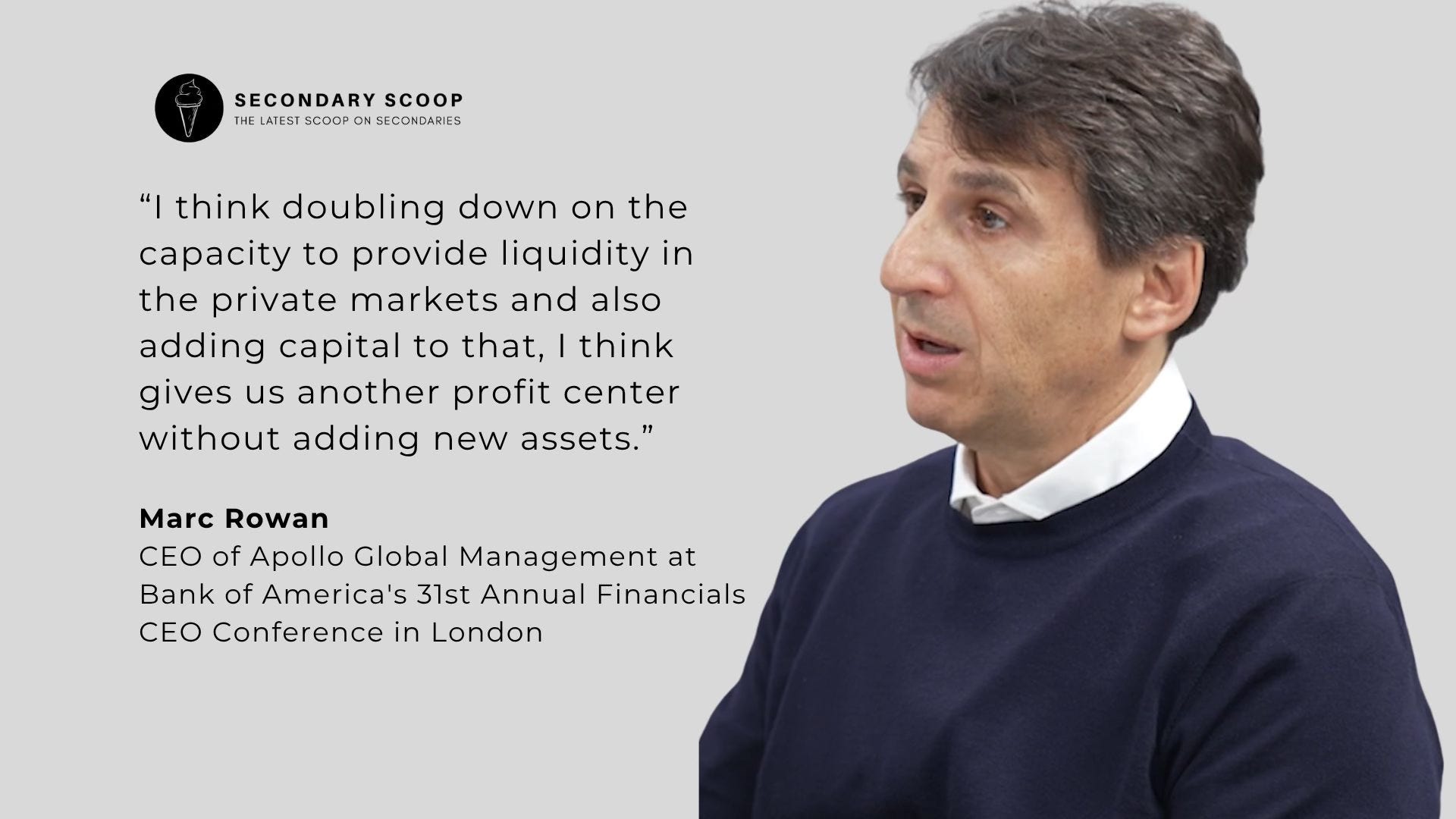
“I think doubling down on the capacity to provide liquidity in the private markets and also adding capital to that, I think gives us another profit center without adding new assets.”
Marc Rowan, Apollo
His second example was lending. Investors can already borrow from Apollo programmatically against its non-equity product at 35% LTV, at fixed rates, over several years. Rowan then asked: “How do we do that more broadly for the private asset industry?” His answer is to build the capacity at the custody level, adding that “lending will be a big potential source of origination, again, without adding new assets.”
Put together, those two ideas describe a market maker with a balance sheet and a portfolio lender open to third-party private assets. Those are the two functions that dedicated secondaries funds and NAV lenders perform today.
What is new and what is restated
Much of Rowan’s framework has been public since the spring. The table below separates what he restated in London from what added to the record, measured against Secondary Scoop’s prior Apollo coverage (the Q1 and Q2 2026 calls and Jim Zelter’s appearance at Bernstein in May).
Two data points on the liquidity backdrop
Rowan offered two observations that secondaries readers will recognize. On private equity, he said the industry “is more than 40 years old. It experienced a massive spurt of growth. Over the last decade, it has been flat to sideways.” That is a blunt description of the maturity behind today’s exit backlog and the DPI drought that has driven GP-led and LP-led volume.
On private credit in the wealth channel, he acknowledged gating across the industry but argued the market has not behaved the way a liquidity crunch should. When investors want their money back, you would normally expect underlying spreads to widen. Instead, in his words, “Spreads have tightened.” He attributed this to institutional and CLO demand more than offsetting weaker high-net-worth flows. If he is right, it matters for how secondary buyers price semi-liquid credit fund interests. Discounts driven by redemption pressure rather than asset quality should prove temporary.
And Europe?
Speaking in London, Rowan spent considerable time on Europe but did not connect it to secondaries. His argument was about private credit. Europe runs roughly the reverse of the US lending mix, where he put banks at 25% and investors at 75%. Its capex needs are large and its borrowers are often quasi-sovereign, which is why he expects Europe to be the fastest-growing private credit market in percentage terms. “Europe is gonna need to make its peace with private markets,” he said. He also pointed to UK pension risk transfer through PIC and to non-insurance pension risk transfer in Germany.
Any link from there to European secondaries is our inference, not his. A market building private markets exposure from a low base will, in time, produce the portfolio management needs that secondaries serve.