


Ardian just published its 2025 Integrated Report — and as expected, we went straight for the secondaries section.
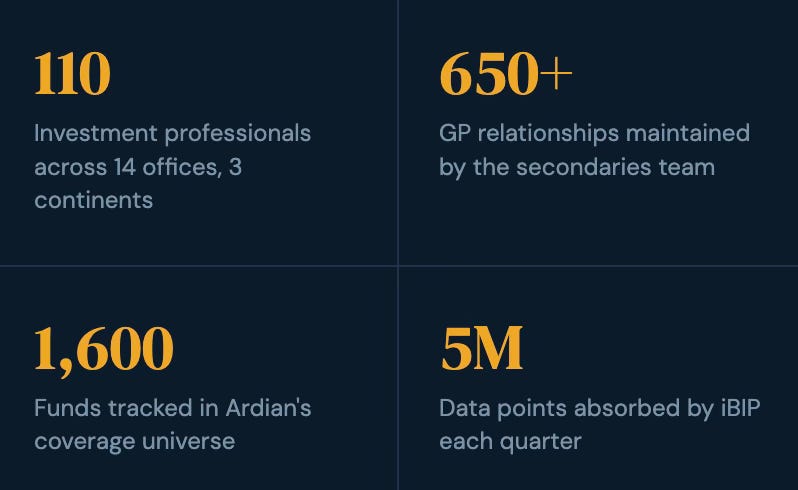
In 1996, when Dominique Senequier was handed a mandate to build a private equity business inside AXA, the European secondaries market barely existed. Today, Ardian runs the world's largest secondaries platform, with $97 billion in Secondaries & Primaries AUM, a 110-person team spread across 14 offices on three continents, and a proprietary database absorbing five million data points every quarter. The 30th anniversary of the firm is also, in many ways, the coming-of-age story of the secondaries market itself.

FROM NICHE TO NECESSITY
A Market That Remade Itself
The secondaries market of 2025 is structurally different from anything that existed even five years ago. Private equity secondary volume reached approximately $240 billion in 2025 — up roughly a third on 2024, and double the volume recorded in 2023. Ardian projects the market will double again within three years, driven by forces it describes as “getting stronger and reinforcing each other.”
The first force is structural over-allocation. As exits slowed in the higher interest rate environment that followed 2022, LP portfolios have matured without the liquidity events that would normally rebalance them. More than 80% of unrealized value in buyout funds has now been held for at least four years — the point at which exits would historically begin to flow. Instead, IRRs for recent vintages have declined across the industry, and portfolio sales to the secondary market have accelerated sharply.
The second force is behavioral. Over the past two years, more than half of all secondary market sellers have been first-time sellers — a cohort that barely existed a decade ago. Ardian’s observation, drawn from its own deal flow, is that first-time sellers typically return: once LPs complete an initial secondary transaction and recognize it as a portfolio management tool, they become recurring participants. This creates a compounding effect on deal supply that is independent of the exit environment.
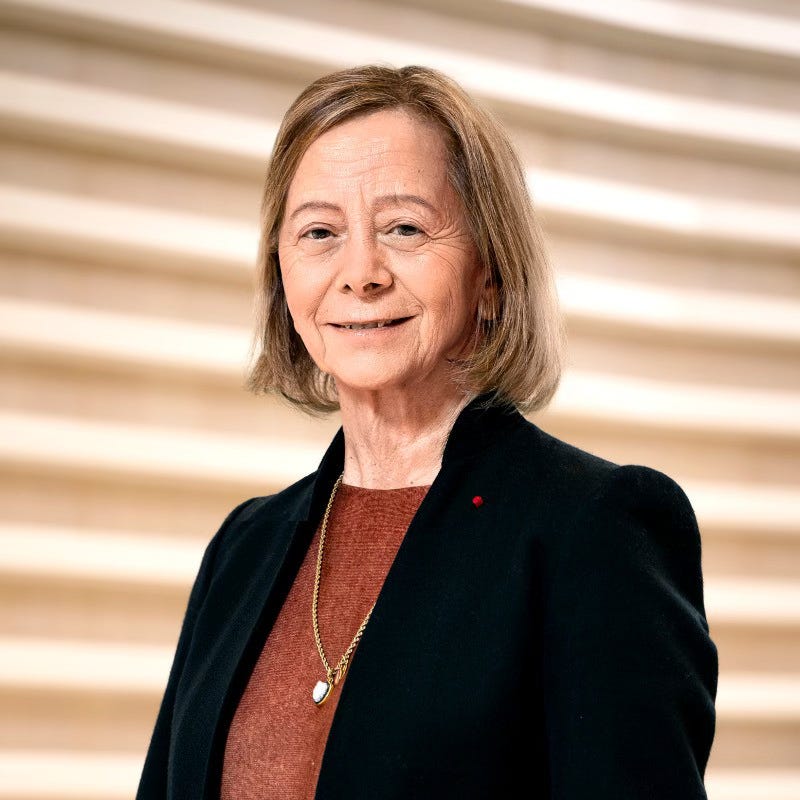
“The secondary market has fundamentally changed. Now it is giving GPs the opportunity to keep their star companies under management and continue growing them.”
— Dominique Senequier, CEO and Founder
COMPETITIVE ADVANTAGE
Scale, Relationships, Information — and Why They Compound
Ardian identifies three mutually reinforcing barriers to entry. Scale enables it to write large checks with certainty of execution — evidenced by ASF IX, a $30 billion oversubscribed close in January 2025. Relationships are deepened by Ardian’s dual role: through Ardian Customized Solutions, it is also a significant primary LP in the same funds it transacts on the secondary side. That positioning unlocks GP consent on transfers and generates company-level data flows competitors cannot replicate. Information — captured through quarterly GP interactions at company level, covering forecasts, business plans, and exit timing — feeds iBIP, the firm’s proprietary database. Ardian runs bottom-up LBO analysis on every underlying company in its portfolio each quarter, building what it describes as a permanent state of due diligence.
The result is an origination capability that is proactive rather than reactive: Ardian develops a live buy-list and approaches GPs and LPs directly to propose continuation fund structures or portfolio sales. The same names that led the secondaries market a decade ago still lead it today — Ardian argues this persistence reflects how difficult the underlying loop is to break into at scale.
2025 IN NUMBERS
ASF IX, SACVs, and a Loss Ratio Below 1%
Private wealth clients accounted for 22% of ASF IX commitments — a structural shift in the LP base the firm is building for deliberately. On risk-adjusted returns, the sub-1% loss ratio across approximately $50 billion deployed over more than 20 years is the headline figure Ardian offers in a market where investor scrutiny of performance metrics is intensifying.
In the GP-led segment, single-asset continuation vehicles generated more than $60 billion in deal flow in 2025, up roughly 70% year-on-year and up from just $3 billion in 2018. SACVs now represent approximately a quarter of total secondary market volume. Ardian completed its first continuation vehicle on the sell side in 2025 — Syclef, a refrigeration services platform held for five years by the Expansion team — and has deployed approximately $800 million as a buyer in this segment, with about $1 billion in dry powder allocated and a stated priority of increasing that firepower over the next two years.
ADJACENT MARKETS & OUTLOOK
Infrastructure Secondaries and What Comes Next
Infrastructure secondaries — approximately $28 billion in deal flow in 2025, growing at 33% CAGR since 2021 — is the segment Ardian describes as mirroring where buyout secondaries were a decade ago: earlier in the curve, growing rapidly, and structurally undercapitalized. The market expanded from $10 billion to $25 billion in just two years. Ardian's first infrastructure secondaries fund closed in 2015 at $525 million; the current generation is roughly 15 times larger and raising in half the time.
THE UNDERCAPITALIZATION THESIS
Despite record fundraising, Ardian calculates that total secondaries dry powder across the industry represents less than half of 2025 deal flow. Demand from sellers structurally exceeds the supply of capital — a dynamic that Ardian expects to persist and that naturally advantages buyers able to deploy at scale with certainty of execution.
“Information cannot be bought. It can only be assembled, quarter by quarter over decades, by those that have the scale, the right relationships, and the team to draw on 26 years of investment judgment.”
— Ardian 2025 Integrated Report