


Ares’ secondaries group has an easy fundraising story to tell. Michael Arougheti told analysts on October 29 that secondaries AUM has grown roughly 70% over two years. It ended the third quarter at $46.3bn, up 21% year over year, spread across private equity, real estate, infrastructure and credit.
The returns story is less uniform. Ares reports four secondaries return lines on slide 6 of its Q3 deck, and they point in different directions. Over the last twelve months, the gap between the best and worst of them is about 20 percentage points of gross return. That is a wider spread than in any other Ares segment: the six credit composites range from 6.8% to 17.0%, and the four real assets lines from 2.2% to 10.7%.
The spread
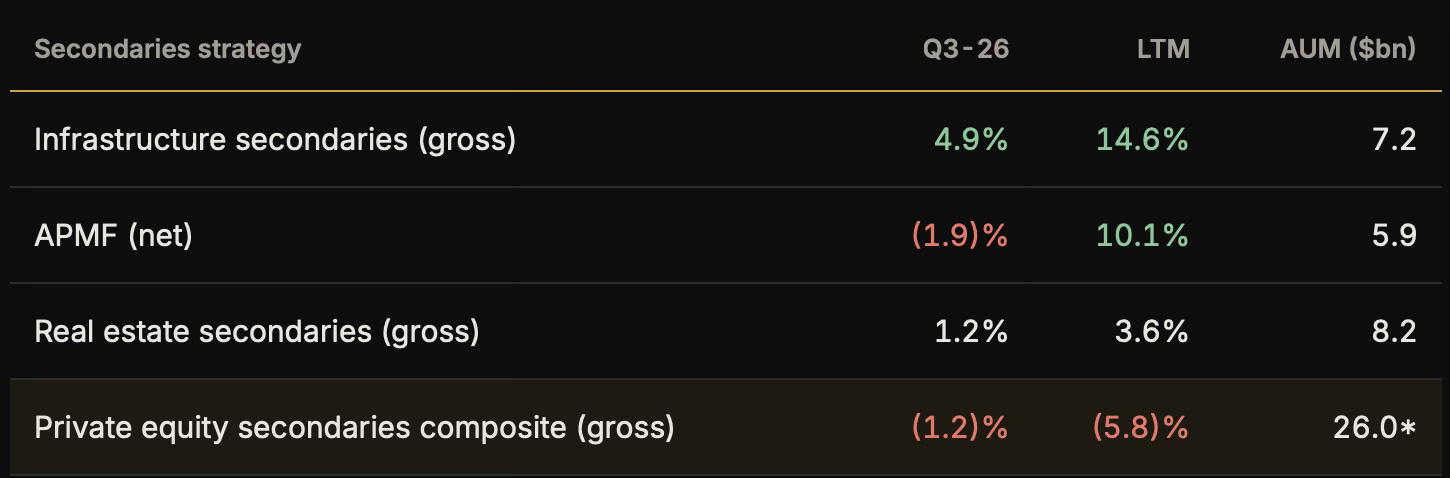
Source: Ares Q3 2026 earnings presentation, slides 6, 28 and 32. *Total private equity secondaries strategy AUM, which includes APMF and AGSS; the composite itself covers only LEP XVI and LEP XVII. Net LTM returns: infrastructure secondaries 12.3%, real estate secondaries 3.0%, PE secondaries composite (4.9)%.
Infrastructure secondaries, represented by Landmark Infrastructure Partners II alone, returned 4.9% gross in the quarter and 14.6% over twelve months (4.3% and 12.3% net). That performance is the backdrop to Ares’ third infrastructure secondaries strategy raising more than $5bn after lifting its hard cap. It also explains this quarter’s new launch: a dedicated infrastructure fund focused only on GP-led transactions.
Real estate secondaries were positive but thin, at 3.6% gross over twelve months. Management pitched the tenth fund in that series on the same conditions weighing on those returns, citing “persistent interest rate volatility and limited DPI.” The fund is expected to hold a first close above 50% of its $2.5bn target by year-end.
The private equity secondaries composite is the outlier, at −1.2% for the quarter and −5.8% gross over twelve months.
What sits inside the PE secondaries composite
Ares’ endnotes define the composite as Landmark Equity Partners XVI (2016 vintage) and Landmark Equity Partners XVII. It excludes APMF, the evergreen wealth vehicle, and AGSS, the structured solutions fund, even though both are booked within the private equity secondaries strategy.
Returns for all Ares secondaries drawdown funds are built from underlying portfolio marks reported on a three-month lag. The Q3 figures therefore largely reflect GP valuations as of the second quarter.
The defense
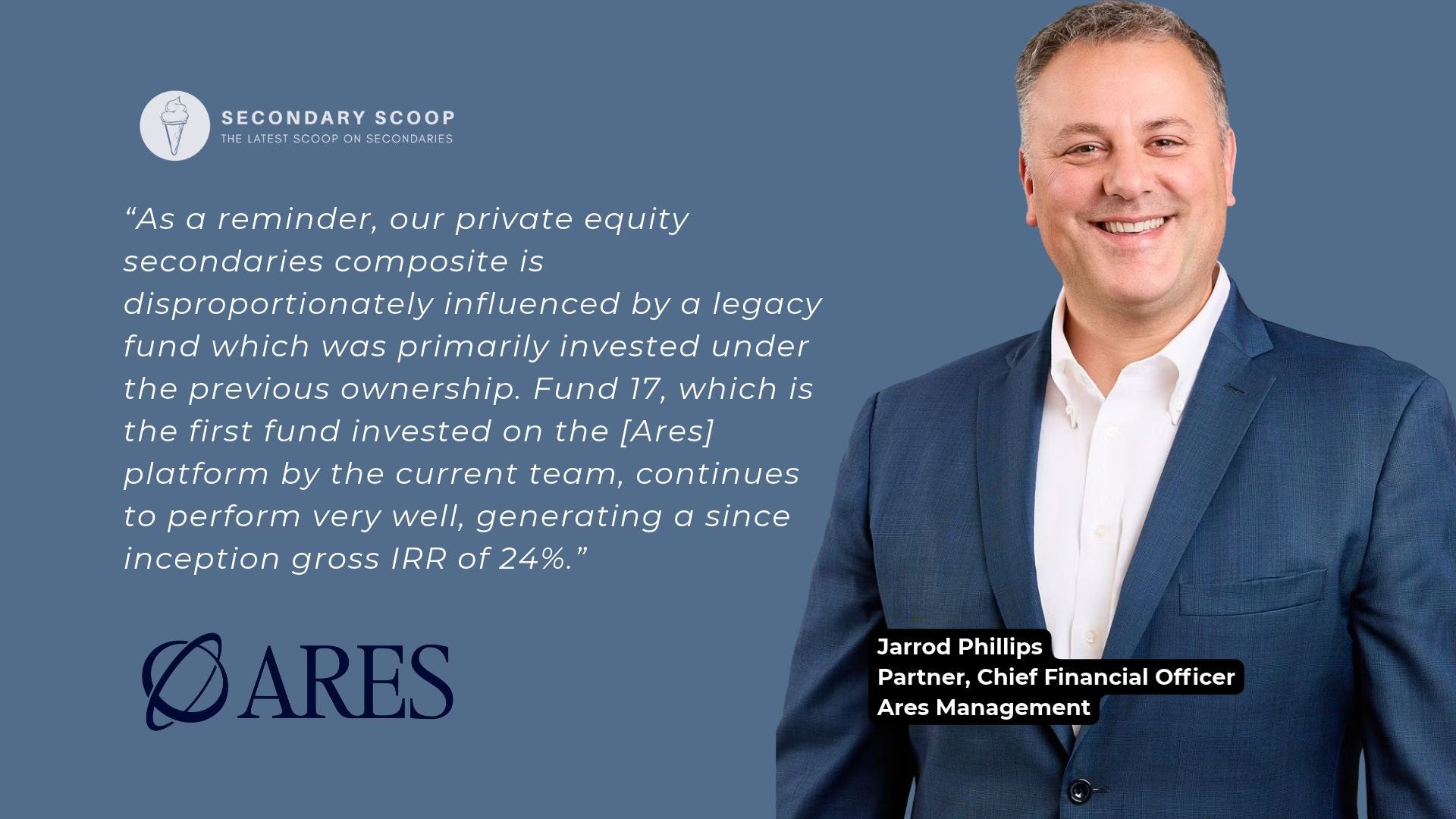
CFO Jarrod Phillips addressed the composite in prepared remarks, framing his explanation as a reminder.
“As a reminder, our private equity secondaries composite is disproportionately influenced by a legacy fund which was primarily invested under the previous ownership. Fund 17, which is the first fund invested on the [Ares] platform by the current team, continues to perform very well, generating a since inception gross IRR of 24%.”
Jarrod Phillips, CFO, Ares Management, Q3 2026 earnings call
The legacy fund is LEP XVI, a 2016 vintage raised by Landmark before Ares acquired the firm in 2021. Fund 17 is LEP XVII, the composite’s other component. The argument is that the negative number belongs to the old regime and the new one is doing well. Part of that claim can be checked against the deck. Part of it cannot.
What the deck lets you check
LEP XVI appears in the significant-funds table on slide 32, and its numbers support the first half of the defense. It has $4.9bn of commitments, $4.5bn invested, $2.1bn realized and $3.3bn still unrealized. That is 1.3x gross and 1.2x net, for a 10.6% gross and 6.1% net IRR.
Ten years after its vintage, the fund’s realized value equals about 46% of invested capital, and unrealized NAV makes up roughly 61% of total value. LEP XV, its 2013 predecessor, shows what a cleaner outcome looks like. It has already returned 1.17x invested capital in realized value and stands at 1.4x net with a 10.1% net IRR. The weakness in LEP XVI is real, it is visible, and Ares is not hiding it.
What it doesn’t
LEP XVII is not in the table. The deck discloses no size, no MoIC, no net IRR and no twelve-month return for the fund that management holds up as proof of the current team’s record. The 24% is a management-stated, since-inception gross figure.
Ares’ own endnotes for the secondaries group add a relevant qualifier. The funds may use short-term credit facilities and long-term facilities permitted by their governing documents, and Ares states that gross fund-level IRRs would generally have been lower had capital been called from LPs instead.
The more basic gap is weighting. Without LEP XVII’s twelve-month return or its share of the composite, a reader cannot tell how much of the −5.8% sits in each fund. “Disproportionately influenced” may well be accurate. But the claim rests on data Ares holds and did not publish, and a two-line split of the composite would settle it.
The demand argument
Phillips added a second line of support. He said the strong performance of Fund 17 and APMF is “corroborated by the significant investor demand we’ve seen in our recent PE secondaries fundraising.”
The composition of that demand matters. Private equity secondaries raised $2.0bn in Q3, and $1.4bn of it went to AGSS and related vehicles, bringing that strategy to $4.2bn. AGSS is Ares’ structured solutions fund, which provides capital to GPs for fund commitments, new strategy launches and succession, and its final close was announced on October 2. Strong demand for a new GP-financing product says little about how a traditional LP-portfolio fund is marked.
The incentive math
Slide 13 makes the same point from the carry side. Of Ares’ $32.1bn of incentive-eligible secondaries AUM, $14.9bn is uninvested. Of the $17.2bn that is invested, $7.2bn is generating incentive income and $10.0bn sits below hurdle.
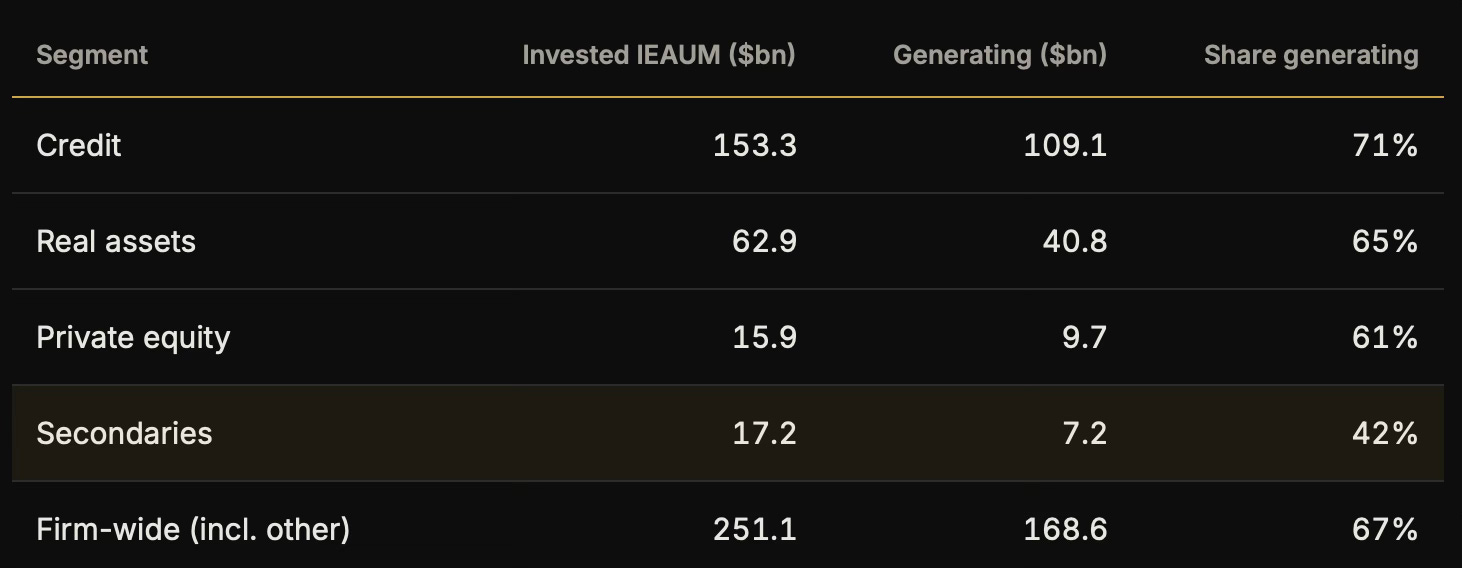
Secondary Scoop calculation from slide 13: invested IEAUM = incentive-eligible AUM less uninvested IEAUM. Credit’s invested base includes $39.3bn tied to Part II fees below hurdle.
Secondaries has the lowest share of invested incentive-eligible capital generating incentives of any Ares segment. The balance sheet tells a similar story. Secondaries accounted for 2% of the $1,021.4m of net accrued performance income at the end of 2025, and by September 30 its share had fallen below the 1% threshold Ares uses for its chart. Realized net performance income from secondaries was $0.6m in the quarter.
One caveat applies. The deck does not break below-hurdle capital down by fund, and young vintages commonly sit below hurdle in their early years. Not all of the $10.0bn is legacy drag, but the deck doesn’t show how much is.
APMF: a quarter that cost the fourth
APMF, the evergreen private markets fund at $5.9bn of AUM, posted a net −1.9% for the quarter. That follows a strong first half, with year-to-date net returns of 8.1% and an annualized 13.7% since inception.
The negative quarter matters for fee-related performance revenue. Secondaries FRPR fell to $5.7m from $17.1m a year earlier, though the year-to-date figure of $56.5m is still 31% ahead of 2025, largely on the back of the second quarter.
“In secondaries, following the exceptionally strong performance of APMF in the second quarter, Q3 performance left a small high-water mark to overcome in Q4, but we’re on track, subject to market conditions, to generate FRPR in the fourth quarter.”
Jarrod Phillips, CFO, Ares Management, Q3 2026 earnings call
The lower FRPR and the absence of last year’s $27.2m in ASIS III catch-up fees produced a 32% year-over-year drop in secondaries fee-related earnings, to $50.7m. Year to date, the segment’s FRE is up 1%.
What the analysts didn’t ask
Thirteen analysts asked questions on the call. None asked about secondaries performance. Secondaries came up in the Q&A only as a growth story. Asked by Goldman Sachs’ Alex Blostein about U.S. direct lending deployment, Arougheti framed secondaries as a counter-cyclical outlet:
“So not surprisingly, when the M&A environment is slowing for PE, we start to see it pick up in places like opportunistic credit, credit secondaries, GP solutions, and the like.”
Michael Arougheti, CEO, Ares Management, Q3 2026 earnings call
Asked by an analyst about Ares’ $1.1bn purchase of a performing direct lending portfolio from an institutional investor, Arougheti said more such books will change hands. Some of that flow, he added, will run through Ares’ credit secondaries business, “which is enjoying a lot of growth right now.” Asked by another analyst about diversification, he offered four words on the segment: “Secondaries is growing well.”
On asset gathering, that holds. On realized returns in private equity secondaries, the quarter’s disclosures give LPs less to go on than management’s confidence suggests.