

Two sovereign wealth funds: Abu Dhabi’s ADIA buying, Saudi Arabia’s KAUST endowment selling, made headlines this week in a $1 billion-plus private-markets stake sale advised by Jefferies.
In the last ten months or so, at least six sovereign-or-sovereign-adjacent institutional investors have shown up on the secondary market as sellers, not the buy-side role the market usually assumes for this class of investor. Some completed. One reversed. All of it happened largely as separate, one-off stories in separate outlets. Put together, it reads as a genuine shift in who’s supplying the secondary market.
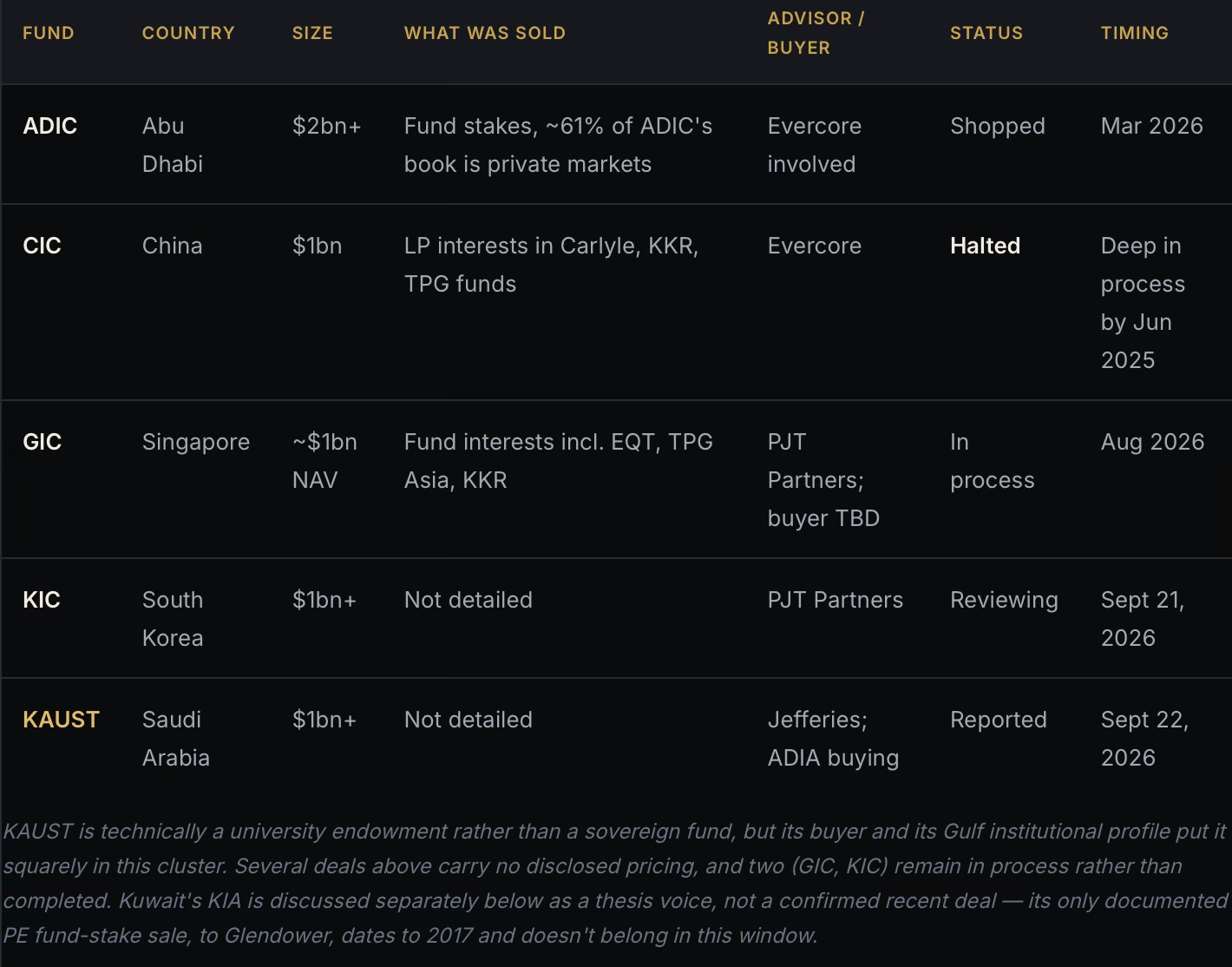
Why sovereign funds selling is the more interesting story
Sovereign wealth funds are usually cast as secondaries buyers, long-duration capital with no redemption pressure, the natural counterparty for an LP that needs out. ADIA itself fits that mold: it has spent the past year expanding its private equity allocation range and running a real estate secondaries platform with Ardian. That’s what makes the other side of this list notable. A fund selling fund stakes on the secondary market, rather than buying them, is doing something closer to what a stretched endowment does: freeing up capital, repricing exposure, or managing an internal reorganization. That’s not the sovereign-fund script.
One Deal, Two Very Different “Whys”
The two best-documented cases in this list point in opposite directions, and that contrast is the real substance of the story.
China Investment Corporation got the furthest into a sale before pulling back. CIC, a $1.3 trillion fund, was deep into a process to sell $1 billion of LP interests in Carlyle, KKR and TPG funds (advised by Evercore) reducing exposure to illiquid US assets amid trade tensions and the threat of capital restrictions under a second Trump administration. Then, per Private Equity Wire, CIC reversed course as signs of thawing US-China relations emerged, and, notably, out of what the reporting describes as sensitivity to perceptions that it was retreating from US private capital markets, despite sitting below its own 50% alternatives allocation target. For CIC, the calculus wasn’t really about the assets. It was about optics and geopolitics.
GIC’s sale, by contrast, reads as plain portfolio management. Singapore’s roughly $1.16 trillion sovereign fund has been quietly marketing about $1 billion of net asset value in fund interests, including positions in EQT, TPG Asia and KKR vehicles, with PJT Partners advising and buyers approached since around July 2026.
“[GIC has] adopted a more cautious stance towards private markets” and is “increasingly focused on recycling capital across its investment portfolio.”
Lim Chow Kiat, CEO, GIC, as reported by Private Equity Wire
That’s about as close to an on-record rationale as this entire cluster gets. None of the other five deals (ADIC, CIC, KIA, KIC or KAUST) comes with an attributed quote from the institution itself in what’s been publicly reported.
Korea Investment Corporation Rounds Out the List
The most data-rich profile in this entire cluster belongs to the newest entrant. Korea Investment Corporation: a $232 billion sovereign fund as of February 2026, is reviewing the sale of more than $1 billion in private equity investments and has appointed PJT Partners, the boutique investment bank spun out of Blackstone, as advisor, according to Caproasia, reported Sept 21, 2026, one day ahead of the KAUST/ADIA news. Private equity is a comparatively modest 7.6% of KIC’s book, well behind equities (41.6%) and fixed income (32.8%), and the fund’s PE investments have returned an annualized 12.87% over the past decade. This isn’t a fund exiting a weak asset class. What stands out instead is the timing: KIC is simultaneously preparing to launch a $13.6 billion strategic investment account in 2027 targeting artificial intelligence, semiconductors and other technologies tied to South Korea’s national security interests. Selling $1 billion of existing PE stakes while standing up a new multibillion-dollar strategic vehicle reads less like a retreat from private equity and more like capital being deliberately redirected toward a named priority, the same “recycling capital” logic GIC’s CEO articulated, but aimed at a specific destination rather than a general shift in stance.
The Advisor Pattern Underneath It
PJT Partners is advising both KIC’s and GIC’s sales, two separate Asian sovereign funds, in the same window, going to the same boutique. If that holds up as more than coincidence, it mirrors what Jefferies has built on the endowment side, where it’s now advised both Harvard’s and KAUST’s sales inside roughly eighteen months. The secondaries advisory league table increasingly looks like it’s segmenting by client type as much as by deal type, Jefferies with the university-endowment relationships, PJT building out a sovereign-fund book, Evercore showing up on both CIC’s and ADIC’s mandates.
Kuwait’s Case for the Whole Trade
The clearest strategic voice in this entire cluster was made over a year ago by Sheikh Saoud Salem Al-Sabah, managing director of Kuwait’s roughly $1 trillion sovereign fund, when he told the Qatar Economic Forum in May 2025 what amounts to the thesis for this whole piece.
“The opportunities in private equity are in secondaries and special situations.”
Sheikh Saoud Salem Al-Sabah, Managing Director, Kuwait Investment Authority, Qatar Economic Forum, powered by Bloomberg, May 2025
Al-Sabah’s broader point was that the industry spent its cheap-capital years doing deals without defined exit strategies, and that secondaries, as a category, is now where the opportunity set has shifted. KIA itself has already acted on the sell side: it sold a portfolio of European private equity fund stakes to Glendower, a move tied to changes at its London office rather than to market timing. Small in scale next to CIC or ADIC, but one more data point on the same list.