


Blackstone reported its third-quarter results today, and secondaries barely featured in management’s telling. Yet the numbers show Blackstone’s secondaries business now carries more unrealized carry than its flagship buyout franchise. At September 30, net accrued performance revenues (NAPR) in Secondaries stood at $1,196m, edging past the $1,158m in BCP Global, the corporate private equity program that built the firm. A year ago, the gap ran $674m the other way. Secondaries is now the second-largest pool of accrued carry in Blackstone’s Private Equity segment, behind only Energy/Energy Transition at $1,271m, and accounts for 16.5% of the firm’s $7.26bn total. The crossover is narrow, and it owes as much to a sharp drop in BCP Global’s carry as to growth in secondaries. But it marks a shift in where Blackstone’s future performance fees are coming from.
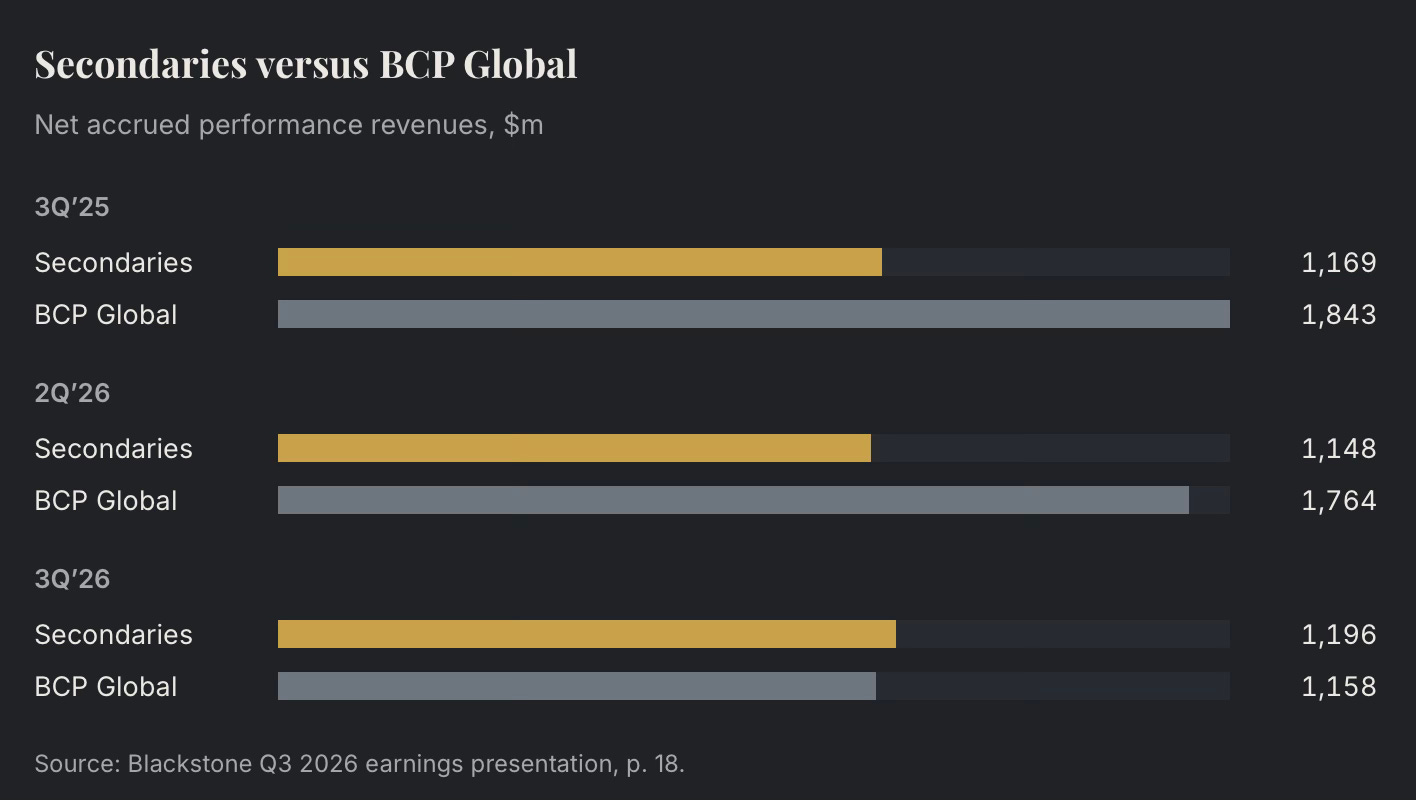
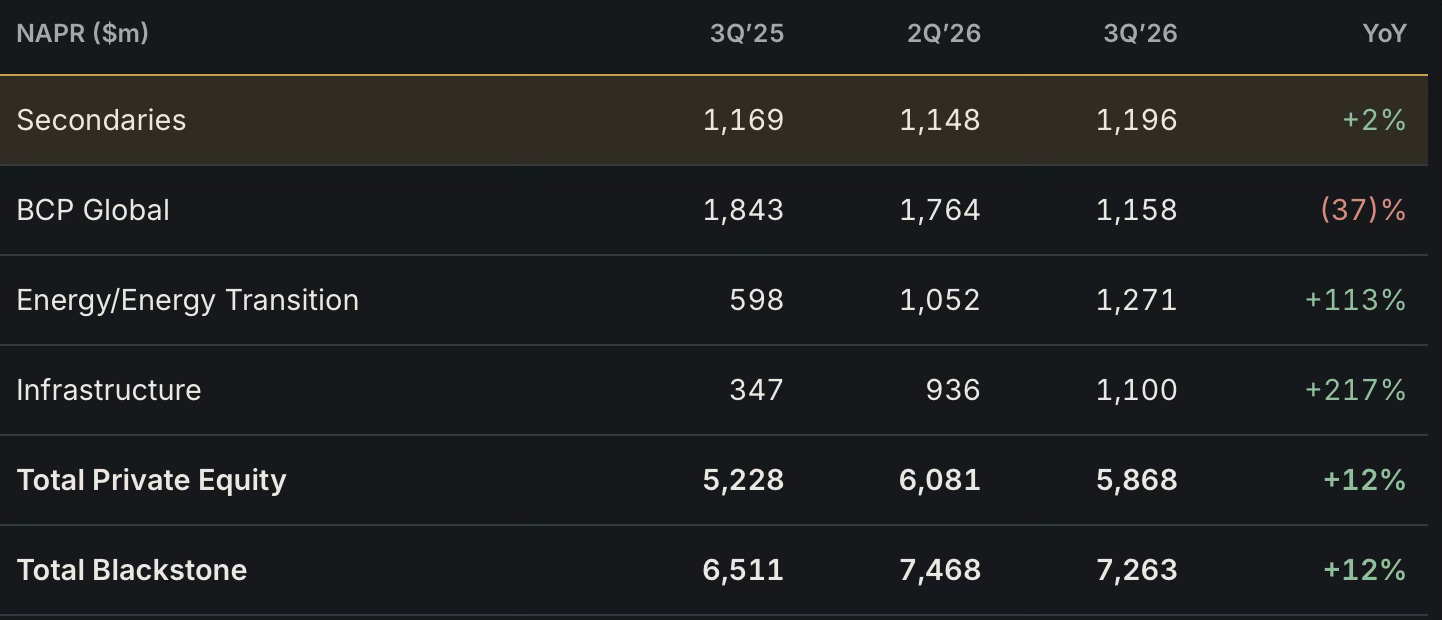
Source: Blackstone Q3 2026 earnings presentation, p. 18. Year-over-year changes calculated by Secondary Scoop.
The crossover was not part of Blackstone’s narrative on the call. Walking through the $7.3bn receivable, CFO Michael Chae highlighted two pools: corporate private equity, of which he said nearly one-third is public and liquid, and the private equity energy business, which he said had more than doubled year over year. Secondaries went unmentioned.
Not just a harvest
The obvious reading is that buyout carry is converting to cash. Private Equity realizations were $9.8bn in the quarter, with Recognition Music Group, Ennovi and SP.LINKS named among the exits. That is part of it, but the arithmetic says it is not the whole story.
BCP Global’s NAPR fell $606m quarter over quarter. Across the entire Private Equity segment, net realized distributions were only $325m, offset by $112m of net performance revenues. Even if every dollar of PE distributions came out of BCP Global, it would explain roughly half of the decline. The remainder implies a reduction in accrued carry from performance in BCP Global, which the deck does not break out at the fund level. Firm-wide, GAAP unrealized performance allocations were negative $627m in the quarter.
Secondaries moved the other way, adding $48m quarter over quarter. And the cash side of the quarter was soft: total segment net realizations fell 34% year over year to $332m. Chae noted on the call that the firm had guided to a sequential decline, and net realizations came in down 20% quarter over quarter.
What “Secondaries” covers in this line
Blackstone’s notes state that Secondaries reflects Strategic Partners and GP Stakes unless otherwise indicated. The NAPR figure is not split between the two, so the $1,196m is not a pure secondaries number.
GP Stakes is reported separately as BXGP: $10.0bn of perpetual capital AUM ($13.2bn including non-perpetual and co-investment vehicles) and a 12% net return since its 2014 inception. The appreciation figures discussed below exclude GP Stakes.
Will the lead hold? The Q&A points to a test in Q4
Asked by TD’s Bill Katz where fourth-quarter realizations would come from, Chae pointed to closings on previously announced sales, primarily in private equity, and gave an unusually concrete marker:
“What we have under contract that is expected to close in terms of carry realizations alone in the fourth quarter is expected to surpass the total net realization levels for the firm from the third quarter.”Michael Chae, CFO, responding to an analyst question on the Q3 2026 earnings call
Q3 net realizations were $332m. If a meaningful share of the Q4 carry comes out of BCP Global, the gap between buyout and secondaries carry could widen further. That is a possibility, not a forecast: the call did not attribute the Q4 realizations by fund, and new marks can rebuild accrued carry as fast as exits drain it. What it does confirm is the dynamic behind the crossover. Blackstone’s buyout carry is in harvest mode; its secondaries carry is not yet.
Read the 4.3% with the calendar in mind
Secondaries appreciated 4.3% in the quarter, ahead of Corporate Private Equity at 2.8% and Tactical Opportunities at 2.2%. On a twelve-month basis the order flips: Secondaries is up 9.3% against 14.7% for Corporate Private Equity.
The quarterly comparison is not like for like. Strategic Partners reports on a three-month lag from fund financial statements, so the Q3 print largely captures second-quarter marks. In its notes, Blackstone says current market activity is expected to affect reported results in upcoming quarters. Third-quarter volatility, including the rate move that hit opportunistic real estate, will show up in Strategic Partners’ numbers in Q4.
SP X: $16bn raised, at least $22bn targeted
The clearest new secondaries disclosure came in President Jon Gray’s prepared remarks. Blackstone held additional closings for its new private equity flagship secondaries vehicle, Strategic Partners X, and for its real estate secondaries vehicle, with the flagship at:
“Over $16 billion raised to date toward a target of at least $22 billion.”Jon Gray, President and COO, Q3 2026 earnings call
That is up from the $11bn Gray cited on the Q1 call, and it is the first time we have seen a stated target for the fund in our coverage. At $22bn, SP X would roughly match the $22.2bn Bloomberg reported for SP VIII. The deck shows SP X at $12.35bn of committed capital as of September 30. Blackstone does not reconcile the two figures; post-quarter closings or a broader definition of capital raised are both plausible, so we treat them as separate measures.
The Q&A filled in the economics. BMO’s Brennan Hawken asked whether the firm’s guidance for double-digit growth in base management fees in 2027 included catch-up fees from the newly activated secondaries flagship. Chae said the guidance refers to full-year base management fees against full-year 2026, inclusive of all drivers. In other words, SP X catch-up fees are inside the guidance, not on top of it. Earlier, Chae listed finishing the SP X fundraise among the drivers whose management fees will build through the first half of 2027.
Capital keeps arriving; deployment slowed
Secondaries took in $3.1bn of inflows in Q3 and $25.1bn over the last twelve months, 32% of Private Equity’s $77.8bn. Only Corporate Private Equity, at $34.9bn, raised more within the segment.
Deployment went the other way. Secondaries put $1.95bn to work in Q3, against $13.2bn over twelve months, implying an average of about $3.8bn in each of the three prior quarters. Q3 ran at roughly half that pace, with SP X holding $7.79bn of available capital. Neither the deck nor the call addressed it. Secondaries deployment is lumpy and one quarter is not a trend, but a slowdown in the middle of the largest fundraise in the program’s history is worth watching.
Where the value sits
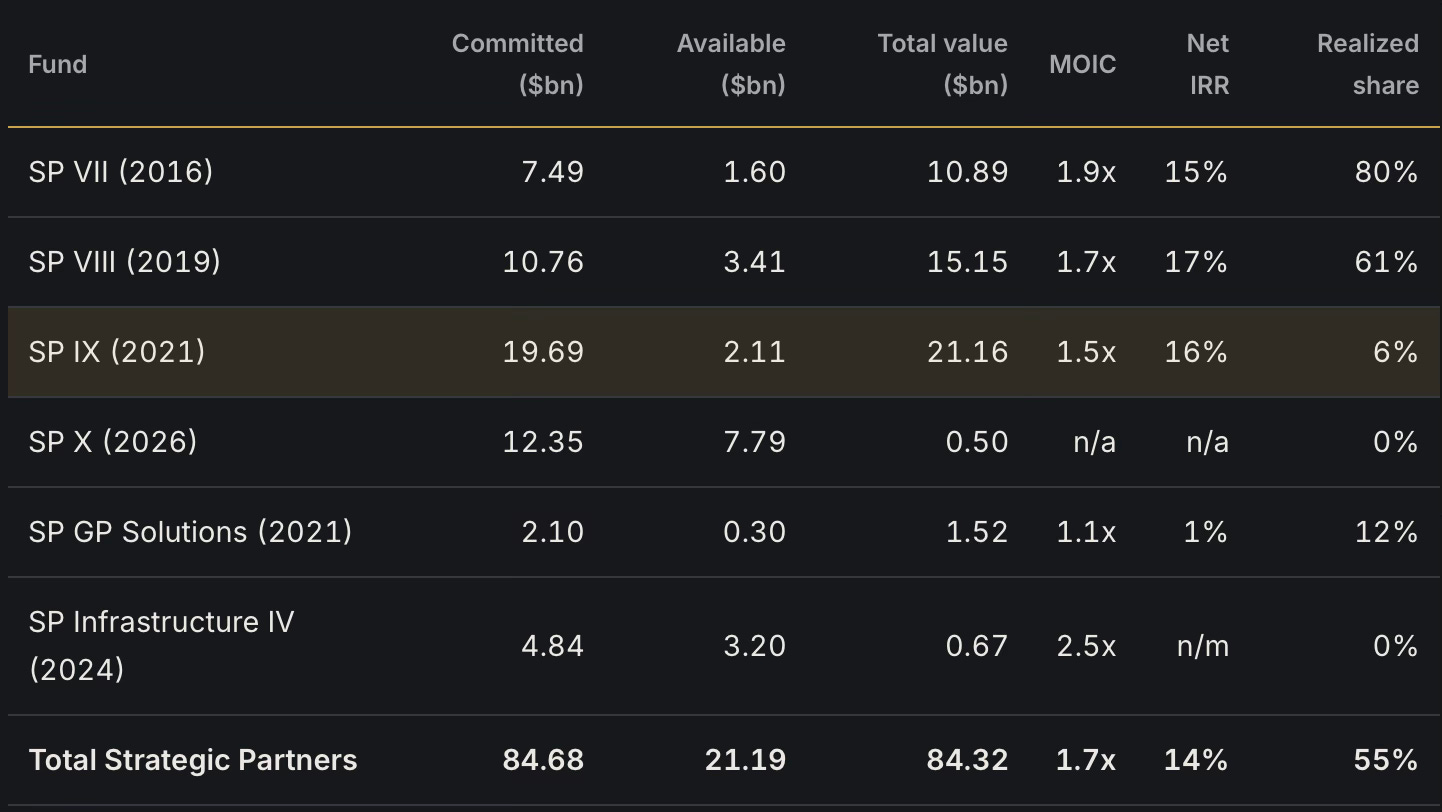
Source: Blackstone Q3 2026 earnings presentation, p. 20. Values, MOICs and IRRs are reported on a three-month lag; committed and available capital are as of Q3. Year is the start of the investment period. Realized share is realized value divided by total value, calculated by Secondary Scoop; Blackstone treats Strategic Partners realizations as returns of capital until fully recovered and does not report realized MOICs. Selected funds shown; the total includes all Strategic Partners vehicles.
Strategic Partners IX is the fund to watch. It holds $19.9bn of unrealized value, its investment period ended in March 2026, and only about 6% of its total value has been realized. SP VII and SP VIII, by contrast, have returned the majority of their value. Blackstone does not allocate NAPR by fund, so we cannot confirm how much of the Secondaries carry pool sits in SP IX. But the path from accrued to realized secondaries carry runs through it.
Two smaller data points. SP VIII’s net IRR is 17% in the Q3 deck; Bloomberg reported 18% as of March. And Strategic Partners GP Solutions, with $2.1bn committed and an investment period running to December 2026, sits at 1.1x and a 1% net IRR, the weakest line in the program.