


It’s only Wednesday, and Blackstone has already filled a week’s worth of headlines. Since Monday, Strategic Partners has picked up part of a $1.3bn co-investment portfolio at roughly 80 cents on the dollar, after an LP club failed to come together. The firm has also taken the junior slot in a $63bn financing to put Broadcom chips in Anthropic’s data centers, a company it already owns about $1bn of. On top of that, it priced $1.1bn of senior notes and opened a second office in India. Here’s what each move means, starting with the one that matters most for secondaries.
The secondaries deal: co-invests, bought without the club
Blackstone Strategic Partners has acquired part of a $1.3bn portfolio of co-investments, PitchBook reported on October 27, citing people familiar with the matter. The portfolio held 22 positions alongside Carlyle, CVC, KKR, Blackstone and Insight Partners. KKR was the largest sponsor at 18.5% of NAV, with names including ERM, Groundworks and Optiv. Blackstone’s own Advarra, owned with CPP Investments, was also in the book.
The process did not run as planned. Strategic Partners had been in talks with its own LPs about clubbing together on the portfolio. In the end it bought a portion alone, and part of the portfolio stayed with the seller, who has not been identified. The whole portfolio was priced at around a 20% discount to NAV. Blackstone and KKR declined to comment.
That discount is the number to watch. In September, HarbourVest bought into Yale’s $1bn LP portfolio in the mid-90s percent of NAV. A high-quality co-investment book with top-tier sponsors trading near 80 cents says less about the assets than about the paper they sit in.
“This is the $1 million question…”
Jake Stuiver, Managing Director, William Blair, to PitchBook, on whether co-investment side letters transfer to a buyer
Co-investments usually come with reduced or zero fees and carry, but those terms tend to be negotiated in side letters rather than the LPA. They do not move to a buyer automatically. GP consent and the treatment of those economics after a transfer are where the pricing gets made. The more uncertain the transfer, the wider the gap between a co-invest’s NAV and what a buyer will pay. William Blair was not involved in this sale.
What we know and what we don’t
Known: portfolio size ($1.3bn), number of positions (22), largest sponsor (KKR, 18.5% of NAV), headline pricing (~20% discount for the total portfolio).
Not disclosed: the seller, how much of the portfolio Blackstone bought, whether the discount on Blackstone’s slice matches the headline figure, and which positions stayed with the seller.
Worth noting: the portfolio included a co-investment in Blackstone’s own Advarra. It hasn’t been reported whether that position was in the slice Strategic Partners bought. If it was, a Blackstone secondaries fund buying into a Blackstone portfolio company is the kind of configuration LPs tend to ask about.
It is also the second Strategic Partners process in roughly five weeks where the intended syndication did not come together. In September, Project Eclipse, a ~$3bn collateralized fund obligation backed by about 700 fund interests, was put on hold after investors balked at the leverage and the age of the underlying book, and no taker emerged for the equity tranche. The two deals are very different. Still, both point the same way: when outside capital doesn’t show up, Blackstone has the scale to keep the risk itself.
The Fund X number doesn’t add up yet
PitchBook’s piece puts Strategic Partners Fund X, the tenth flagship secondaries fund, at $12.3bn of committed capital. That figure sits below the numbers already in the public record.
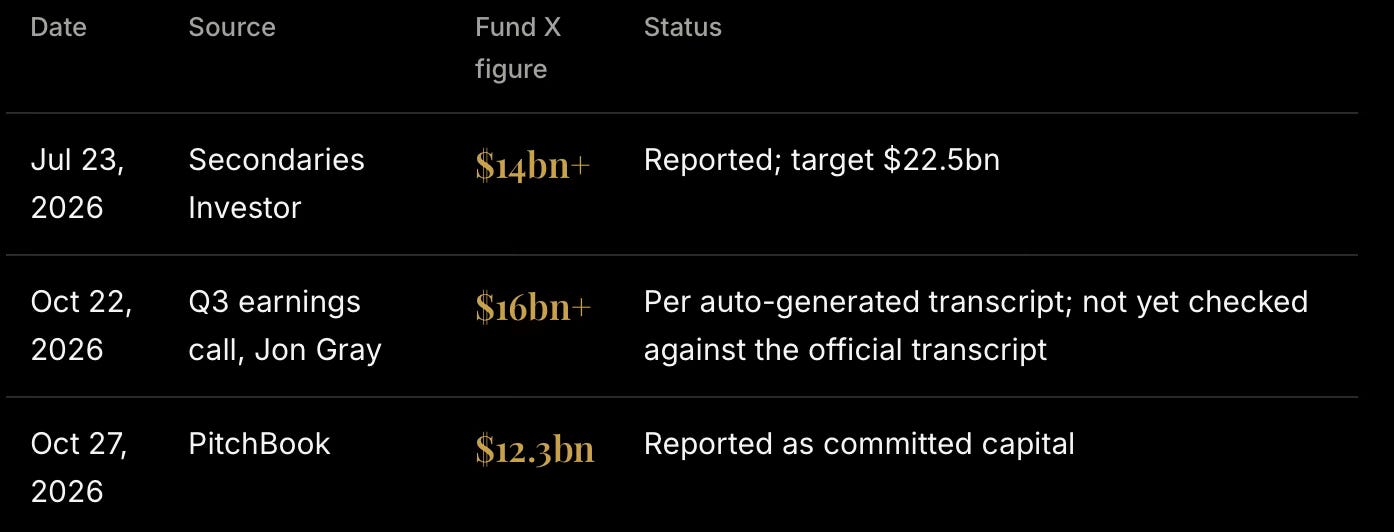
A fund doesn’t shrink by $4bn in three months. The likeliest explanation is that the figures measure different things, for example the main fund alone versus the main fund plus related vehicles, or capital closed versus capital committed including soft circles. We haven’t been able to confirm which basis each source uses, so we’re treating Blackstone’s own call figure as the most recent and flagging the gap rather than picking a number.
Beyond secondaries: $63bn for AI chips, with Blackstone in the junior slot
New this week
On October 26, Bank of America, Blackstone, Citi and Morgan Stanley announced a $63bn financing to buy Broadcom XPU accelerators and networking gear, held in a newly formed SPV and leased to Anthropic. Deliveries are expected from calendar 2027. The three banks are arranging the first lien. Blackstone is the sole provider of the committed portion of the second lien. Broadcom is providing residual value support to the SPV equal to the first-lien amount.
Reuters, citing two sources, put the first lien at about $43.5bn, or 69% of the total. That implies roughly $19.5bn of second-lien capital. How much of it Blackstone will hold after syndication has not been disclosed. In earlier Bloomberg reporting on the same deal, Blackstone was set to commit about half of a smaller junior tranche from its funds and syndicate the rest.
The structural point: Broadcom’s support covers the senior lenders, not the second lien. Blackstone’s capital is the piece most exposed to what the chips are worth when the leases run off. Jon Gray framed the deal as “an enormous opportunity to finance compute capacity at scale.” Kirkland & Ellis advised Blackstone.
What the press release doesn’t mention is that Blackstone is already on the other side of this trade. It took part in Anthropic’s $13bn raise in 2025 and added about $200m in February 2026, bringing its stake to roughly $1bn at a $350bn valuation, according to Bloomberg. Most of that new money came from BXPE, its retail-focused private equity vehicle. In May, Blackstone also became a founding partner, alongside Hellman & Friedman and Goldman Sachs, in a reported ~$1.5bn Anthropic venture that embeds AI engineers in PE-owned companies. So Blackstone is now an equity holder in Anthropic, a partner in one of its businesses, and the junior lender to the vehicle leasing it chips. The equity likely gains if the compute capacity pays off. If the leases come under strain, the second lien sits closest to the loss. How Blackstone manages the conflict across its equity, credit and wealth vehicles hasn’t been disclosed.
This is a primary asset-based financing, not a secondaries transaction. We include it because it is where a growing share of Blackstone’s credit capital is going, and because large, illiquid junior positions like this one are exactly what tends to reach the secondary market a few years later.
Also from Blackstone this week
$1.1bn senior notes Oct 27
Blackstone priced $600m of 5.650% notes due 2031 and $500m of 5.900% notes due 2033, issued through Blackstone Reg Finance Co. Proceeds are for general corporate purposes.
Second office in India Oct 27
Blackstone opened a Global Capability Center in Bengaluru for corporate functions, overseen by Susan Yung of BXCI Investment Operations. Investment professionals remain in Mumbai.
Already reported last week
Q3 results Oct 22
Distributable earnings fell 9.2% to $1.72bn, or $1.32 a share, ahead of consensus. Secondaries took in $3.1bn of inflows in the quarter, mainly from Fund X and the ninth real estate secondaries strategy, and appreciated 4.3% (9.3% LTM).
BETP V final close Oct 19
Blackstone Energy Transition Partners V closed at its $8.7bn hard cap, more than 50% larger than its predecessor.