


Buenavista Equity Partners said Tuesday that its board resolved on September 15 to appoint Enrique Centelles Satrústegui as Chief Executive Officer, handing him executive responsibility across private equity, infrastructure and venture capital. Centelles has run the firm’s private equity business as Managing Partner since 2012, and the announcement explicitly credits him with building the group’s secondaries strategy.

For most readers, this is a Spanish people move. For secondaries readers, it’s something more specific: the firm’s top job now belongs to the executive who, at a lower mid-market Madrid shop that was still called GED Capital, used GP-led structures three times over a decade, including a single-asset continuation vehicle syndicated to four international secondaries buyers in 2022, well before CVs became a routine exit channel for European mid-market sponsors.
Three deals, three structures
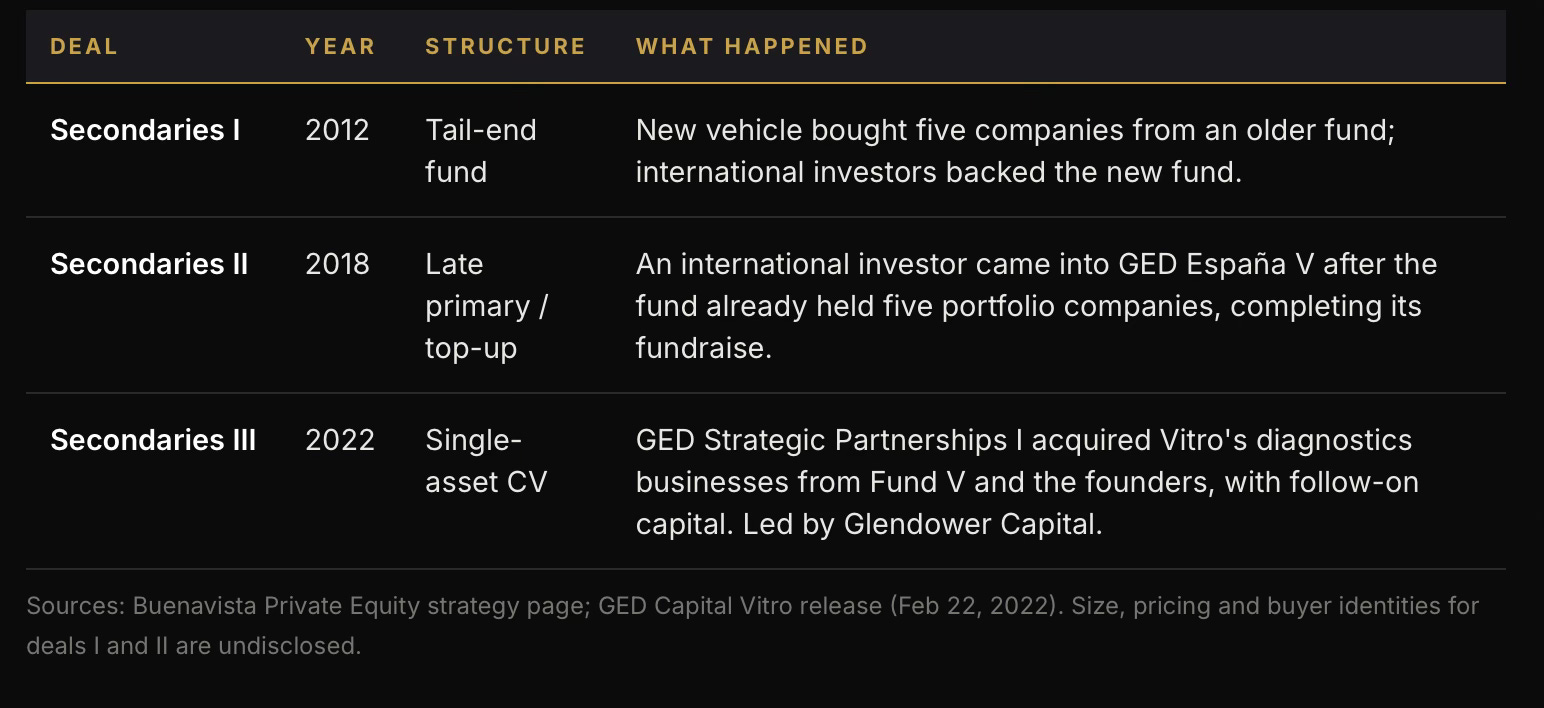
Buenavista’s website now labels its GED-era secondaries work as Buenavista Secondaries I, II and III. Today’s release summarizes them as tail-end portfolios, early secondary deals and a continuation vehicle. Mapped against the public record, they look like this:
2012: THE TAIL-END FUND
The firm describes its first transaction as a “tail-end” vehicle that bought and sold five companies, with international investors participating in the new fund. It has never named the vehicle or the buyers.
The public record offers a strong candidate. CNMV registers show GED Iberian B, FCR de Régimen Simplificado, registered on September 14, 2012 and now in liquidation. When GED sold pharmaceutical packaging maker Nekicesa to Essentra in 2019, trade press reported that the sale marked the divestment of GED Iberian B, set up in 2012, even though GED had acquired Nekar, Nekicesa’s predecessor, back in 2006, during the GED Iberian Fund I era. An asset bought in 2006 exiting from a vehicle created in 2012 is exactly the footprint a tail-end restructuring leaves.
Secondary Scoop inference: Buenavista has not confirmed that GED Iberian B is Secondaries I, and we have not been able to verify the buyer group or pricing.
2018: A “SECONDARY” THAT IS REALLY A TOP-UP
The second deal is described in the Vitro release as “an early secondary investment in GED España V,” and on the firm’s website as a “late-primary” or “top-up,” in which an international investor entered the fund once it already had five portfolio companies.
TERMINOLOGY CHECK
A late primary or top-up is new capital committed to a fund already partway through deployment, the investor buys into a seeded portfolio, so it shares the secondary buyer’s advantage of visibility over existing assets. But no existing LP interest changes hands. It sits at the edge of the secondaries market rather than inside it, and we would not count it in GP-led volume data.
It is still revealing. Seeded-portfolio access was the pitch to a foreign LP, and the timing fits: GED VI España held a €100m first close in April 2019, and the firm said every investor in that close had also backed the previous vehicle.
2022: VITRO AND GED STRATEGIC PARTNERSHIPS I
The deal that defines the strategy is the Vitro exit. GED España V had bought 51% of Seville-based in vitro diagnostics group Vitro in June 2017. The exit ran as a dual track:
Jun 2017 GED España V takes control of Vitro.
2018 Vitro moves to majority control of Cytognos, its flow cytometry business — its first add-on under GED ownership.
Nov 2020 Spanish press reports GED has hired Lazard to explore a sale of Vitro.
Jan 2022 Cytognos sold to Becton Dickinson.
Feb 2022 Remaining molecular diagnostics and anatomic pathology businesses move into single-asset CV GED Strategic Partnerships I (GED SPI), which buys out Fund V and the founders and secures follow-on capital.
The syndicate was led by Glendower Capital, now CVC Secondary Partners, alongside Newbury Partners, Headway Capital Partners (through its HIP IV SCSp fund) and Norway’s Argentum. GED described it as oversubscribed. Fairview Capital Group was exclusive financial advisor on the secondary; KWM advised on law. On the company side, Lazard handled the Cytognos sale, Garrigues advised and KPMG did valuation work. Vitro’s management reinvested and stayed on as minority shareholders.
…a tool to provide optionality for our investors while supporting exceptional portfolio companies.
Enrique Centelles Satrústegui on the secondary market, GED Capital release, February 2022
Vitro’s CEO, Javier Fernández López, framed the deal from the company’s side, praising GED for supporting growth “beyond the perimeter of their original investment plan, capital and time horizon.” That is the continuation-vehicle thesis in fifteen words.
What the website says vs. what the record shows
Buenavista lists Secondaries as one of three private equity strategies, next to Buyout and Healthcare. Its strategy page describes secondaries funds in buy-side terms, acquiring portfolios of third-party funds, or direct secondaries, rather than investing directly in companies.
Yet every transaction the firm cites is GP-led on its own funds. The same page says the team has implemented secondary structures that bring forward liquidity for its investors “occasionally.” Today’s release credits Centelles with launching and managing Buenavista’s “buyout and secondary funds,” but we could find no public announcement of a dedicated, third-party secondaries fund with a target size or close.
Gap disclosed: if such a vehicle exists, it has not been publicly marketed.
Why the CEO seat matters for the secondaries angle
The appointment lands in the middle of a capital-raising cycle. In mid-2024 GED sold 25% of the management company to Libertas 7 (the Noguera family), Aligrupo (the Alcaraz family) and the Matos family’s vehicle, named Livrefluxo in 2024 filings and Vieira de Matos Capital in today’s release, with proceeds earmarked for scaling the next funds. Three months later the firm dropped the GED name, a move trade press tied to attracting international investors. Buenavista Buyout Innvierte III launched in 2025 with a €250m target and took a commitment of up to €75m from Fond-ICO Global in July 2026.
Those moves create two secondaries-relevant pressures a CEO owns rather than a strategy head:
Legacy fund management. GED España V (2017 vintage investments, including Vitro) and GED VI España (first close 2019) are both at or past the age where LPAC conversations turn to extensions, tail-ends and GP-led options. Centelles has run all three versions of that playbook before.
The international LP pitch. The 2022 syndicate put Glendower/CVC, Newbury, Headway and Argentum on GED’s investor register. The Vitro release said as much, describing the deal as adding new partners to the GED platform. For a manager courting foreign LPs, a working relationship with global secondaries buyers is a credential in itself.
My priority in this new chapter will be to continue driving its growth, strengthen our capabilities and teams…
Enrique Centelles Satrústegui, CEO, Buenavista Equity Partners, September 22, 2026