


Carlyle’s headline Q2 2026 numbers were strong across the board: $472 million in distributable earnings, the firm’s best pre-tax DE quarter in nearly four years, and $485 billion in total AUM. But buried inside the segment tables is a more specific story for the secondaries market: Carlyle AlpInvest, the firm’s secondaries and portfolio finance unit, quietly turned in the best quarter of any of Carlyle’s three business lines, on a relative basis.
AlpInvest’s total AUM reached $112 billion as of June 30, up 16% year-over-year, more than triple the growth rate of Carlyle’s Global Credit segment (4%) and running against a 1% year-over-year decline in Global Private Equity AUM. Fee related earnings hit a record $86.5 million, up 27% from $68.3 million a year earlier, and distributable earnings rose to $95.8 million from $78.2 million. Inflows into the segment totaled $4.5 billion for the quarter, driven by continued fundraising in secondaries and portfolio finance strategies alongside further growth in evergreen wealth vehicles.
The margin story
The more interesting number, for anyone tracking how the secondaries business model is maturing, is FRE margin (fee related earnings as a share of total segment fee revenue). On that measure, AlpInvest now runs meaningfully ahead of Carlyle’s other two segments.
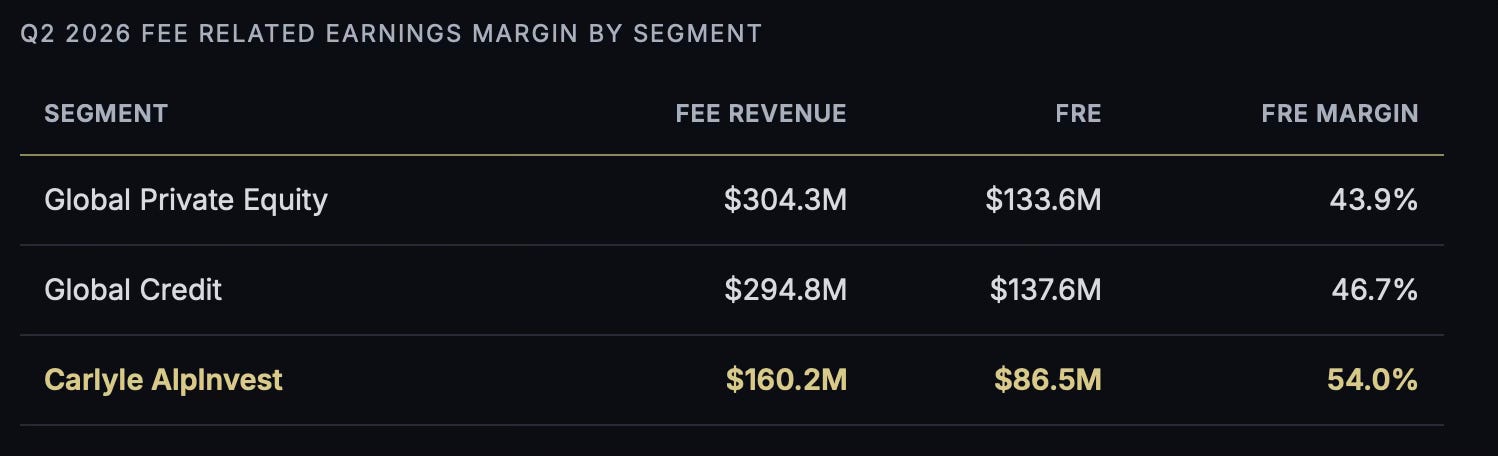
A big part of that margin advantage traces to fee related performance revenues, which more than tripled year-over-year for AlpInvest: from $10.1 million in Q2 2025 to $32.1 million in Q2 2026. On the earnings call, Carlyle’s CFO attributed the jump primarily to demand across the firm’s wealth channel, where year-to-date inflows are running more than 60% ahead of last year, with AlpInvest wealth products singled out as a specific driver alongside the firm’s private equity solution getting picked up on additional distribution platforms.
Carlyle AlpInvest is Carlyle’s dedicated secondaries, co-investment and portfolio finance platform, tracing its lineage back roughly 26 years. It sits alongside Global Private Equity and Global Credit as one of Carlyle’s three reporting segments and is organized into three buckets: Secondaries & Portfolio Finance ($51 billion of AUM), Co-Investments ($24 billion), and Primary & Other ($37 billion). Available capital for the segment stood at $34 billion as of quarter-end, against $78 billion of fair value.
How CEO Harvey Schwartz frames the business now
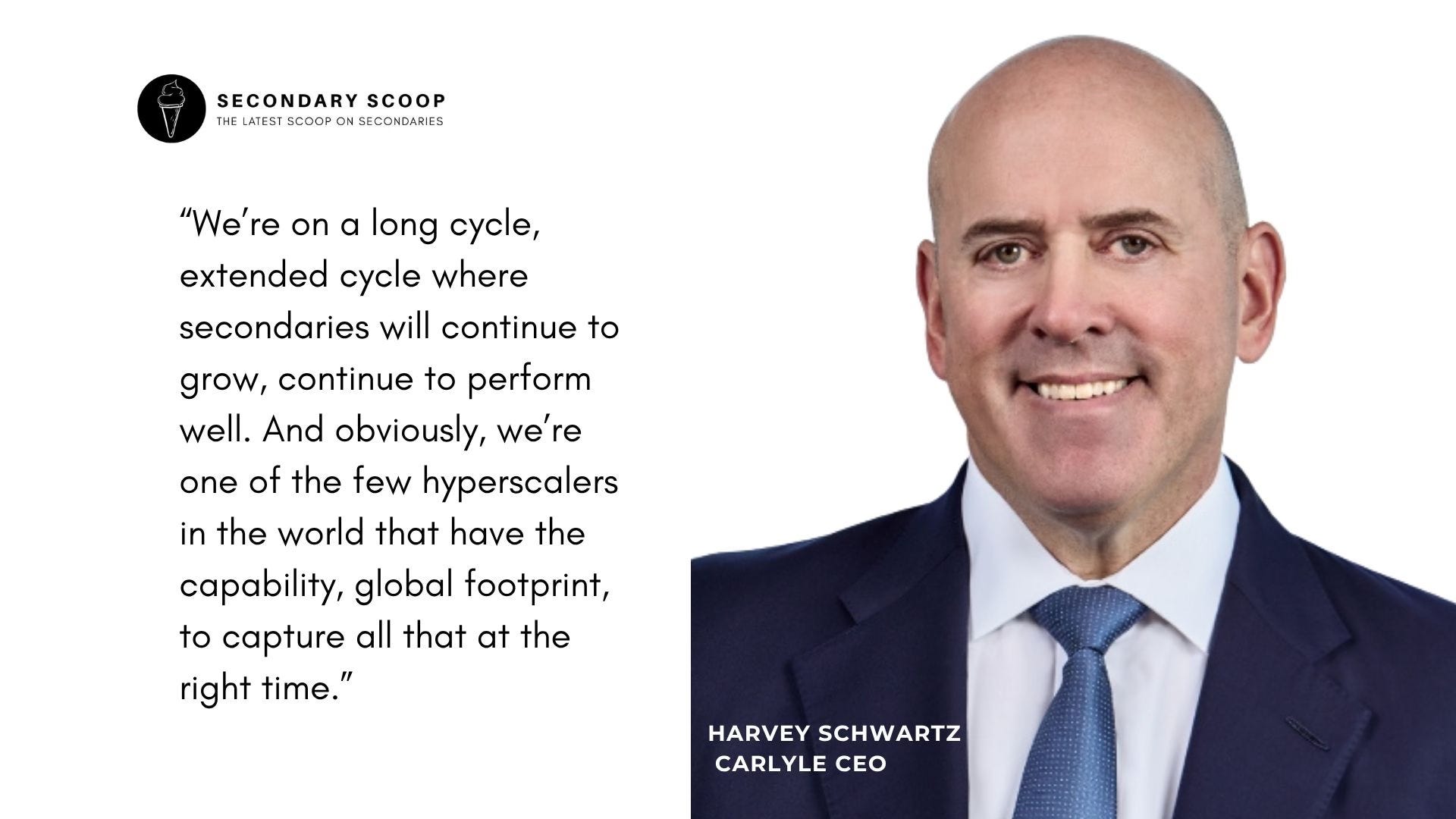
Asked directly on the call whether AlpInvest’s growth was cyclical or secular, CEO Harvey Schwartz argued for both, but leaned into a reframing of the business that’s worth flagging for anyone still describing secondaries platforms primarily as GP-led or LP-led transaction shops.
“We’re on a long cycle, extended cycle where secondaries will continue to grow, continue to perform well. And obviously, we’re one of the few hyperscalers in the world that have the capability, global footprint, to capture all that at the right time.”
— Harvey Schwartz, Carlyle CEO, Q2 2026 earnings call
Schwartz went further, describing a structural shift in how AlpInvest’s conversations with GPs and LPs have changed:
“There’s a secular shift here... which is really about how these businesses are truly now corporate finance solutions providers. If you went back several years, it was really about the secondary business, which was really more point-to-point business in some respects. But now our dialogue around the world with GPs and LPs is really about portfolio repositioning, how to think about the optimized portfolio, how do GPs create value for themselves and grow their businesses.”
— Harvey Schwartz, Carlyle CEO, Q2 2026 earnings call
That “corporate finance solutions” framing is doing real work for Carlyle’s fundraising narrative. It’s the same logic underpinning the buildout of the portfolio finance strategy, which the CFO flagged as a specific highlight: Carlyle’s second vintage single-asset secondaries strategy closed this quarter at four times the size of its predecessor fund, a scaling data point that fits the broader pattern of secondaries LPs concentrating capital in repeat, brand-name managers rather than spreading commitments across a wider field of new entrants.
What the fund-level numbers show
Carlyle’s supplemental disclosures give a rare look at vintage-by-vintage secondaries fund performance. The flagship AlpInvest Secondaries Fund (ASF) series shows the scaling trend directly: ASF VIII, AlpInvest’s current-generation diversified secondaries vehicle, closed at $13.4 billion in committed capital, roughly double the $6.8 billion raised for its 2020-vintage predecessor, ASF VII.
SELECTED ALPINVEST FUND PERFORMANCE, AS OF JUNE 30, 2026
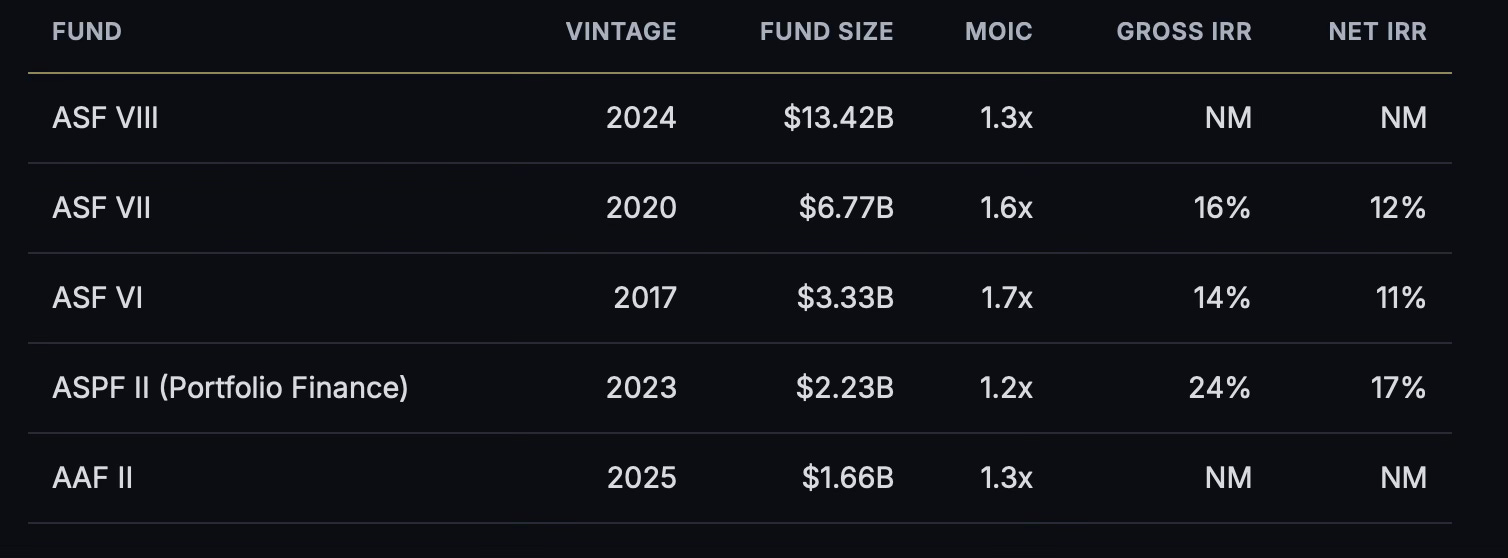
Worth noting: ASPF II, AlpInvest’s Strategic Portfolio Finance vehicle, is posting the highest gross and net IRRs of the group at 24% and 17% respectively, despite being only 70% invested. That’s the fund family most directly tied to the “portfolio finance” strategy Schwartz referenced, NAV-based and preferred-equity-style financing for GP portfolios rather than traditional secondaries purchases, and its early return profile helps explain why Carlyle keeps returning to it in investor commentary.
On realizations, AlpInvest generated $1.6 billion of proceeds in the quarter and $10.7 billion over the trailing twelve months, while deploying $3.2 billion in the quarter against $15.1 billion LTM. Net accrued performance revenues for the segment reached $655 million, up 4% from $627 million a year ago — a comparatively modest increase relative to the FRE growth, consistent with a business increasingly monetized through recurring fee income rather than carry realization timing.