


Straight to the point. During last week’s Carlyle, Q3 2026 earnings call, a Morgan Stanley analyst asked about institutional demand going into Carlyle’s flagship fundraising cycle. CEO Harvey Schwartz didn’t start with buyout or credit. He started with AlpInvest’s side of the house.
“Secondary co-invest solutions business right in the center of a huge amount of institutional interest in activity.”
Harvey Schwartz, CEO, Carlyle, Q3 2026 earnings call
He tied that demand to two things. One was the industry’s exit problem: “the industry has been slow to monetize on the private equity side.” The other was structuring: “being a real solution provider has proved to be a really unique advantage.” He said the momentum “feels quite sticky and persistent right now.” He was much more cautious about private equity fundraising, saying he “wouldn’t say it’s a hockey stick at this stage.”
That fits how Carlyle has talked about AlpInvest all year. In Q1, when AlpInvest posted record inflows of $6.8 billion, Schwartz said it was “much more than” a secondaries business. No analyst asked about AlpInvest’s quarterly numbers on this call.
What the segment reported
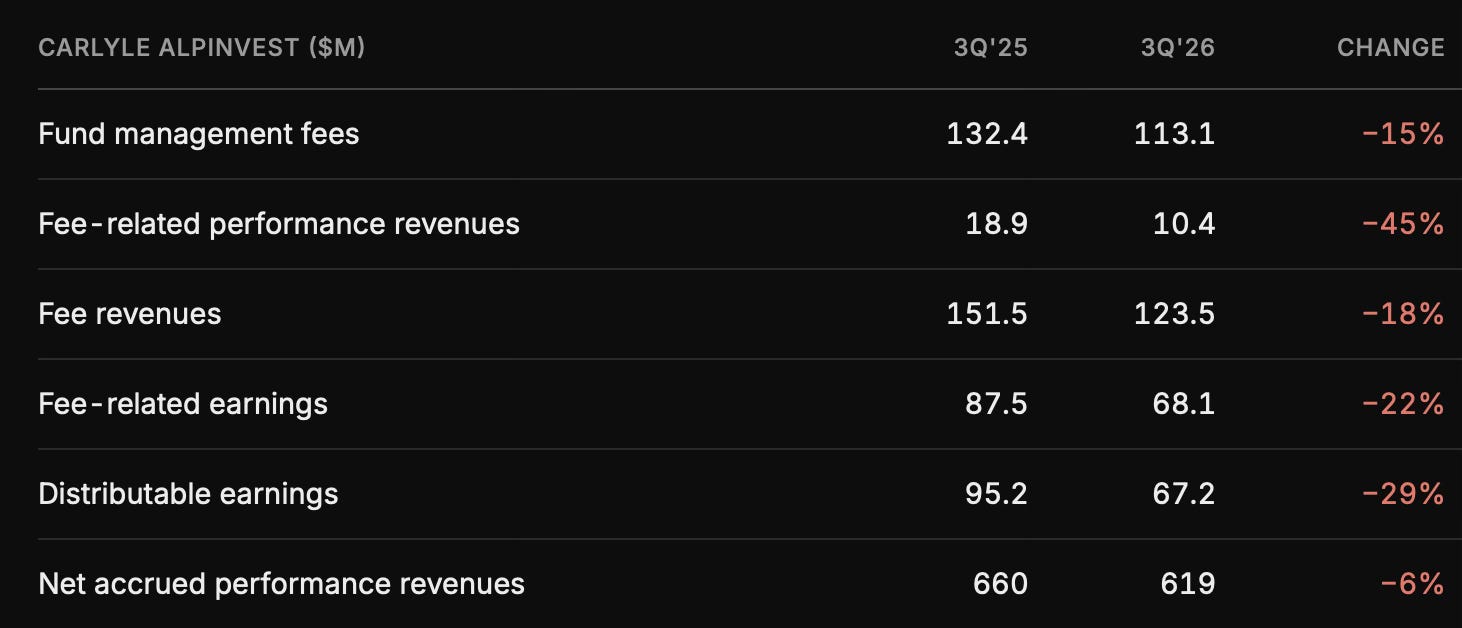
Source: Carlyle Q3 2026 earnings presentation (8-K Ex. 99.2). Percentage changes calculated by Secondary Scoop.
AUM fell 1% in the quarter, to $110.5 billion from $111.7 billion. Inflows were $1.4 billion. Outflows, including realizations, were $3.3 billion. Market gains of $0.9 billion covered only part of the difference. Fee-earning AUM held steady at $69.9 billion, with $1.5 billion in and $2.0 billion out.
The inflow trend matters more than the single quarter. AlpInvest raised $15.2 billion over the last twelve months and $12.7 billion year-to-date. Combined with the $6.8 billion Carlyle reported for Q1, that implies this pattern:

4Q’25 and 2Q’26 derived by Secondary Scoop from Carlyle’s reported LTM ($15.2bn), YTD ($12.7bn) and Q1 ($6.8bn) figures. Inputs are rounded, so derived values are approximate.
Inflows fell in each quarter of 2026: $6.8 billion, then about $4.5 billion, then $1.4 billion. Year-over-year AUM is still up 8% because of the first half. Over the same twelve months, outflows were $11.1 billion and market gains added $5.4 billion.
THE CATCH-UP FEE PROBLEM
The year-ago quarter is a tough comparison. AlpInvest’s 3Q’25 management fees included $31 million of one-off catch-up fees, and this quarter had none. Without them, management fees rose about 12%, from roughly $101 million to $113 million. CFO Justin Plouffe put the adjusted year-to-date increase at 16%, and year-to-date FRE was a record $222 million.
So the 22% drop in FRE overstates the problem. It doesn’t explain the slowdown in inflows, though, and that’s the real story this quarter.
Where the growth is coming from
The weak flagship quarter and the CEO’s optimism are easier to reconcile once you see what AlpInvest now sells. In his prepared remarks, their CFO said AlpInvest had historically raised money mostly through closed-end carry funds and institutional SMAs, but has since added “new evergreen strategies for the wealth channel and new verticals like portfolio finance and credit secondaries.”
Carlyle’s release says Q3 inflows came “primarily in our secondaries & portfolio finance and CAPM funds.” CAPM is AlpInvest’s closed-end tender-offer private markets fund for wealth investors. In the Q&A, UBS’s Michael Brown asked about the wealth channel. Plouffe said Carlyle’s wealth inflows were up 24% over twelve months and wealth AUM was up 30% year-over-year, and added:
“I’d particularly call out our products in Alpinvest, which continue to take in strong inflows.”
Justin Plouffe, CFO, Carlyle, Q3 2026 earnings call
In addition, Schwartz said Carlyle’s wealth flows have so far come almost entirely from perpetual products: “it’s really been all driven by Evergreen, which has been our focus.” Wealth-channel drawdown funds, he said, are a 2027–2028 story.
The year-to-date numbers show the same shift. AlpInvest’s fee-related performance revenues are $53.7 million, up 35% from $39.7 million, even though the third quarter was down. Carlyle attributes its record firm-wide fee-related performance revenues to “record AUM in our global wealth platform.” The segment’s growth is moving away from the flagship fund cycle and toward evergreen and newer products. That doesn’t change the quarterly totals: one $1.4 billion quarter didn’t cover what went out.
Between flagships
Most of the gap comes from fund timing. AlpInvest’s last secondaries flagship, ASF VIII (2024 vintage, $13.4 billion), has invested $8.0 billion, about 60% of the fund. At 1.3x total value, $0.7 billion has been realized, and Carlyle still reports the IRR as not meaningful. The segment has $32 billion of available capital, a third of the firm’s $94 billion. It deployed $2.4 billion in Q3, more than it raised.
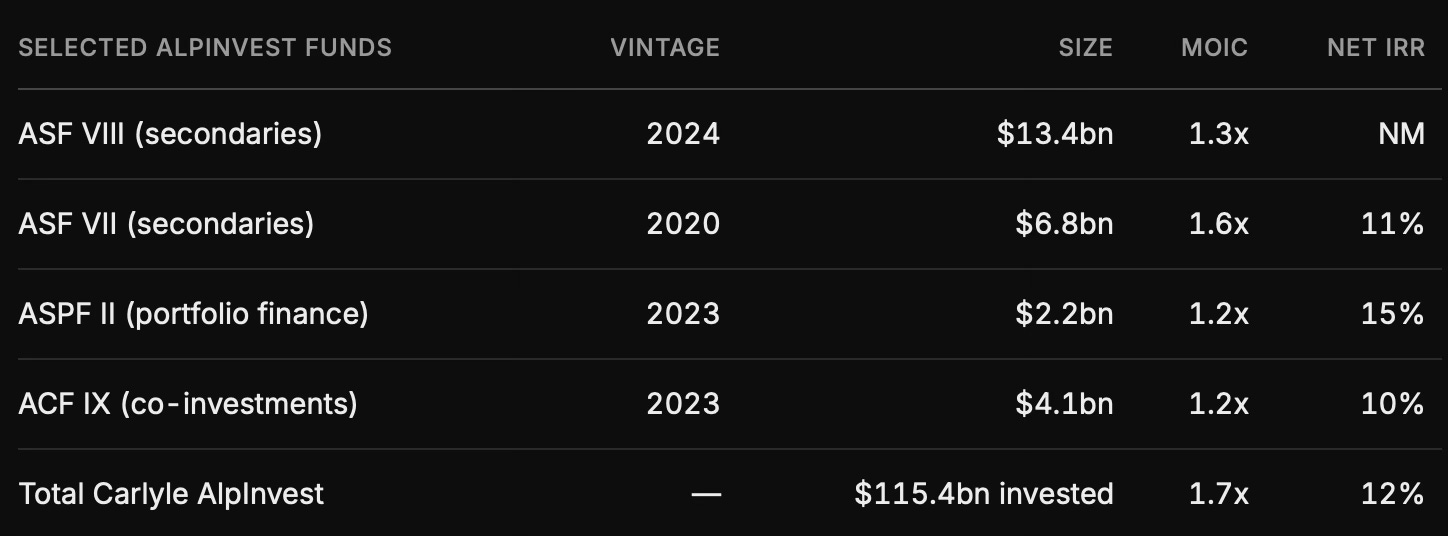
Source: Carlyle Q3 2026 earnings presentation, AlpInvest fund performance table, as of September 30, 2026. Net IRR shown as reported; “NM” = not meaningful per Carlyle.
A flagship that is 60% invested and not yet raising its successor produces quarters like this one. Fee-paying capital stays flat while distributions leave. If Carlyle follows its usual pattern, the next ASF close will show up as a large inflow quarter and erase the dip. Carlyle has not said when the next ASF fundraise starts. Plouffe’s guidance of at least $20 billion of Q4 inflows, including the $5 billion Unum reinsurance deal, is firm-wide and not broken out by segment.
Still buying
A slower quarter for raising money is not a slower quarter for doing deals, and AlpInvest’s recent activity shows it. In late October, Oakley Capital Investments agreed to sell AlpInvest interests in five Oakley funds at 94.25% of NAV. AlpInvest is also taking on about £244 million of unfunded commitments. Trade press reported the same week that AlpInvest and HarbourVest, both existing LPs, are leading Nautic Partners’ roughly $3 billion continuation vehicle. AlpInvest has also done three collateralized fund obligations, the most recent at $1.25 billion.
That mix of LP portfolio purchases, LP-led continuation vehicles and structured liquidity is what Schwartz means by a “solution provider.” It is also why his comment and the segment’s quarter don’t contradict each other. Demand for AlpInvest’s services can be strong while new capital comes in slowly, especially while the flagship is between raises and the evergreen products are still small next to a $110 billion business.