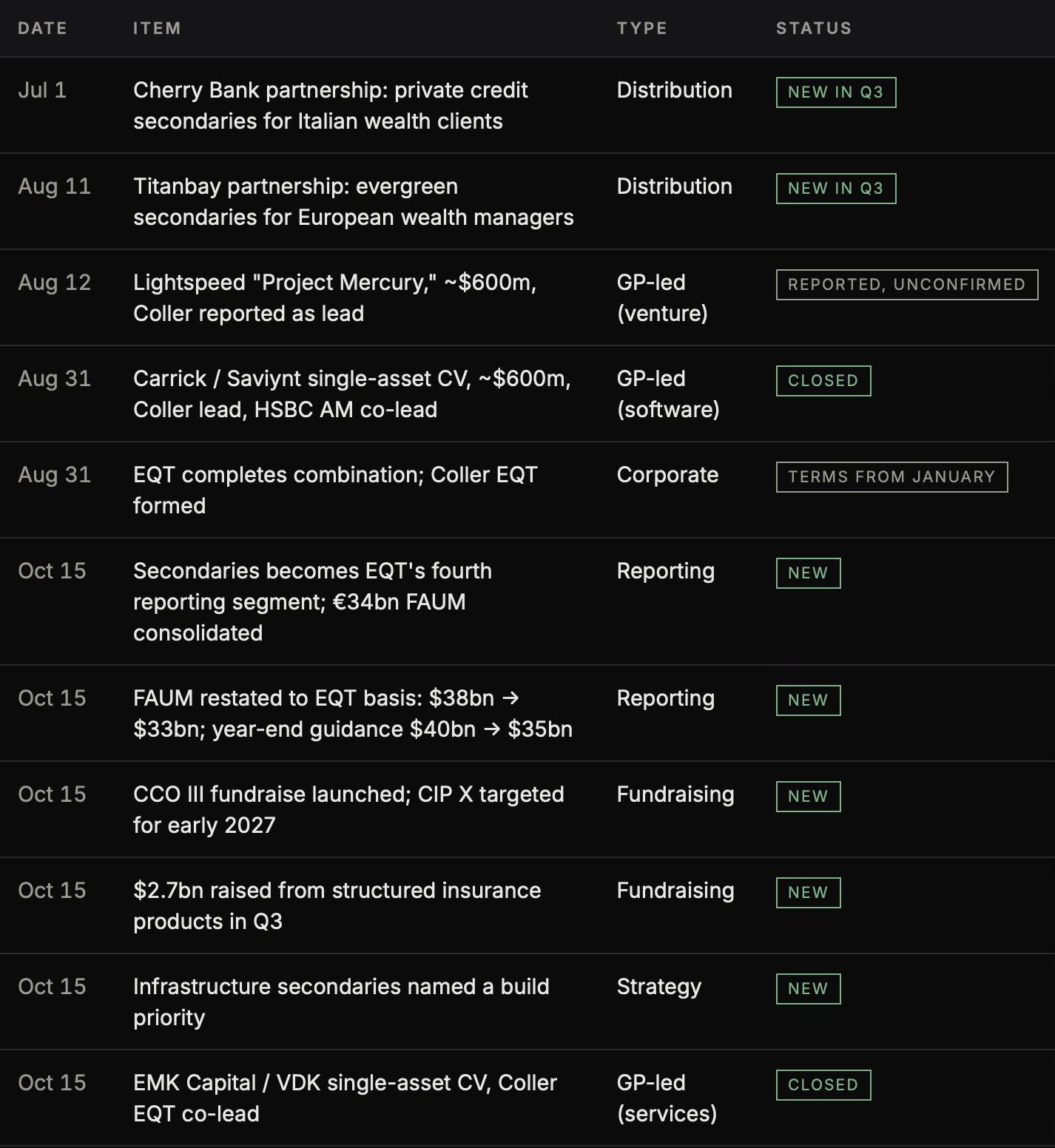
EQT's Q3 report is the first set of numbers with Coller inside. It adds a fee-reporting restatement, a new credit secondaries fundraise, an insurance figure that stands out against the rest of EQT, and a stated plan to build infrastructure secondaries. Here is everything Coller EQT announced or closed between July and mid-October.
The close, briefly
The terms were set in January and confirmed at closing on August 31, so we only recap them here. EQT paid a $3.2bn base consideration, mostly in about 80.4 million EQT shares, with up to $500m of cash earn-out tied to Coller’s performance through March 2029. EQT also took 10% of the carry in Coller International Partners IX (CIP IX) and the right to invest in 35% of the carry in future closed-end Coller funds. Jeremy Coller stays on as Head and CIO of the renamed Coller EQT and joins EQT’s Executive Committee. EQT has committed to doubling Coller’s FAUM within four years.
What’s new is how the business now looks inside EQT’s accounts. Yesterday, EQT reported Secondaries as a fourth operating segment next to Private Capital, Infrastructure and Real Estate. Coller brought 323 FTEs and €34bn of fee-paying AUM into the group. Of EQT’s €10.9bn of net inflows to key funds in the quarter, €10.3bn came from adding Coller. Of the €24.4bn of net inflows to other strategies, €19.0bn did.
The restatement: same fees, smaller base
The most technical disclosure may be the one LPs and analysts ask about most. Coller EQT ended Q3 with $38bn of fee-paying AUM on its own methodology. On EQT’s methodology the figure is $33bn. From Q4, Coller EQT will report on EQT’s basis, and the year-end FAUM guidance for the segment drops from $40bn to $35bn.
WHY THE NUMBER MOVES
Many closed-end funds lower fees after the investment period in one of two ways. They keep the same fee rate but charge it on a smaller base, such as invested capital instead of commitments. Or they keep the same base and charge a lower rate.
Coller’s funds use the second method. EQT’s funds use the first. To put both on one basis, EQT will reflect Coller’s rate step-downs as a smaller capital base. Management fees don’t change, so the reported average fee rate rises by the same proportion. EQT says the change “does not impact fund economics or outlook.” It also notes a one-time effect on some of its own older Life Sciences funds, which stepped down rates the same way.
The fund pipeline
CIP IX, Coller’s latest private equity secondaries flagship, now counts as one of EQT’s key funds. EQT says it is “performing on plan” and was 75–80% invested as of October 15. On the call, management put it at about $10bn of fee-generating commitments. Coller EQT is preparing to launch CIP X early next year.
On credit, Coller EQT has launched fundraising for CCO III, the third vintage of its credit secondaries series. The fund charges fees on invested capital and has not been activated yet, so it adds nothing to fee-paying AUM for now.
This matters because credit secondaries are EQT’s only route back into credit. EQT sold its credit business in 2020. Asked whether it now needs a primary lending platform, CEO Per Franzén said no.
“Given the growth opportunity that we see ahead also in the insurance segment, we don’t see a need for us to add a primary credit platform in order to be able to capture that opportunity.”, Per Franzén, CEO, EQT · Q3 2026 webcast, October 15
Insurance is where Coller looks least like the rest of EQT
In Q3, Coller EQT raised $2.7bn for its funds and vehicles through structured insurance products. On the call, management said insurers account for close to 25% of Coller EQT’s client commitments, compared with less than 10% for EQT overall, and that Coller has raised almost $9bn from insurance since 2024. EQT framed the opportunity as products that mix both sides of its platform.
“This is a core growth area for Coller EQT going forward, but also for EQT as a whole, given the possibility to create combined primary and secondary insurance solutions.”, EQT management · Q3 2026 webcast, October 15
A new leg: infrastructure secondaries
This is the one strategic signal from the quarter that hadn’t appeared in any earlier EQT or Coller release. Coller’s nine strategies span private equity and credit secondaries. Infrastructure secondaries were not among them. Asked by Morgan Stanley about expansion into secondaries within infrastructure, EQT said it intends to build one.
“On the infra secondaries, this is a key opportunity for us. We’re fully focused on building this leg of the business. … First of all, we need to have the right people in order to run this. And that’s priority number one.”, EQT management · Q3 2026 webcast, October 15
EQT gave no timeline beyond noting it was “about 45 days in from the closing.” It will be entering a segment that has started to fill up. StepStone closed a $1.7bn infrastructure secondaries fund in August, and Hamilton Lane is in market with its third.
Distribution: two wealth deals before the close
Coller signed two European wealth partnerships in the quarter, both before it formally became part of EQT.
On July 1, it partnered with Italy’s Cherry Bank to offer its private credit secondaries strategies to the bank’s wealth clients. Boris Maeder, head of international private wealth distribution, called credit secondaries “a market segment that we believe remains under allocated for many investors.”
On August 11, it partnered with Titanbay to put Coller’s evergreen secondaries funds on Titanbay’s platform for European wealth managers. Titanbay’s TradeEngine handles subscriptions, redemptions and allocations. Titanbay co-CEO Michael Gruener: “Distributing an evergreen fund into the wealth channel is one of the hardest operational problems in private markets.”
Deal flow: venture, software and European services
Coller led or co-led three GP-led deals that became public during the period:
Lightspeed “Project Mercury” (reported August 12). Bloomberg reported that Coller is lead buyer on a roughly $600m continuation process. The vehicle would move Lightspeed’s stakes in OpenAI, Verkada, Rippling, Reflection AI and Glean out of Select V, Opportunity II and a separately managed account, and add new primary capital for Anthropic. UBS is advising. Neither firm commented, and we have not seen a close announced.
Carrick Capital / Saviynt (August 31). A roughly $600m single-asset continuation vehicle for the identity-security company, with Coller as lead and HSBC Asset Management as co-lead. Existing LPs could roll or sell at 11x gross (10x net) on Carrick’s original investment. Carrick committed $255m of new capital as part of Saviynt’s $700m Series B at about a $3bn valuation.
EMK Capital / VDK (October 15, just after quarter-end). Coller EQT co-led a single-asset CV for VDK, a European technical installation services group of more than 150 businesses. Size was not disclosed. It is the first deal announced under the Coller EQT name. Partner Martin Fleischer said the deal shows “the role the secondaries market can play” in backing platforms through their next phase.
Q3 at a glance