Continuation vehicles, GP stakes and NAV-based structures have all quietly gone from "exception" to "normal" in the space of a few years, and normal enough that a panel spanning a law firm, an investment bank, an asset manager and a pension fund could sit down at IPEM Global's Secondaries Summit in Paris and treat "who actually pays for all this liquidity" as a settled, discussable question rather than a provocation. Moderated by Brian Digney of the Standards Board for Alternative Investments (SBAI), the panel brought together Sabina Comis, Global Managing Partner at Dechert LLP; Paul Henriot, Managing Director at HSBC Global Asset Management; Jerome Marie, Senior Managing Director at ODDO BHF; and Pravi Prakash, Investment Manager at RPMI Railpen.
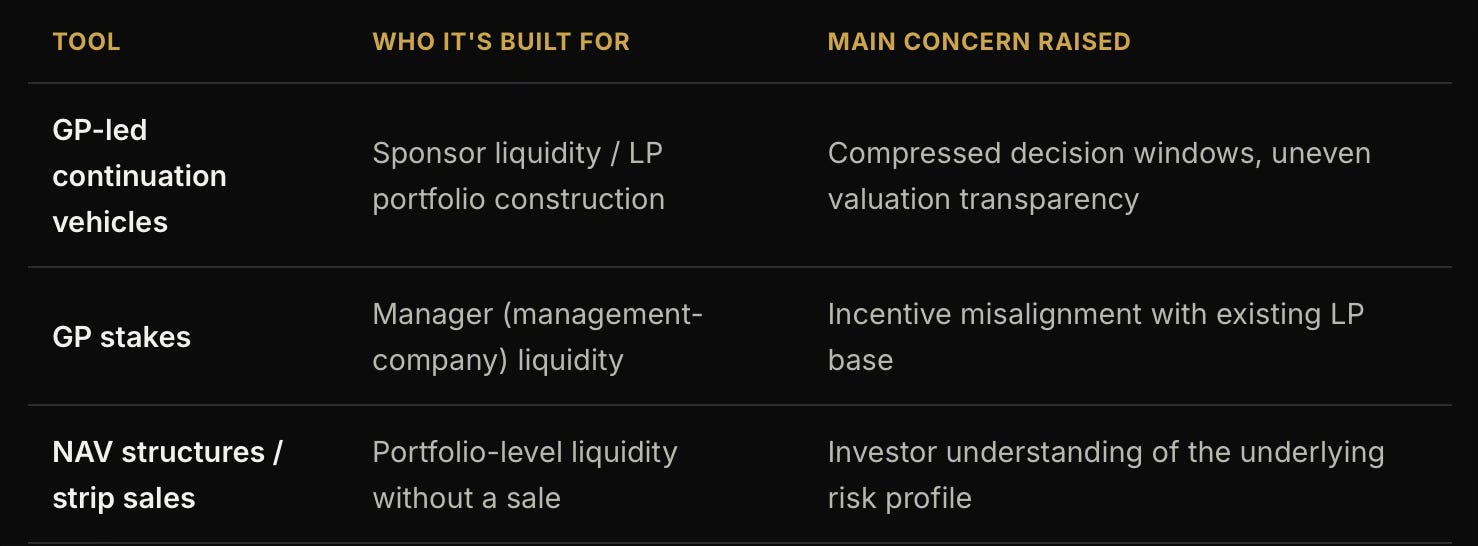
The premise of the session was refreshingly unglamorous: three liquidity tools: GP-led continuation vehicles, GP stakes, and NAV-based structures such as strip sales, have all migrated from niche to normal in a short span of years, and the panel’s job was to be candid about who actually bears the cost of that normalization. The framing point, made early, was structural: none of these tools create new equity. They transfer risk between a seller who wants liquidity and certainty, and a buyer who absorbs that risk in exchange for a claim on future upside, a distinction the discussion returned to repeatedly when weighing whether a given structure serves the LP, the GP, or mostly the intermediaries designing it.

Continuation vehicles: no longer the exception, still not standardized
Before getting to what’s wrong with how CVs are run, the panel was clear about why they exist at all. The core rationale, as laid out in the room, is a mismatch between an asset’s ideal hold period and a fund’s fixed lifespan: a genuinely strong, “trophy” asset can still be compounding value well past the point a traditional fund structure requires it to be sold. A continuation vehicle is what lets stakeholders: the GP, the existing LP base, and the incoming CV investor, separate the fund’s contractual duration from the asset’s own optimal duration, and it’s that shared understanding of the benefit of a longer hold for the right asset that the panel described as the real justification for the structure, not simply a liquidity release valve.
Part of the discussion made the case that continuation vehicles have become a genuine portfolio-construction tool rather than a purely defensive one, underwritten by some investors as incoming capital with the same rigor applied to primary due diligence, treating each CV as an investment decision in its own right rather than a binary roll-or-cash-out choice forced on them by a GP.
That said, the process complaints raised were pointed and specific. Investors are typically given roughly 20 business days to decide whether to roll or liquidate, a window widely regarded as too short given the complexity of the decision, with valuation information that isn’t always transparent, evidenced, or delivered with enough lead time to properly assess. Some processes were described as “really controversial,” alongside others that were well run, with the broader point being that the industry still lacks a complete standard for how a GP should run a CV process, even as informal guidance (through bodies like ILPA) has started to fill the gap.
Transparency and education were treated as two sides of the same problem. On transparency, the ask was specifically about valuation: LPs need pricing information that is evidenced and delivered early enough to actually underwrite a roll decision, not simply presented as a fait accompli alongside the fairness opinion. On education, the panel’s read was more optimistic, LPs, in aggregate, are becoming noticeably more sophisticated about these structures than they were even a few years ago, increasingly organizing collectively (through LPACs, for instance) to push back on unfavorable terms, and working alongside guidance bodies to make the overall process more LP-friendly. Neither transparency nor education was described as solved; both were described as visibly improving.
“The 20 days is not the right deadline for... continuation vehicles. It needs to be negotiated, [it needs] equal footing, and maybe the market should move.”
WHAT “BEST PRACTICE” MEANS HERE, PER THE PANEL
The discussion converged on a short list: engage LPs before a CV is brought to market rather than only once terms are set; deliver fairness opinions before pricing is agreed, not after; provide clear documentation of how the sale process was run; and give LPs access to the data room when they want to evaluate rolling. None of this is currently mandatory, it was described as good practice some sponsors already follow, not an enforced standard.
GP stakes: a liquidity tool for the manager, not the LP
The panel then turned to GP stakes, minority investments in the management companies behind private funds, discussed as a liquidity tool worth including alongside continuation vehicles even though it operates at a different level of the structure entirely. The consensus was that LPs generally don’t object to GPs bringing in a new capital partner at the management-company level. The concern raised was about incentives: a new stakeholder brings its own priorities, which may or may not align with what existing LPs want from the GP, pushing, for example, toward aggressive AUM growth rather than continued stewardship of existing assets, or redirecting a GP’s attention toward a new strategic partner’s agenda. The ask was for guardrails ensuring GP-stakes transactions don’t disadvantage either the existing LP base or the incoming stakeholder, rather than opposition to the structure itself.
NAV structures, strip sales, and the next frontier
Strip sales and other NAV-based structures got the least airtime of the three tools, discussed mainly as an extension of the same risk-transfer logic, a seller carving off a slice of a portfolio’s future cash flows for upfront liquidity while a buyer takes on the associated risk, structurally adjacent to the preferred-equity solutions other summit panels covered in more depth. The closing remarks pointed to collateralized fund obligations (CFOs) as the genuine “next frontier”, a securitization-based liquidity tool expected to become increasingly relevant, particularly for the European market, with a caution that it can be an efficient capital tool without yet being widely understood by the investors buying into it.