


We just got a PitchBook note on private equity’s “zombie problem,” landing on a number that’s hard to unsee: 2,536 US portfolio companies have now blown past the traditional five-to-seven-year exit window, and GPs are sitting on more than $860 billion of buyout NAV inside funds older than seven years.
Buried in the report is a line that tends to get quoted out of context: “The rise of GP-led secondaries is not coincidental; it maps almost directly onto the period when exit markets seized up and aging assets began to accumulate.” Read on its own, that sentence is an easy indictment: continuation vehicle growth as proof of a zombie problem, full stop. But that’s not actually what PitchBook argues. The report draws a specific, testable line (and two market reports published within days of it, Jefferies’ H1 2026 Global Secondary Market Review and Campbell Lutyens’ H1 2026 Secondary Market Flash Report), hand us the pricing data to check it.
The Test PitchBook Actually Proposes
Here’s the distinction, in the report’s own words: “When a GP rolls an asset into a CV at or above its prior carrying value, and sophisticated secondary buyers that conduct real diligence and are under no obligation to participate agree to that pricing, it is a credible signal that the asset has genuine merit and the sponsor has conviction. Single-asset CVs built around high-quality businesses with growing earnings, reduced leverage, and active acquisition histories are a legitimate tool for capturing additional value.”
The concern PitchBook actually raises is narrower than “CVs are bad.” It has two specific triggers: multi-asset vehicles where stronger assets can obscure weaker ones inside a blended basket, and pricing that clears below the GP’s prior carrying value, what the report calls “a quiet but telling acknowledgment that the mark was optimistic.”
Concern arises when CVs are used to avoid the discipline of the open market -especially in multi-asset vehicles where stronger assets can obscure weaker ones- or when pricing falls below the GP’s prior carrying value.
PitchBook, “Private Equity’s Zombie Problem,” Aug. 17, 2026
The Market Is Already Running This Test
Campbell Lutyens’ H1 2026 flash report is, in effect, a live scorecard for exactly the distinction PitchBook draws. Single-asset CVs (SACVs) and multi-asset CVs (MACVs) are diverging sharply on price, and the direction of travel is telling.
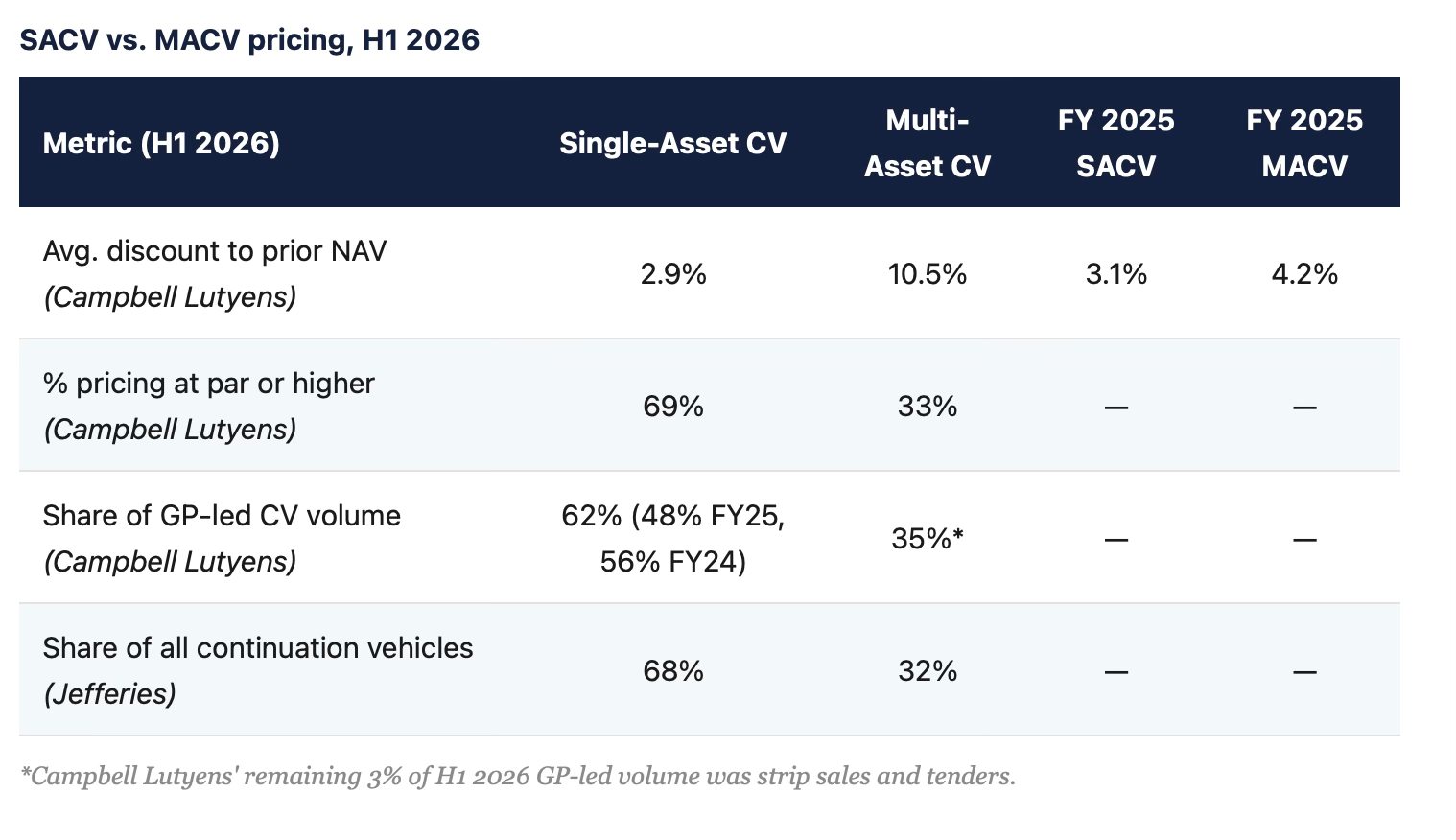
SACV discounts actually tightened slightly, from 3.1% at year-end 2025 to 2.9% in H1 2026, with 69% of all single-asset deals clearing at par or better. MACV discounts, meanwhile, moved from 4.2% to 10.5%, more than double, in two quarters, and only a third of them priced at par or higher. Campbell Lutyens’ own read is nearly identical to PitchBook’s: “While pricing remains strong for SACVs, discounts widen materially for MACVs as investors differentiate between high-quality and mixed-quality portfolios.”
SACV discounts tightened to 2.9% amid strong demand for high-conviction assets. While pricing remains strong for SACVs, discounts widen materially for MACVs as investors differentiate between high-quality and mixed-quality portfolios.
Campbell Lutyens, 1H 2026 Secondary Market Flash Report
That’s not a market being fooled by camouflage. It’s the opposite: buyers pricing the basket risk PitchBook warned about, in real time, and charging for it.
Sponsors Are Self-Selecting, Too
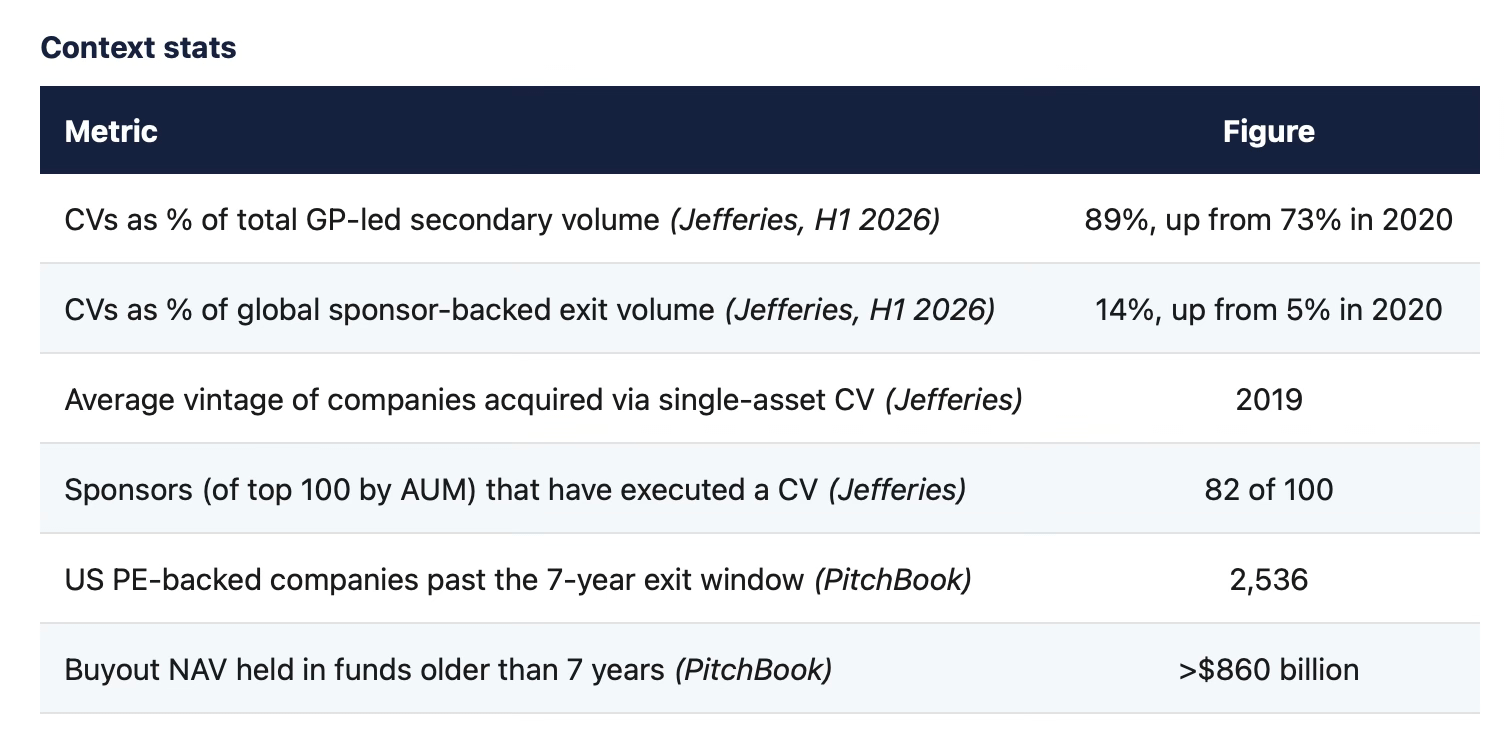
Jefferies’ H1 2026 review adds a second layer to the picture. Continuation vehicles now account for 89% of all GP-led secondary volume, up from 73% in 2020, and 14% of total sponsor-backed exit volume globally, up from just 5% in 2020, CVs have gone from a niche liquidity tool to a mainstream exit channel, with 82 of the top 100 sponsors by AUM having now executed one. Single-asset structures make up 68% of that CV volume.
The detail that matters most for the zombie debate: the average vintage of companies moved into a single-asset CV is 2019, seven years old, squarely inside PitchBook’s own “acute concern” zone for holding periods. Sponsors aren’t avoiding their oldest assets when structuring single-asset deals; they’re leading with them, because those are the assets they’re confident will clear real diligence from a buyer with no obligation to say yes.
Where the Opportunity Sits for Secondary Buyers
PitchBook is unusually direct about who benefits from this dynamic, and it isn’t only distressed or special-situations buyers. “Secondary buyers can deploy capital into CVs or LP portfolio sales at improved pricing,” the report notes and “these same secondary buyers (the sophisticated investors who set CV pricing through arm’s-length negotiation and independent diligence) are among the most direct beneficiaries of the zombie dynamic, as their pricing leverage increases precisely when sponsors are most motivated to transact and least able to demand full value.”
The H1 2026 data shows two distinct ways that leverage is being monetized. On the single-asset side, capacity is the constraint, not opportunity: Jefferies reports that nearly 15% of secondary investors can now write checks above $250 million into SACVs, up from 11% in 2025, and a growing subset can commit more than $500 million; buyers with that scale are positioned to win high-conviction, well-underwritten stakes in genuinely strong assets at fair, defensible prices. On the multi-asset side, the opportunity runs the other way: buyers with the diligence bandwidth to price each underlying asset individually, rather than trade the headline discount, are the ones capturing the spread between a MACV’s blended ask and what the weak assets inside it are actually worth.