


Eurazeo occupies an interesting position in the European private markets landscape: a genuine middle-tier player, sitting well below the continent’s giants but punching above its weight in one specific corner of the business. Earlier this year, Eurazeo was among the five firms shortlisted for the European Commission’s €5 billion Scaleup Europe Fund, the largest dedicated tech-scaleup vehicle ever assembled in Europe, alongside EQT, Atomico, Northzone, and Vitruvian Partners, with EQT winning in May 2026.
But scale isn’t the whole story, and it’s not why we’re spending this much time on Eurazeo. It’s the secondaries franchise sitting inside that mid-tier platform, which is genuinely differentiated and, we think, underappreciated relative to what it’s actually doing. That’s the thread this piece follows.
On July 6, 2026, Eurazeo announced the final close of its fifth-generation private equity secondaries programme at €2.3 billion, comfortably clearing its initial €2 billion target and marking a 130% jump over Secondaries IV, which closed at €1 billion back in 2021.
That gap, a firm that lost the continent’s highest-profile fund mandate of the year, but is quietly running one of Europe’s longest-standing and fastest-scaling secondaries franchises, is exactly why we’re dedicating this coverage to Eurazeo’s overall secondaries strategy specifically.
It’s a listed, diversified European investment group spanning private equity, private debt, and real assets, with secondaries sitting as one line inside. It’s “Secondaries & Mandates” business now represents 17% of the Group’s total assets under management, has been operating continuously since 2003, and just posted one of the sharpest single-vintage jumps of any secondaries programme tracked in this newsletter this year.
The close, in the founders’ own words
Eurazeo’s press release names two on-record spokespeople from the Secondaries & Mandates team. Christophe Simon, Managing Partner, framed the raise as validation of a specific market position:
“The closing of our fifth secondaries programme at €2.3 billion marks an important milestone for Eurazeo and a significant step forward in the development of our secondaries platform. The strong increase in commitments reflects the growing recognition of our strategy in the market and the relevance of our differentiated positioning.”
CHRISTOPHE SIMON, MANAGING PARTNER, SECONDARIES & MANDATES, EURAZEO PRESS RELEASE, 6 JULY 2026
Amine Rais, Partner on the same team, was more specific about deployment pace and market conditions:
“The secondary market remains deep and highly dynamic, with attractive opportunities continuing to emerge across Europe. Our disciplined focus on European buyout assets allows us to access resilient, high-quality transactions in a segment where we have long-standing expertise. Against a volatile market backdrop, we are seeing a record level of opportunities, and ESF V is already well into its deployment phase, with approximately 50% invested to date across 22 secondary transactions.”
AMINE RAIS, PARTNER, SECONDARIES & MANDATES, EURAZEO PRESS RELEASE, 6 JULY 2026
That deployment pace is worth sitting with: a fund that closed on July 6 was already roughly half-invested across 22 transactions by the announcement date, meaning the bulk of that capital had gone to work well before the formal close, consistent with what several reports tracked in this newsletter this year describe as evergreen-style deployment cadence blurring into what used to be sequential fundraise-then-invest cycles.
Fund performance: ESF IV vs. ESF V

*Fund size shown reflects Eurazeo's H1 2026 selected-funds-performance disclosure (€1,037m), which differs from the €2.3bn total aggregate commitments figure cited in the July close announcement — the latter includes ESF V plus associated co-investment and mandate vehicles. Both figures are Eurazeo's own; the difference is scope, not a discrepancy. Gross IRR/MOIC/DPI figures are early-stage given ESF V's ~49-50% deployment as of mid-2026.
ESF IV, the 2021 vintage, is fully committed at 109% invested and already showing a 0.4x DPI, real distributions, not just paper markups. ESF V is still in the growth phase of its J-curve, which is exactly what you’d expect roughly a year into deployment. The more useful read here isn’t the early-vintage numbers themselves but the scaling pattern: Eurazeo has now taken its flagship secondaries vehicle from €1.0bn (Secondaries IV) to €2.3bn in aggregate commitments (ESF V and associated vehicles) in a single vintage cycle, a steeper jump than the firm’s own direct lending platform posted over the same period (EPD VI’s €3.2bn to EPD VII’s €5.5bn, +70%), and one of the larger vintage-over-vintage increases logged in this newsletter’s tracking of secondaries fundraises this year.
WHAT “SECONDARIES & MANDATES” ACTUALLY COVERS
Eurazeo’s Secondaries & Mandates line invests across both GP-led secondary opportunities(continuation vehicles, fund restructurings) and traditional LP secondaries (buying LP fund interests directly), with a stated focus on European mid-market buyout assets. The July close release frames this as “long-standing expertise” dating to 2003, making Eurazeo’s secondaries franchise older than several of the GP-led-focused platforms that have dominated 2026 coverage, including Coller Capital’s newer credit-secondaries push and most of the European VC-secondaries entrants covered elsewhere in this newsletter’s research.
A small distinction worth getting right
Eurazeo’s H1 2026 results slides also disclose a small legacy line item, confusingly also labeled “Secondaries,” sitting inside the firm’s balance-sheet Buyout portfolio: three investments, €0.1bn in NAV, down 10% in value creation for H1 2026. This is not the same thing as the ESF fund management business. It appears to be a handful of older direct-holding positions carried on Eurazeo’s own balance sheet rather than in a third-party-managed fund, the kind of legacy classification quirk this newsletter has flagged before with other multi-strategy managers (see: 50 South Capital AUM vs. Northern Trust’s total Alternatives Services AUA). Any headline figure citing Eurazeo’s “secondaries” performance should specify which of the two lines it refers to.
The retailization angle: E.P.S.O. joins the evergreen wave
Eurazeo’s H1 2026 fundraising pipeline slide names a new “Eurazeo Prime” evergreen product line built for international wealth-management distribution, structured under SFDR Article 9. Two vehicles sit inside it: E.P.I.C. for private credit, and E.P.S.O. for secondaries, both currently at first-close stage. This sits alongside Eurazeo’s existing flagship evergreen private equity vehicle, EPVE 3, which has surpassed €3.7 billion in AUM with what management describes as “limited redemptions, in line with historical average.”
The pattern tracks directly with what this newsletter has already documented at Partners Group (four-vertical secondaries platform including a 2025 private-credit-secondaries evergreen JV with Generali) and Capital Dynamics (a mid-market secondaries specialist now building out private-wealth distribution alongside its institutional GSEC series). Eurazeo joining that list with E.P.S.O. confirms secondaries-specific evergreen wrappers are becoming standard infrastructure for any manager with a large enough secondaries franchise to retail, not a one-off innovation at any single platform.
The ESG angle: A rare look at GP-Led diligence mechanics
This newsletter’s own research earlier this year found that ESG has largely disappeared as a standalone category in the major secondaries market barometers, Coller’s own 44th-edition Global Private Capital Barometer, for instance, dedicates a full section to liquidity and zombie funds but doesn’t mention ESG at all. The working thesis from that research was that ESG hadn’t gone away so much as gone underground: less marketing language, more embedded mechanics inside actual deal diligence.
Eurazeo’s newly overhauled Responsible Investment Policy (V5, July 2026) is a useful primary-source confirmation of exactly that. It explicitly carves out “Secondaries & Mandates” as a distinct diligence track, separate from the firm’s direct-ownership strategies, with several specific mechanics:
A different exclusions test. Eurazeo’s standard exclusion policy uses a 20%-of-revenue materiality threshold for restricted sectors. For secondary transactions specifically, that threshold is instead “assessed by transparency”, a look-through basis appropriate to a fund-of-funds structure where Eurazeo doesn’t control the underlying companies directly.
Exempted from the standard ESG playbook. The policy’s 20-point “O+ Essentials” framework, the operational sustainability checklist applied to majority-controlled portfolio companies, explicitly does not apply to Secondaries & Mandates, reflecting the reality that a fund-of-funds investor has far less operational control than a direct owner.
A distinct, lighter-touch diligence methodology. Sustainability due diligence for secondaries transactions draws on fund manager documents, DD-phase questionnaires to fund managers, and third-party sector research, rather than the in-depth operational assessments (including external HSE experts, in some cases) used for direct Buyout and Real Assets deals.
Mandatory GP-led side-letter language. For every GP-led transaction Eurazeo completes, the policy requires sustainability clauses in the legal documentation, covering exclusion-policy compliance, sustainability criteria in the GP’s ongoing selection and monitoring process, incident notification obligations, and annual sustainability reporting. The policy states this in mandatory terms: it is “a prerequisite for the completion of the GP-led transaction.”
Why this matters for the broader thread: most ESG-and-secondaries commentary available publicly comes from law firms and advisors writing in general terms (Ropes & Gray, Malk Partners, Petra Funds Group). Eurazeo’s policy is a rare instance of a GP itself publishing the specific mechanics, down to the exclusions-testing methodology, for how ESG actually gets applied inside its own GP-led secondaries transactions.
Where Eurazeo sits on the Specialist-to-Platform spectrum
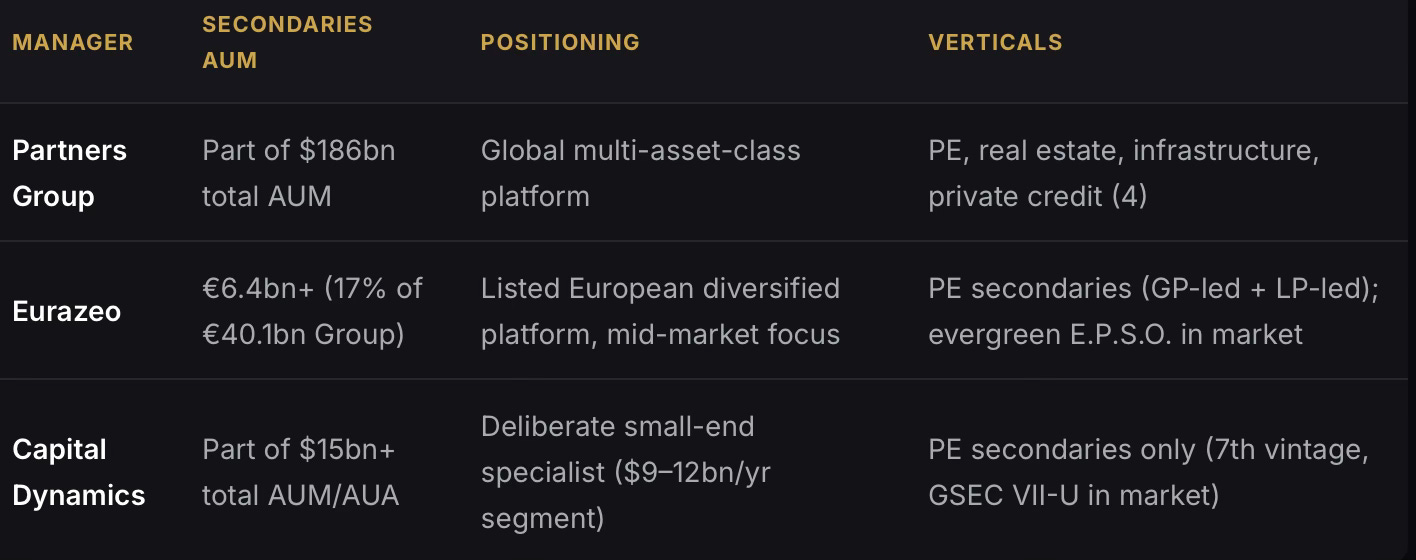
AUM figures as most recently disclosed by each firm; not all figures are directly comparable given differing reporting conventions and dates (see this newsletter’s ongoing coverage of market-sizing methodology divergence across secondaries reports).
Eurazeo lands in an interesting middle position on this spectrum. It’s not chasing scale the way Partners Group’s four-vertical build does, nor is it explicitly positioning against the mega-deal market the way Capital Dynamics does; but its 2003 start date, its European mid-market focus, and its now-€6.4bn+ AUM put it closer to a genuine platform than most coverage credits it for. The Christophe Simon quote’s reference to “differentiated positioning” reads, in context, like an implicit nod to exactly this kind of category confusion: Eurazeo isn’t trying to be Coller or Ardian, and the market hasn’t quite worked out where to file it instead.
Some background: A French platform with a two-decade-plus secondaries track record
Eurazeo’s own corporate history predates its private equity identity by well over a century. The firm traces its lineage to two French entities: Eurafrance, an investment holding company founded in 1969, and Gaz et Eaux, a 19th-century water-and-gas utility (founded 1881) that gradually converted into a pure investment vehicle before being renamed Azeo in 1999. The two merged in April 2001 to form Eurazeo, under founding CEO Patrick Sayer, a former Lazard LLC New York executive brought in by the David-Weill family, Lazard’s controlling family at the time, specifically to run the new entity independently of Lazard itself. Eurazeo has traded continuously on Euronext Paris since that 2001 merger, giving it one of the longer public listings among Europe’s large private-markets platforms.
The secondaries business is younger than the parent company but still has real seniority in the market: Eurazeo dates its activity in PE secondaries to 2003. That predates most of the specialist shops that now dominate the secondaries press cycle: Ardian’s fund-of-funds heritage, for instance, only became fully independent from AXA in 2013. Eurazeo’s own materials describe the platform as having closed more than 100 secondary transactions by the time its fourth vintage came to market, with €5.7 billion committed since 2001 across its three connected strategies: primary fund commitments, secondary transactions, and direct equity co-investments.
Christophe Simon, Managing Partner and Head of Secondaries & Mandates, has led the team since joining Eurazeo in 2007, following four years at Ernst & Young’s Audit and Transactions Services practice in New York. He holds a master’s degree in corporate finance and financial engineering from Université Paris-Dauphine. He’s joined by Amine Rais, Partner on the same team, and a broader dedicated Secondaries & Mandates group Eurazeo now sizes at more than 30 professionals, a large dedicated secondaries bench relative to the overall size of the platform.
At an earlier Secondary Fund investor day held at Paris’s Hôtel de Crillon, Simon summarized the team’s positioning in terms that track closely with the messaging around this year’s ESF V close:
“Over the last [years], our ability to build resilient and performing portfolios, firmly anchored in the European mid-market, is what sets us apart. A disciplined, selective and diversified strategy, combining LP-led and GP-led transactions, backed by long-standing relationships with leading managers.”
One structural footnote worth flagging for anyone cross-referencing older Eurazeo materials: the group absorbed Idinvest Partners, a separate French private equity, venture, and private debt platform, into the unified Eurazeo brand in 2018. Idinvest wasn’t a secondaries specialist itself, but the integration is part of how Eurazeo’s broader asset-management platform got built out from a listed holding company into today’s multi-strategy group.