


Most secondaries platforms sit firmly on one side of the trade. Eurazeo is now on both. Its Secondaries & Mandates team raises third-party capital to buy LP interests and GP-led assets. The ESF V final close at €2.3bn, which we covered in July, more than doubled the prior vintage. The listed group behind that team is a seller. Eurazeo carries a €7.1bn investment portfolio, mostly held through its own funds, and wants to shrink it.
The 9M 2026 trading update put the two halves in the same room. In the Q&A, an analyst asked about the exit pipeline after a quiet second half outside the Aroma-Zone sale. Bavière did not stop at the usual M&A pipeline language. He named the secondary market as the second leg of the plan.
“For the second component, we could also use a secondary market as we did in 2025. In 2025, we realized two secondary transactions for a total of 400 million euros.”
Christophe Bavière, CEO, Eurazeo, 9M 2026 trading update Q&A
Later in the call, an analyst asked what Bavière’s new mandate to “accelerate” means in practice. Secondaries came up again.
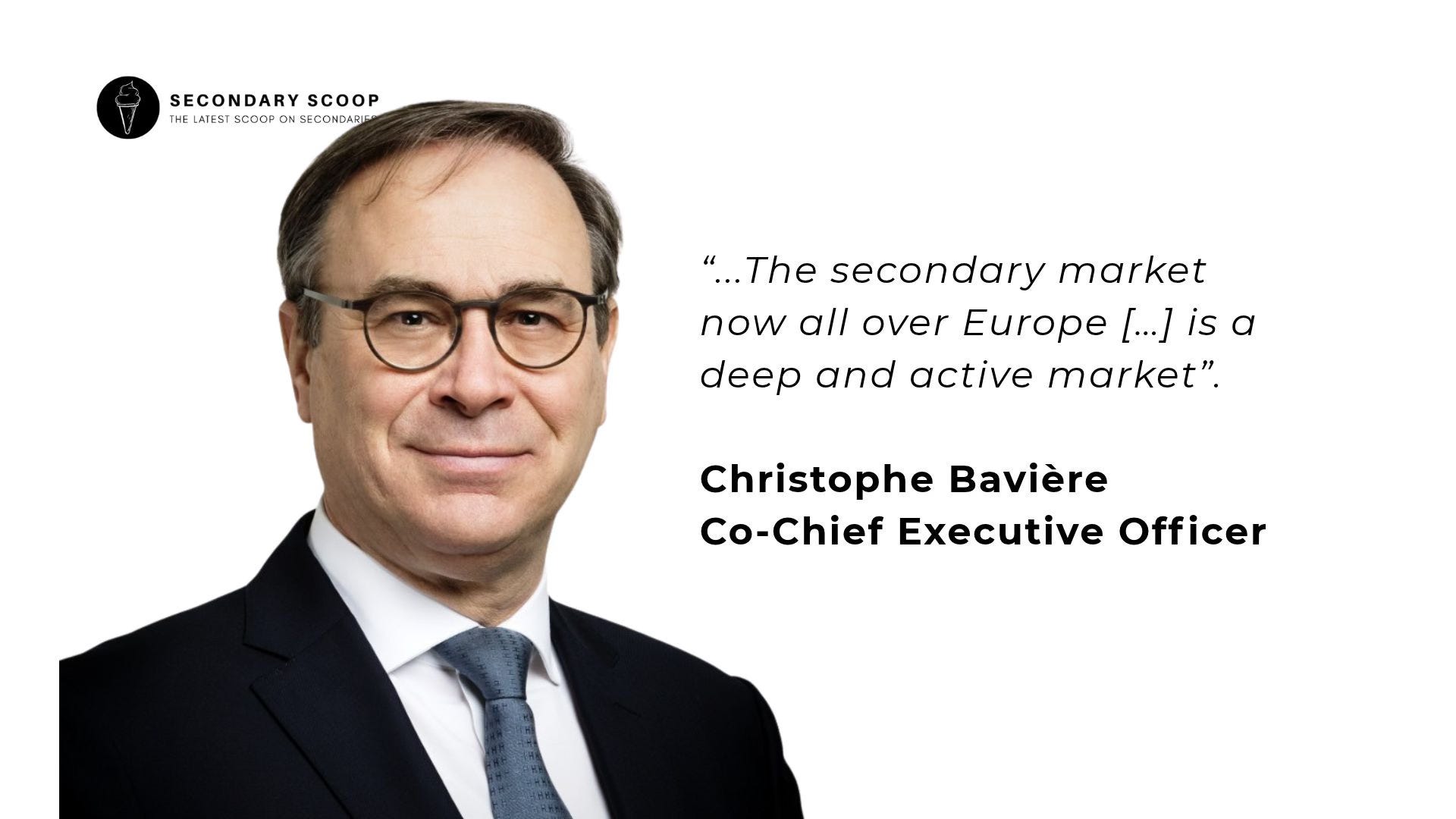
“We can also accelerate through secondary transactions. Again, the secondary market now all over Europe […] is a deep and active market.”
Christophe Bavière, CEO, Eurazeo, 9M 2026 trading update Q&A
The call came a week and a half after a governance change. On October 26, Eurazeo’s supervisory board ended the co-CEO arrangement and named Bavière sole chairman of the Executive Board. Co-CEO William Kadouch-Chassaing will not continue past the current mandates, which expire on February 5, 2027. Bavière is no stranger to this market: when the co-CEO structure was set up in 2023, Eurazeo noted that his oversight had included secondary transactions and fund of funds. On the call he set out three priorities: scale the asset management franchises, finish the shift to an asset-light model, and keep returning capital to shareholders. Secondaries now support the second and third.
Why the balance sheet needs the secondary market
The pressure on the balance sheet is plain in the numbers. Balance-sheet AUM is down to 22% of the group total, from 31% at the end of 2023, and management says it is on track to go below 20%. Shareholder returns are running high. Eurazeo has returned about €1.3bn since the start of 2024, and buybacks are set to reach about 25% of share capital over the full program. Meanwhile, Eurazeo SE’s net debt rose from €960m at year-end 2025 to €1,636m at September 30. A CIC analyst raised that point directly, describing it as drawing on credit lines to fund buybacks.
Realizations are the release valve. Group-wide realizations reached €2.3bn in 9M, up 34%. On the balance sheet itself, announced and completed divestments totaled €0.9bn, or 13% of the end-2025 portfolio, against a full-year target of about 15%. Bavière put Eurazeo “in the guidance… maybe in the low range,” and said the exit market “has not normalized as fast as expected.”
That is the DPI drought from the seller’s side. A manager that needs predictable cash for dividends, buybacks and deleveraging cannot wait for every asset to reach a trade sale or IPO. The secondary market turns that timing problem into a pricing decision. A CEO who calls the market “deep and active” on a public earnings call is telling investors he regards it as a routine liquidity tool, not a last resort.
“As you know, in a market where exits are slow, this ability to return liquidity to LPs is a key differentiating factor.”
Laurence Branthomme, CFO, Eurazeo, 9M 2026 trading update
The buy side keeps growing
On the other side of the house, Secondaries & Mandates finished September at €6.64bn of AUM, up 8% year-on-year. Third-party AUM rose 9% to €6.34bn, about 16% of group AUM. Eurazeo credits the ESF V and PME V closings for the 18% rise in third-party private markets management fees, to €195m. The ESF V close itself was announced in July and is not new information. What is new in this release is the updated fund-level data.

Source: Eurazeo 9M 2026 press release, Appendix 5, and slides, p. 18 (”fund performance as of June 30, 2026”). The €1,250m fund size covers the ESF V main fund; the €2.3bn headline includes associated vehicles.
Two details stand out. First, Eurazeo’s own balance sheet committed €200m to ESF V. The group is a seller of secondaries from its portfolio and an LP in its own secondaries buyer at the same time. That is not a conflict on its face, but anyone underwriting a future Eurazeo-originated deal should check how allocation is handled. Second, ESF IV’s 0.5x DPI is among the higher figures in Eurazeo’s table for funds of a similar age. EC V (2022) shows 0.0x and Growth III (2019) shows 0.1x. Secondaries are the part of the platform that is actually returning cash to LPs.
The wealth channel is still building. E.P.S.O., Eurazeo’s evergreen secondaries vehicle, appears in the 9M deck as part of a new “Eurazeo Prime” range for international markets, next to the E.P.I.C. private credit fund. No AUM was disclosed. The group’s flagship retail product, EPVE 3, has €3.8bn of AUM and about 1% redemptions in Q3. On the call, management said gross wealth inflows had “momentarily slowed down.” E.P.S.O. is being rolled out while retail inflows are softer.