


Invest Europe published its 2025 Capital Under Management & Dry Powder report on July 23, drawing on data from more than 1,140 fund managers covering 93% of the region’s €1.37 trillion private equity industry. It’s the kind of report that usually gets cited once in a press release and filed away.
Read against what we track on this desk, the data lines up into three related stories: how long capital sits before it moves in either direction, whether the industry’s multi-year dry powder buildup has actually started to unwind, and who is, and increasingly isn’t, getting access to the fundraising market. All three feed directly into the conditions that produce secondaries deal flow. We’re taking all three in turn.
01
The Overhang That Won’t Move
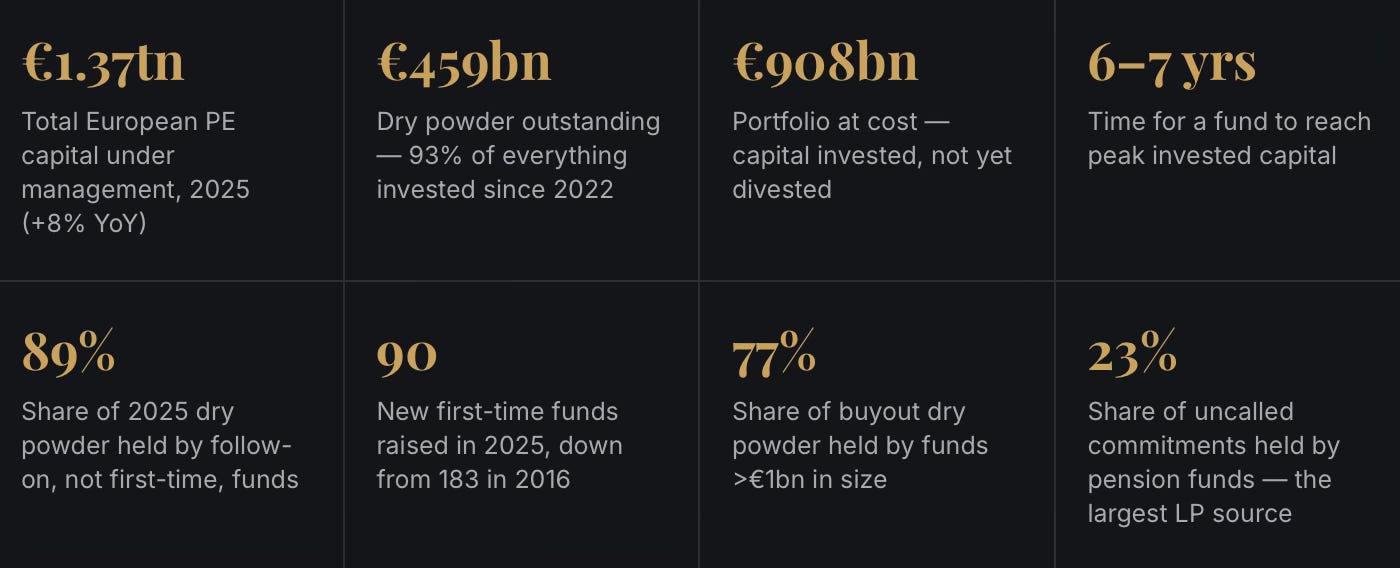
Start with the number GPs would rather not dwell on: €459bn in dry powder sitting across Europe’s private equity industry at the end of 2025, equivalent to 93% of everything the industry invested in the four years since 2022 combined (€133bn in 2022, €99bn in 2023, €128bn in 2024, €135bn in 2025, or €495bn all in). At the current pace of deployment, Europe’s GPs are sitting on nearly four years of forward investing capacity.
That overhang itself isn’t news, it’s been a talking point since 2022. What’s more specific to this dataset is how long funds are taking to work through it. Invest Europe’s own read: it takes funds roughly five to six years after a final close for dry powder to fall below 30% of total commitments, and six to seven years for portfolio-at-cost, capital that’s actually been invested, to reach its peak share of fund size.
Extend that timeline and it collides with the standard private equity fund life (typically ten years, sometimes with one or two one-year extensions) in an uncomfortable way. If it takes six or seven years just to get most of a fund’s capital invested, there is very little runway left inside the original term to hold those investments to a natural exit — let alone realize full value from capital deployed toward the end of that window.
The mechanical case for continuation vehicles doesn’t require any narrative about distressed exit markets. Funds are structurally running out of time to complete the deployment-to-exit cycle inside a standard fund life.
That’s the mechanical case for continuation vehicles that doesn’t require a narrative about distressed exit markets or shut IPO windows. Even in a healthy dealmaking environment, funds are structurally running short on time to complete the deployment-to-exit cycle inside a standard fund term. A GP-led continuation vehicle isn’t a workaround in that context — it’s closer to a scheduling fix, buying the fund and its LPs the years the original structure didn’t budget for.
READING INVEST EUROPE’S NUMBERS
Capital Under Management (CUM) = Dry Powder + Portfolio at Cost. Dry powder is capital committed but not yet called, including future management fees. Portfolio at cost is capital invested and not yet divested, recorded at cost.
One methodology wrinkle worth flagging before the next section: Invest Europe publishes two different scopes of dry powder in this report. The headline €459bn figure covers the full industry universe, including funds still in the process of raising. A separate time series — used for the fund-size and vintage-year breakdowns below — is restricted to funds that have already reached final close, a narrower but internally consistent dataset. We’ve flagged which scope is in play in each section that follows.
02
The First Crack in the Overhang
Within that narrower “final closings” dataset, something shifted for the first time since Invest Europe’s series began. Dry powder held by closed European PE funds rose every single year from 2016 through 2023, from €154bn to a peak of €364bn. It has now fallen for two consecutive years: to €361bn in 2024, and €349bn in 2025.
It’s a modest decline in percentage terms, about 4% off the 2023 peak, but it’s a reversal after seven straight years of growth, and it lands in the same window Invest Europe flags as one of the industry’s most active four-year investment periods on record. Buyout, which drives the overall trend at scale, tells the same story: closed-fund buyout dry powder peaked at €273bn in 2023 and has fallen to €257bn in 2025.
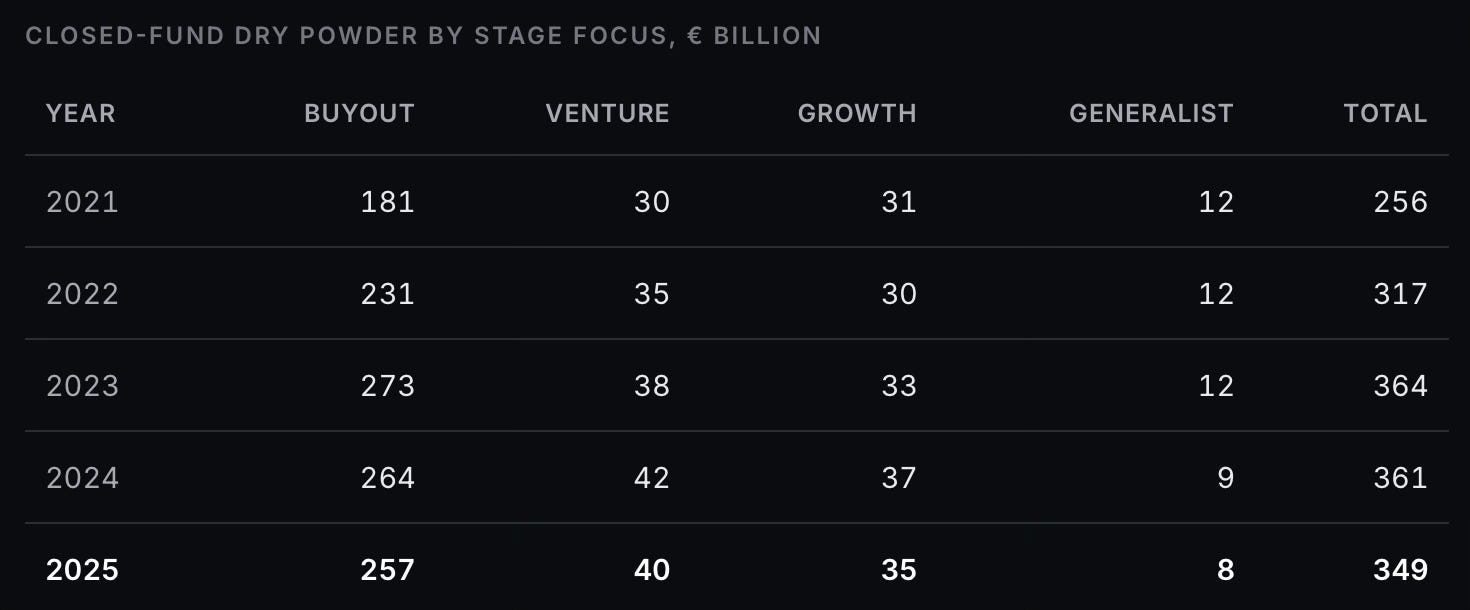
We’d resist reading too much certainty into this. Two explanations are consistent with the same data, and Invest Europe’s report doesn’t adjudicate between them:
GPs are genuinely digesting the backlog, deploying faster than new capital is arriving, which would be a straightforwardly constructive signal for an industry working through its overcapitalization problem.
Fewer large funds reached final close in 2024 and 2025 than in the prior two years, shrinking the denominator of this particular dataset without necessarily meaning existing funds deployed any faster, consistent with the broader, well-documented fundraising slowdown across Europe over this period.
What the data does confirm cleanly: for the first time since 2016, the deployment picture (dry powder among closed funds) and the fundraising picture (total capital under management, which hit a record €1.37tn in 2025) have decoupled. Total CUM kept climbing through 2024 and 2025 even as closed-fund dry powder fell — meaning growth in the overall pool is now coming from portfolio value and funds still fundraising, not from fresh, uncommitted firepower at existing closed funds. That’s worth watching in the next report cycle regardless of which explanation turns out to be right.
03
Flight to Scale
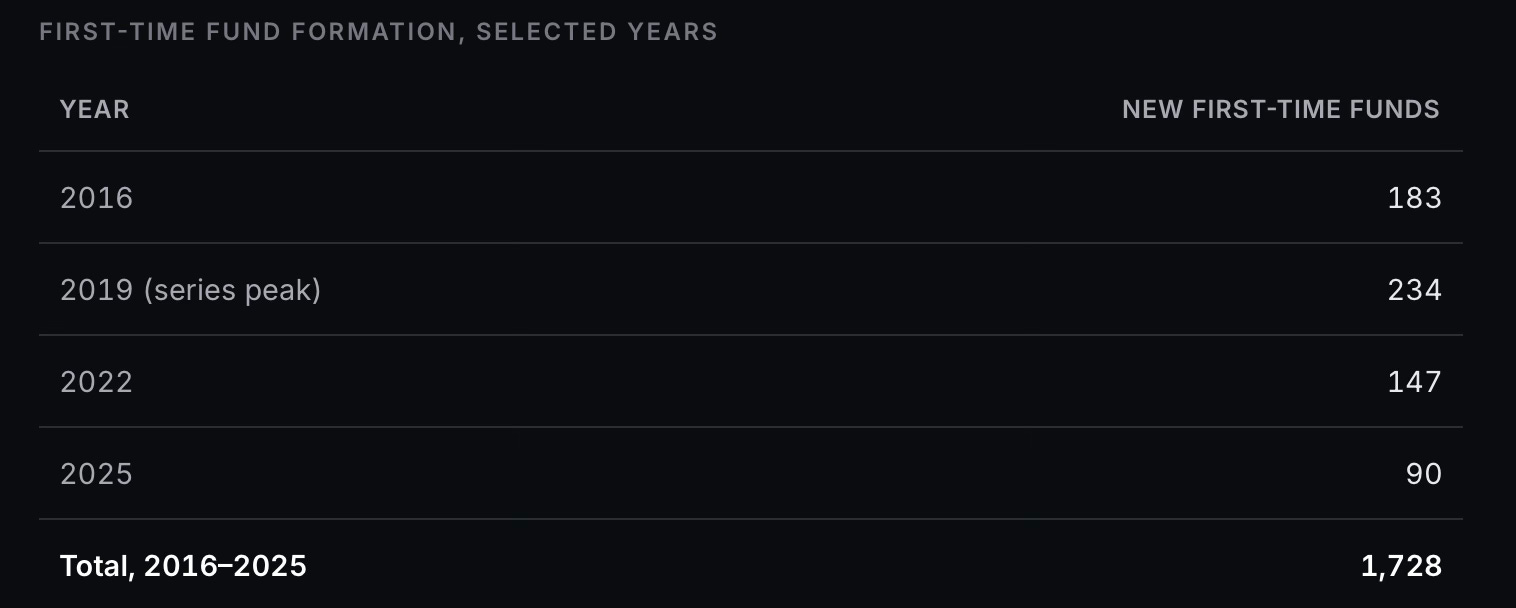
The third story is about who gets to raise a fund at all. Europe minted 90 new first-time private equity funds in 2025. In 2016, it minted 183, more than double. The decline hasn’t been one bad year; new first-time fund formation has fallen in eight of the last nine years, from a series peak of 234 in 2019 down to fewer than half that level by 2025.
The capital has consolidated even more sharply than the fund count. Follow-on funds, vehicles raised by GPs who’ve already closed at least one fund in that strategy, now hold 89% of Europe’s dry powder and 79% of its invested capital. First-time funds, despite the collapse in new formations, still hold €246bn in total capital under management in aggregate, a handful of large debut vehicles and established managers launching adjacent strategies keep that figure from collapsing, but the marginal first-time manager is having a materially harder time reaching a first, let alone a final, close than a decade ago.
Layer in fund size and the picture sharpens further. Among buyout funds with final closings, vehicles above €1bn hold 77% of both the strategy’s capital under management (€506bn of €658bn) and its dry powder (€197bn of €257bn). Buyout in Europe is increasingly a mega-fund business; everything below €1bn is fighting over the remaining quarter.
None of this is a secondaries story on its face. It becomes one once you connect it to two things we track closely on this desk: GP stakes and continuation-vehicle-enabled restructurings as a survival mechanism for managers who can’t clear the bar on a traditional flagship raise, and LP-side demand for secondary access to closed, oversubscribed franchises that smaller or newer LPs can no longer get primary allocations into. A market where 90 new managers get funded and 89% of the capital sits with repeat players is a market where the secondary route, buying into an existing fund’s exposure rather than committing fresh primary capital to a first-time raise, becomes structurally more attractive, not less.
04
Who’s Actually Holding the Capital
One more cut worth flagging for anyone mapping likely LP-led sellers: pension funds are the single largest source of Europe’s uncalled commitments at 23%, ahead of funds of funds and other asset managers (20%), family offices and private individuals (14%), and sovereign wealth funds (10%). Insurance companies, government agencies, corporates, banks, and academic institutions/endowments/foundations split most of the remainder in single digits.
Pension funds, 23%. The single largest LP source of uncalled commitments in Europe.
Fund of funds & other asset managers, 20%. The second-largest, and structurally the most liquidity-sensitive.
Family offices & private individuals, 14%. A meaningfully large slice, often underweighted in secondaries coverage that focuses on institutional sellers.
Sovereign wealth funds, 10%. Rounding out the top four LP sources of undrawn capital.
Geographically, capital is heavily concentrated in the UK & Ireland, which holds 46% of Europe’s dry powder and 53% of its invested capital, roughly €696bn in total capital under management, more than four times the next-largest hub, France & Benelux (€324bn; 23%/24% of DP/PAC respectively). Nordics, DACH, Southern Europe, and CEE split the remainder, with CEE registering just €14bn in total capital under management across the entire region.
For a secondaries desk, that concentration matters twice over: it’s roughly where GP-led continuation vehicle sponsors are headquartered, and, via the pension fund and fund-of-funds dominance on the LP side, roughly where the largest pools of uncalled commitment, and eventually fund stakes available for sale, actually sit.