


On Sunday, Evercore announced that its board has appointed Nigel Dawn and Naveen Nataraj as co-presidents, effective January 1, 2027. Both will report to John Weinberg, who remains chairman and CEO and has agreed with the board to stay in the role for at least three more years.
Congrats to Naveen Nataraj, but here at Secondary Scoop, we want to focus on Nigel Dawn becoming co-president of Evercore and chairman of Private Capital Advisory (PCA), the secondaries business he founded.
The detail that matters most is easy to miss. Evercore has not had a president since Ralph Schlosstein, who held the title alongside the CEO role from 2009 until he became co-CEO with Weinberg in July 2020. Weinberg has run the firm alone as chairman and CEO since February 2022. The firm is reviving a title that has been vacant for six years and splitting it between a corporate M&A banker and the person who built its secondaries franchise.
“Evercore is a different firm today, even compared with three years ago.”
Roger C. Altman, founder and senior chairman, Evercore
From lift-out to leadership
Evercore announced PCA in 2013, hiring Dawn and Nicolas Lanel from UBS, where Dawn had founded and led the bank’s secondary advisory business. The unit was originally structured with Evercore as majority owner and its key principals, including Dawn and Lanel, holding a minority stake. Today PCA has teams in the United States, Europe and Singapore, and Evercore describes it as the market-leading business in its space.
The market around it has changed shape. By Evercore’s own count, secondary volume hit a record $226 billion in 2025, with LP-led deals at $120 billion and GP-led deals at $106 billion. The first half of 2026 set another record at $121 billion. In a Bloomberg TV interview in August, Dawn said the full year could reach $250 billion. He attributed the growth to a structural shift: the largest LPs are using the secondary market to generate liquidity while private equity portfolios fail to produce expected distributions.
When a founder of a niche product gets one of the two most senior jobs below the CEO, the product has stopped being niche.
What the appointment tells us about secondaries
Secondaries advisory is now a top-of-house business. For most of the last decade, secondaries advisory sat next to fund placement as a specialist desk inside larger banks. Evercore ranked third globally by advisory fees among public firms for the second consecutive year in 2025. A firm of that size putting its PCA founder into the co-presidency tells you how management views the fee pool: durable and structural, not a cyclical substitute for missing exits. That matches the thesis this publication has argued from the start. Secondaries are becoming a standing portfolio management tool, not a distress valve.
Sponsor coverage and secondaries are converging. Evercore has said so directly. On the Q2 2026 earnings call, Weinberg described the firm’s work integrating the two:
“We’ve continued to invest in bringing together our private capital advisory businesses and our classic sponsor M&A business, and we’re seeing some real fruits to that labor.”
John S. Weinberg, chairman and CEO, Q2 2026 earnings call
WHY THE CONVERGENCE MATTERS
For a sponsor deciding how to exit a strong asset, a single-asset continuation vehicle is now a real alternative to a sale or IPO, not a fallback. An adviser that covers the sponsor on M&A and also runs its GP-led processes can lay out both routes side by side, and potentially run them in parallel. With Dawn at the top of the firm, that model gets a senior sponsor of its own. For LPs asked to roll or sell in a continuation vehicle, it also sharpens a familiar diligence question: how is the adviser’s role, and its fee, structured across the routes it is pitching?
The talent war moves up a level. Evercore added a PCA senior managing director in each of the first two quarters of 2026, alongside an addition to its Asia PCA team, and recently brought in Clay McCoy after his garden leave from Campbell Lutyens. Competitors are building just as hard, but often by buying. Weinberg said in April that strategic acquisitions face a very high bar and that hiring and platform expansion take priority. Evercore is betting on growing its franchise from inside while the rest of the advisory layer consolidates.
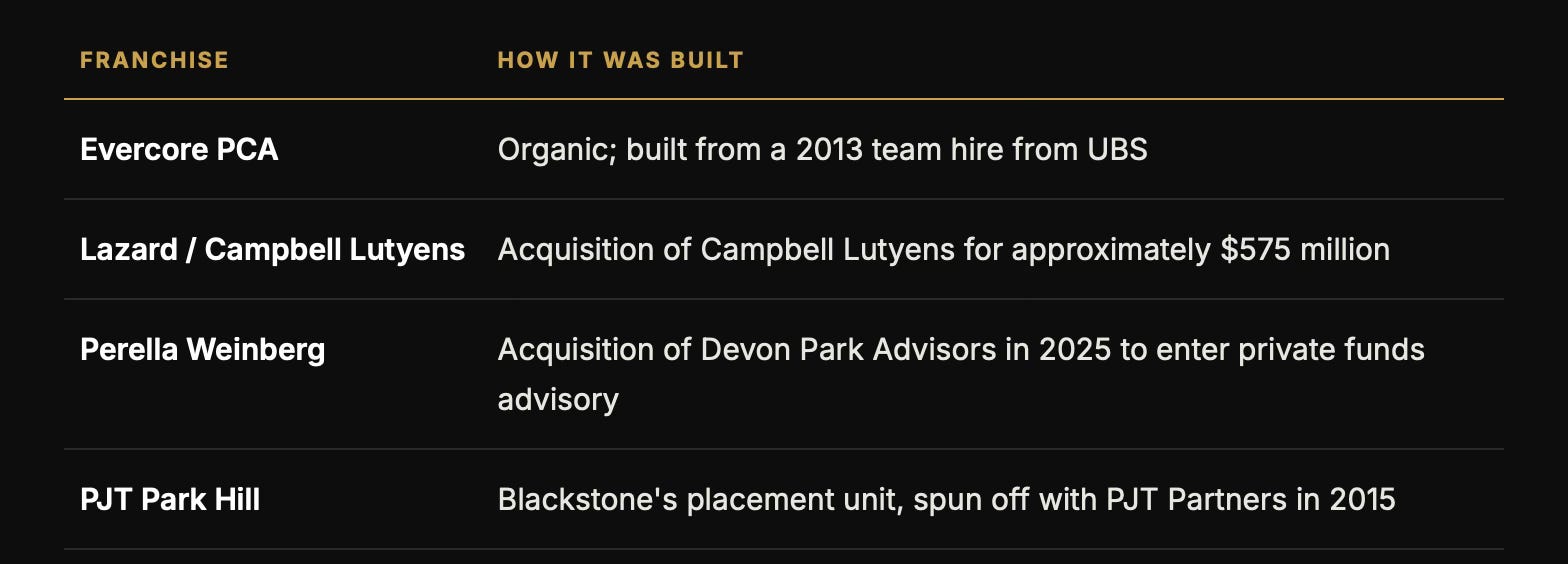
Selected independent advisers. Sources: company announcements and prior Secondary Scoop coverage.
Evercore’s bet, in numbers, and the number it won’t give
The broader strategy is diversification away from pure M&A. Advisory fees rose to $3.27 billion in 2025 from $2.44 billion in 2024. On the Q2 2026 call, Evercore said non-M&A businesses contributed more than 40% of revenue over the prior 12 months. Its investment banking bench stood at 188 senior managing directors at the end of June.
That 40% is not a secondaries number. It combines underwriting, equities commissions and wealth management fees with the non-M&A parts of advisory: restructuring, capital markets advisory, the Private Funds Group and PCA. Evercore does not disclose PCA’s revenue, and Secondary Scoop could not derive PCA’s share of firm revenue from public filings. The only market-share indicator in the public record is a 2024 podcast description stating that Evercore was involved in roughly 30–40% of secondaries activity. That is not an audited figure, and it predates the market’s last two record years.
The tone of the earnings calls is worth tracking too. In Q1 2026, PCA delivered a record first quarter. In Q2, Evercore described it as delivering “another strong quarter,” while other units, including the Private Funds Group, posted records. The market itself set a first-half record, so this is not a sign of weakness. Asked about PCA on the Q2 call, Weinberg said:
“Our PCA business is actually performing well, and we feel really good about the prospects going forward.”
John S. Weinberg, Q2 2026 earnings call
The open question: who runs PCA?
The announcement does not name a new global head of PCA. Dawn becomes chairman of the business and, in Evercore’s words, will “remain closely connected” to it and its clients. In a market where advisers are hiring each other’s senior bankers, the day-to-day leadership of the largest franchise is the question clients and competitors will ask first.
The first chance to hear more is Evercore’s Q3 2026 results on October 28. We will be listening for four things:
Whether a successor, or a co-head structure, has been decided for PCA.
How PCA performed in Q3, a quarter that followed a record first half for market volume.
How the PCA and sponsor M&A integration will be organized under the co-presidents.
Any update on PCA’s build-out in Europe and Asia.