


Hamilton Lane’s fiscal second-quarter results on November 3 showed a secondaries business expanding well beyond its flagship. The firm has its first dedicated GP-led fund in market and has built credit secondaries into its newest credit strategy. Evergreen net inflows rose to nearly $800 million, from about $640 million the previous quarter.
Management used the call to argue that secondaries remain short of capital. A day later in Hong Kong, co-CEO Juan Delgado-Moreira made the case for continuation vehicles, the structure behind Hamilton Lane’s new GP-led fund.
From one flagship to a secondaries stack
The inaugural GP-led secondary fund is now launched, a step management called the start of the platform’s next phase. Erik Hirsch, who moves from co-CEO to executive co-chairman as part of the leadership changes announced alongside Mario Giannini’s planned retirement on March 31, 2027, framed it as an extension of what the flagship already does:
“We view this new strategy as a natural complement to our core secondaries platform and a representation of the next phase of growth for our broader secondaries efforts.”
Erik Hirsch, Hamilton Lane, prepared remarks
Asked by an analyst about first-time funds, Hirsch was more specific about why GP-leds now warrant their own vehicle: “As that market segment continues to grow, we see investor demand of having that as a standalone vehicle also growing.”
THE CO-CEO’S CASE FOR CONTINUATION VEHICLES
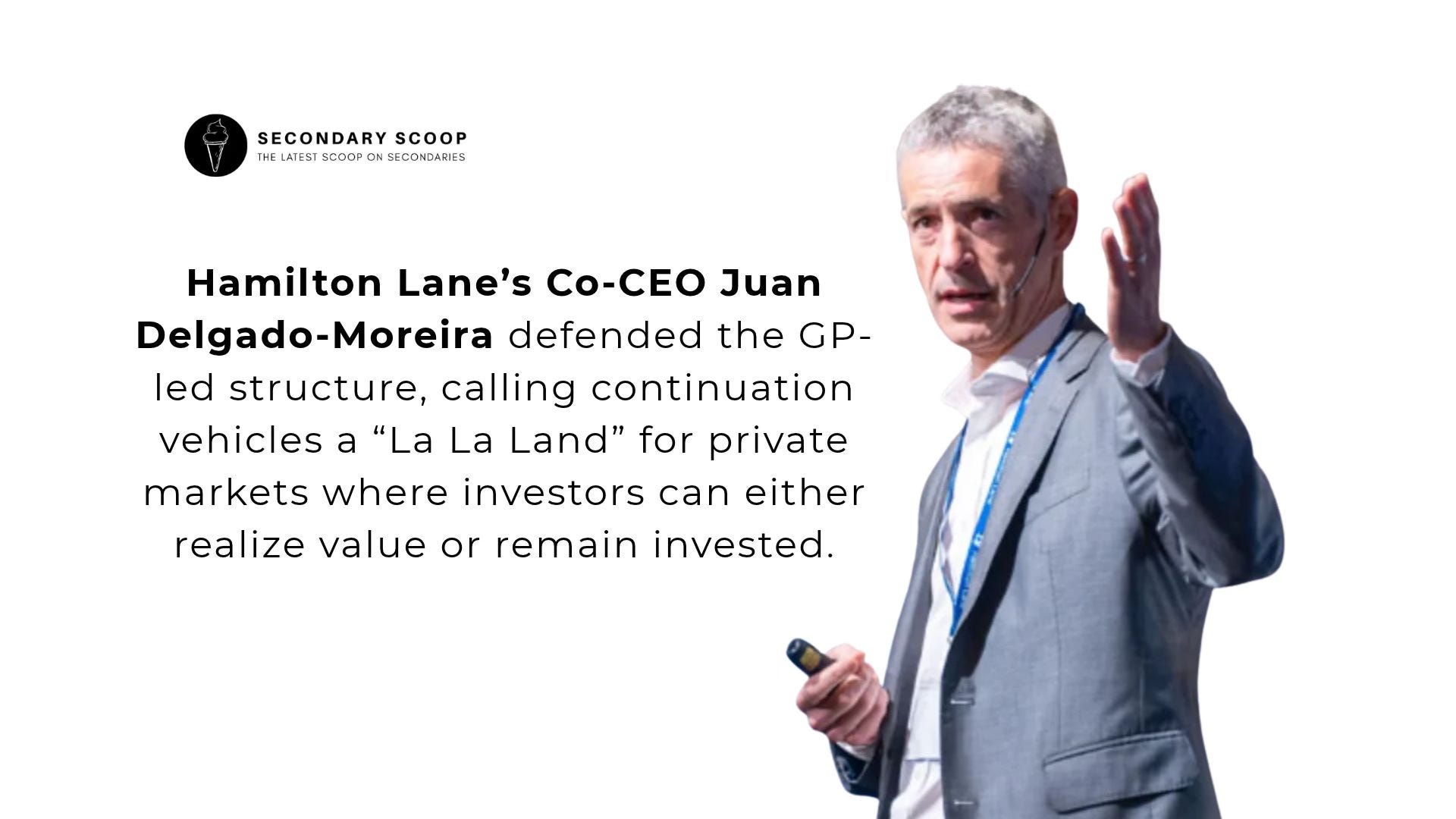
Speaking at Hong Kong’s flagship investment summit on November 4, as reported by Bloomberg, the day after the earnings call, co-CEO Juan Delgado-Moreira defended the GP-led structure, calling continuation vehicles a “La La Land” for private markets. In his view, investors can choose either to realize value or to stay invested. He said third-party valuations and LP advisory committee approvals help address the governance concerns.
He also cited performance: according to Delgado-Moreira, assets rolled into continuation vehicles have produced average money multiples of roughly 4x. He said that is above top-quartile buyout returns and about twice the DPI.
He did not make it a blanket endorsement of the asset class. Delgado-Moreira acknowledged that private equity overall has trailed public equities in recent years. He also said Hamilton Lane may have committed more capital to the asset class in 2021 than it should have, That is worth keeping in mind for the carry table below: Fund V closed in February 2021 and was deploying through that period.
The second addition is easier to miss. Hamilton Lane’s newest credit strategy pairs diversified mid-market lending with a specialty finance sleeve that, in management’s words, “targets differentiated, less correlated opportunities such as credit secondaries and asset-backed and niche lending transactions.” That puts credit secondaries on Hamilton Lane’s list of strategies in market.
Add the evergreen platform, which ended the quarter at nearly $21 billion, and Hamilton Lane is now selling secondaries exposure through an LP-led flagship, a GP-led vehicle, a credit sleeve and semi-liquid products at the same time. Management also listed “additional secondary offerings” among the areas where it expects to keep building.
SIZING FUND VII
BMO’s Brennan Hawkins put Fund VI at $5.6 billion, $1.7 billion above Fund V. Both figures match Hamilton Lane’s own close announcements: Fund V closed on $3.9 billion in 2021 and Fund VI on $5.6 billion in June 2024. Fund VII’s $1.3 billion first close is roughly 23% of its predecessor’s final size. A first close is not a forecast of final size, and on the call Hirsch described growing a fund “from X to something substantially bigger than X” as always requiring a mix of existing clients upsizing and new logos.
“Undercapitalized,” and a midsize player by its own account
Asked how big Fund VII could get, Hirsch answered with the market rather than a number:
“That market continues to be sort of the most undercapitalized relative to the opportunity set.”
Erik Hirsch, Q&A, responding to an analyst.
He added that secondaries have “delivered some of the best risk-adjusted returns across the entirety of the asset class,” and was frank about where the firm stands: “we’re kind of a midsize player. There are firms that are managing funds that are multiples the size of ours.”
The more useful Q&A remark for secondaries buyers came in response to a question on exits and rates. Hirsch said higher-rate environments have historically been followed by lower purchase prices, “effectively, the seller sort of taking on that pain more than the buyer. I suspect that will be the case here.” He paired it with a warning against generalizing about the industry. He described a split between managers returning plenty of cash and raising quickly, and those with “pretty mediocre to lousy portfolios, not a lot of liquidity, and really struggling to raise capital.” That split is where LP-led supply and GP-led demand both come from.
The separate account business points the same way. Hirsch said prospects building new private markets programs “are explicitly asking us to blend primaries with secondaries and co-investment access from day one,” and called this “the default expectation.” That matters for a firm whose SMA capital, by management’s account, flows directly into its specialized funds, secondaries included.
Evergreen: re-acceleration, no gates
Evergreen net inflows rose to nearly $800 million from roughly $640 million the prior quarter, and September alone contributed nearly $400 million. Management said no Hamilton Lane product has had gates. Asked by J.P. Morgan what drove the rebound, Hirsch pointed to wealth investors who are “still very, very early” in their private markets journey and had reacted to negative headlines. He said they are now moving toward more “fact-based decisions.” He also said most evergreen growth comes from new logos rather than existing institutional clients.
For secondaries, this is the channel to watch. Evergreen vehicles do much of the work of “retailizing” secondaries exposure, and Hamilton Lane’s 12-product lineup, including its dedicated secondaries evergreen fund, depends on that flow holding up through the next round of headlines.