

Hamilton Lane’s first fiscal quarter of 2027 reads, on the surface, like most of its recent quarters: fee-related revenue up 44%, fee-related earnings (FRE) up 49%, another dividend increase locked in. Those are the numbers that will lead most of the coverage. But for a secondaries-focused reader, the more interesting sentence sits deeper in the earnings call, in the rundown of what’s coming to market over the next several quarters.
Hamilton Lane is currently raising five closed-end strategies simultaneously: core secondaries, venture, credit, infrastructure; and, new this quarter, “our inaugural GP-led secondary strategy.” That’s not a rebrand of an existing sleeve. It’s a standalone vehicle, launched alongside the firm’s seventh flagship secondaries fund, which just held its first close.
The split: Fund VII and a GP-led sibling
Hamilton Lane’s seventh secondaries fund held its first close “just last week” relative to the August 4 earnings call, on nearly $1.3 billion of investor commitments. Management said a second close is already coming later this calendar year, with “good visibility” on the number, and confirmed the firm is running its usual 18-month window from initial close to final close, consistent with how prior secondaries funds in the series have been raised.
What’s new is what’s raising alongside it. Hamilton Lane did not fold GP-led secondaries into Fund VII as a sub-strategy or a side pocket; it named a separate, first-of-its-kind GP-led vehicle as one of the five strategies currently in market. No commitment total was disclosed for the GP-led fund on the call, it’s early, and the firm didn’t break out a first-close figure for it the way it did for the core fund. That itself is a data point: this is a fund being built from scratch, not a bucket getting relabeled.
WHY THE SPLIT MATTERS
Bundling GP-led deals into a classic LP-secondaries vehicle is still common across the industry, it lets a manager point to one fund and one track record while quietly diversifying deal sourcing underneath. Standing up a dedicated GP-led vehicle is a different signal: it says the deal flow, the underwriting discipline, and the investor base for continuation vehicles are now distinct enough from classic LP portfolio purchases to warrant their own capital pool and, presumably, their own fee terms. Worth watching whether other large secondaries platforms follow the same unbundling logic as GP-led supply keeps outpacing LP-led supply industry-wide.
The rest of the closed-end franchise is moving too
Fund VII isn’t raising in isolation. Hamilton Lane’s direct equity platform (its co-investment fund) just finished its raise entirely: $3.8 billion collected in total, split between $3.3 billion in the fund itself and $500 million in separate accounts investing alongside it. The fund portion alone represents growth of more than 57% over its predecessor. Roughly 30% of that capital is already committed across small and mid-market deals, and management characterized early performance as strong, while flagging it’s still early.
Venture is also gaining speed. Hamilton Lane’s second venture fund held its first close during the quarter at more than $370 million, already north of 60% of the total size of Fund I, which raised $615 million in its entirety. Infrastructure is “a few more quarters away” from market, per management, rounding out the five-strategy pipeline through the balance of fiscal 2027 and into early fiscal 2028.
The quarter in numbers
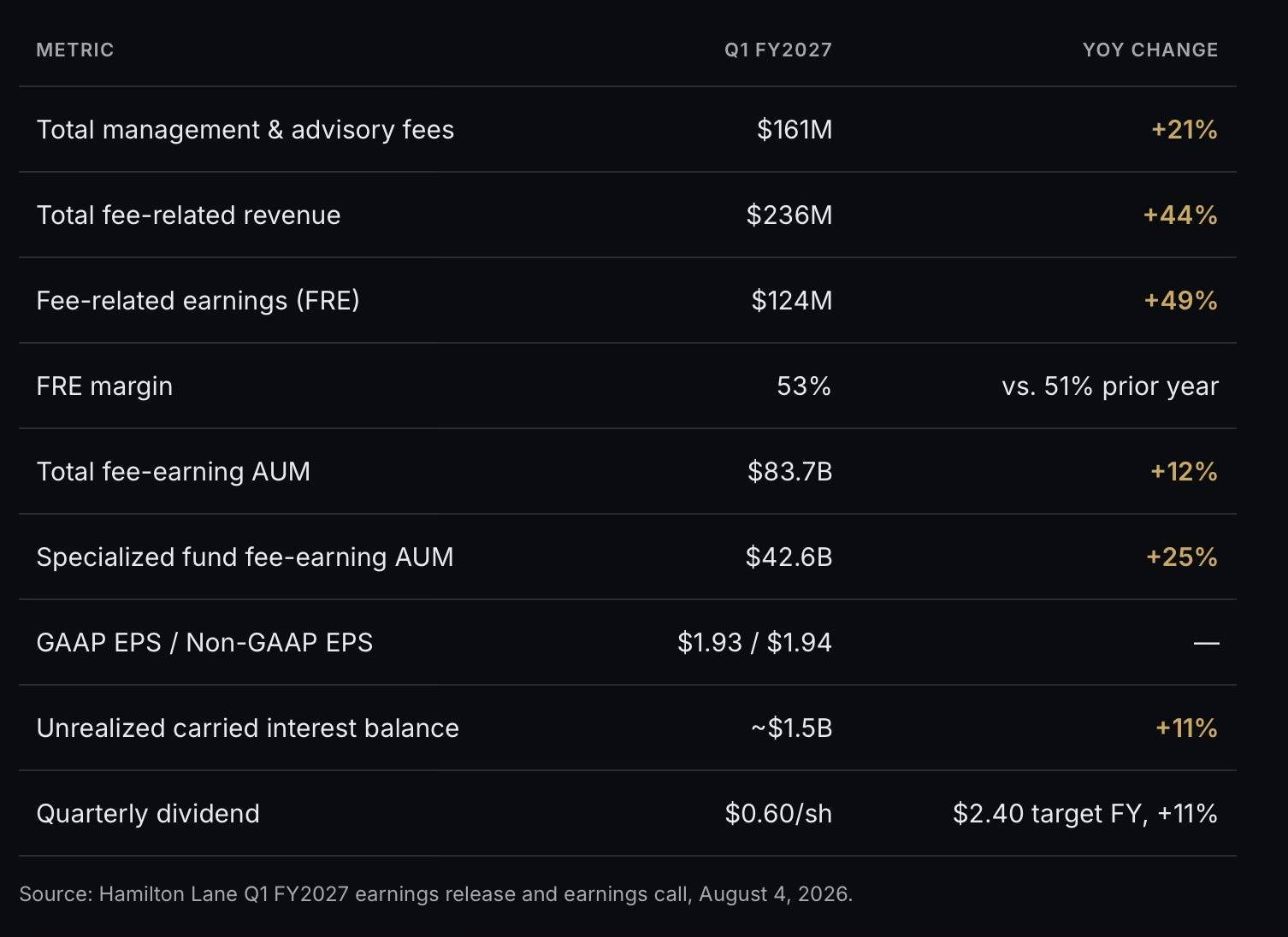
The blended fee rate on fee-earning AUM now stands at 69 basis points, continuing to climb as the mix shifts toward specialized funds, which grew fee-earning AUM by $8.5 billion (+25%) over the trailing 12 months versus a 2% increase in customized separate account fee-earning AUM over the same period. Total incentive fees for the quarter were $114 million, driven primarily by the quarterly crystallization of performance fees on the U.S. private assets evergreen fund. The three largest, most seasoned products in the platform, the U.S. and non-U.S. multi-strategy equity funds and the non-U.S. credit fund, have together generated more than $3.6 billion of total cash realizations from their underlying portfolios to date.
Evergreen liquidity: one fund out of twelve
The evergreen platform generated nearly $640 million of net inflows in the quarter across all strategies, with positive net flows in 10 of 12 funds. The non-U.S. credit fund was roughly flat. The one fund in net outflow was Hamilton Lane’s non-U.S. multi-strategy equity vehicle — its oldest, most mature evergreen product, and also its best performer: a dollar invested in the institutional USD share class at inception was worth $2.32 as of June 30.
Management’s explanation, on the call, split the redemptions into two buckets. The first is straightforward gains-harvesting and rebalancing by longstanding investors whose exposure has grown well past target after years of strong performance. The second is more structural: institutional clients increasingly use the evergreen vehicle as a temporary holding pen for capital earmarked for a separately managed account, then redeem from the evergreen once the SMA is ready to draw. Hamilton Lane framed this as capital retention, not attrition, the dollars move between products, not out the door.
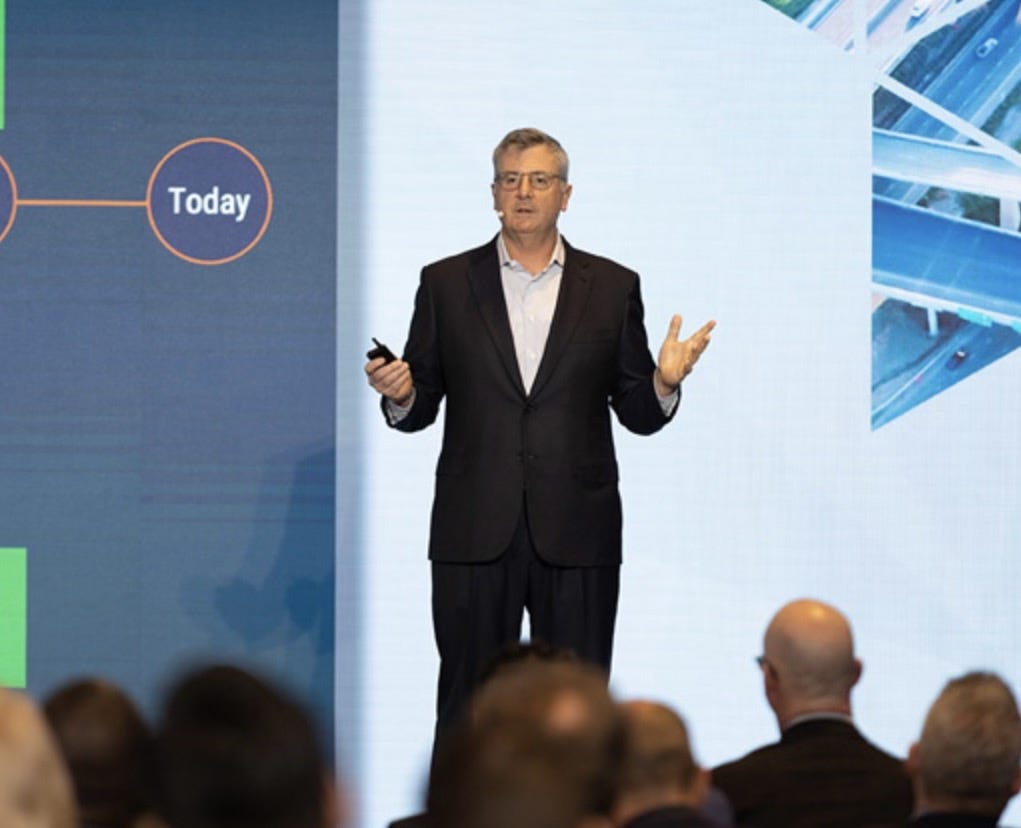
“So headlines, largely not driven by good data, caused investor behavior. And to me, that is an example of a lack of maturity and confidence in an industry and in a sub-asset class that I think is not surprising, given how young it is and how little experience investors have with the space.”
ERIC HIRSCH, CO-CEO, HAMILTON LANE
Hirsch added that Hamilton Lane is “not seeing material differences on the ground between non-U.S. and U.S.” flows, and that the non-U.S. platform’s outflows reflect its longer track record more than any structural weakness, the international evergreen business simply launched more than a year ahead of the U.S. suite. On July trends specifically, he said the firm is “seeing some of the noise subsiding” and “more positive sentiment across the product offerings and across the geographies.”
Balance sheet: three exits in one quarter
Hamilton Lane’s strategic investment portfolio saw three separate liquidity events converge in the same quarter, each tied to a piece of private-markets infrastructure the firm has backed over the past several years.
RUSSELL INVESTMENTS
On July 9, Russell Investments announced that a consortium led by B Capital and including CalPERS had agreed to acquire the firm, in a deal reported at roughly $2.8 billion and expected to close in the first calendar quarter of 2027, subject to regulatory approval. Hamilton Lane entered a strategic partnership with Russell in March 2021; management said it expects to realize just under $50 million based on its share of the transaction value, with an anticipated gain of approximately $18 million recorded when the deal closes. The firm was clear that ending its economic ownership stake does not end the commercial partnership.
SECURITIZE
Securitize completed its previously announced business combination with Cantor Equity Partners II and began trading on the NYSE under the ticker SECZ. Hamilton Lane originally invested $5 million in Securitize starting in 2022 (tokenizing several Hamilton Lane offerings), then participated in a 2024 strategic funding round led by BlackRock. Post-merger, Hamilton Lane holds approximately 1.5 million shares, subject to a 180-day lockup, and will begin marking the position to the public share price starting next quarter.
CANOE
Bloomberg has agreed to acquire Canoe, the AI-driven alternative-investment data platform Hamilton Lane first piloted internally in 2019 before investing in its Series A in 2020. Hamilton Lane expects proceeds of approximately $30 million from the deal, an estimated gain of more than $15 million versus the position’s current carrying value.
READING THE BALANCE SHEET MOVES TOGETHER
None of these three are secondaries transactions in the traditional GP-led or LP-led sense, but they’re a useful reminder of how a platform like Hamilton Lane’s balance sheet actually works: seed and grow infrastructure and data businesses that solve the firm’s own operational problems (fund servicing, data extraction, tokenization rails), then monetize as those businesses get acquired or go public. The tokenization thread in particular: Securitize now public, Hirsch drawing an explicit comparison to what ETFs did for public-market liquidity, is worth tracking as a parallel liquidity-infrastructure story to the GP-led secondaries market itself.