


EQT AB confirmed this morning that it has completed its combination with Coller Capital, seven months after the two firms signed a definitive agreement on January 22, 2026. Coller now operates as "Coller EQT," a standalone Secondaries segment inside EQT's reporting structure. The deal's price and structure were set back in January; today's release is the close itself, plus a handful of figures and a quote worth flagging on their own merits.
The Deal Terms, for Reference
EQT and Coller signed a definitive agreement on January 22, 2026, alongside EQT’s full-year 2025 earnings release, and set the deal’s economics then. Today’s close confirms those terms went through unchanged:
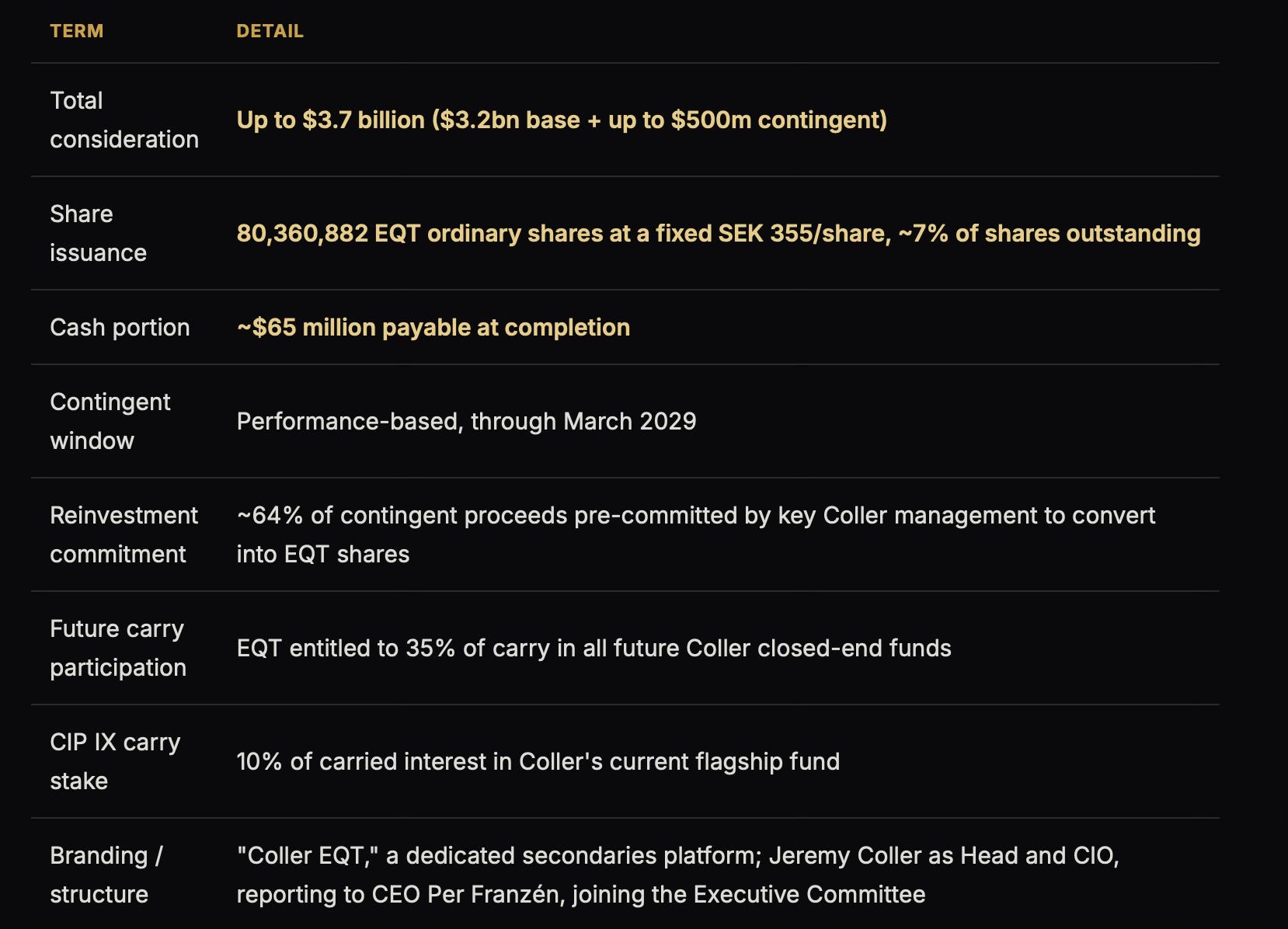
The structure is worth sitting with for a moment. A base deal that’s roughly 96% equity rather than cash tells you EQT wanted Coller’s people bound to EQT’s own share price going forward, not paid out and gone. The earn-out works the same way twice over: it’s itself performance-linked, and nearly two-thirds of it is pre-committed to convert back into EQT stock, a retention mechanism dressed up as a bonus pool. And the carry split: 10% on the fund largely raised under Coller’s independent banner, 35% on everything after, signals exactly how EQT is pacing integration: light-touch economics on what already exists, full house-policy economics on everything Coller EQT raises from here.
A Fourth Segment for EQT
Coller EQT is reported as a new Secondaries business segment, sitting alongside EQT’s existing Private Capital, Infrastructure, and Real Assets segments, a standalone reporting line rather than a division folded into Private Capital. Jeremy Coller’s appointment as Head and CIO, reporting to Per Franzén with an Executive Committee seat, keeps him with both governance standing at the parent company and continued authority over origination, underwriting, and investment decisions at the platform he built. EQT is explicit that the “Coller EQT” brand exists specifically to signal that independence is being preserved, not folded away.
The Scale, in One Line
Combined EQT assets under management stand at €341 billion ($389 billion) as of June 30, 2026, of which €186 billion is fee-generating, a combined figure that only exists now that the deal has closed. The transaction adds nine new strategies to EQT’s client offering across private equity and credit secondaries, spanning closed-end funds, evergreen products, and insurance-dedicated solutions, and the combined evergreen platform now exceeds €10 billion in net asset value. EQT reaffirmed its commitment to double Coller’s fee-generating AUM within four years.
The release also notes Coller EQT “has begun early preparations for continued expansion into new asset classes” — broader in scope than anything said in the Salata interview, which was framed specifically around credit secondaries as EQT’s re-entry point into that market. Today’s language is open-ended: no asset class is named, but the signal is that the platform is being built to expand past its current PE and credit secondaries remit.
The Convergence Thesis, Now Said Twice
On Bloomberg TV two weeks ago, EQT’s global chair Jean Salata said he expects “some sort of convergence between primary and secondary funds,” framing the roughly $4 trillion NAV overhang in private markets as the long-term growth engine for secondaries rather than a backlog to clear. Today, Jeremy Coller, the person actually running the combined secondaries platform, went further:
“Secondaries are one of the most compelling opportunities in private capital today and, as the market matures, my personal expectation is that in the long-term secondaries will become private equity.”
Jeremy Coller, Head and CIO, Coller EQT
Salata described convergence as a coming trend. Coller’s goes much further, not secondaries converging with private equity, but secondaries becoming private equity. Coming from the person whose name is now on EQT’s fourth reporting segment, that reads less like marketing language and more like a stated thesis for how the platform will be built out.