


ILPA has published the final version of its continuation vehicle guidance, four months after it released a draft for public comment on June 24. Read against that draft, the direction of travel is clear. The provisions that told GPs how to run a process have mostly been loosened into standards a GP can depart from if it explains why. These include how long LPs get to elect, which options they must be offered, how much carry must be rolled and what bid information must be shared. The provision that tells GPs what rolling LPs must end up with has not been loosened. If anything, it has been tightened.
The document is clear about its own posture. It describes its best practices as “designed to guide, not dictate,” and says a deal that falls short of them “is not in itself a sign of a flawed process.” Where a GP materially departs from the principles, it should be prepared to explain how LP concerns were otherwise addressed.
ILPA’s acknowledgments credit GPs, law firms, financial advisers, lenders, underwriters and other industry bodies among those who commented. The document does not say which comments drove which changes.
Why ILPA is stepping in
ILPA first issued continuation fund guidance in 2023. It is rewriting that guidance three years later because the tool has changed category, from a tail-end fix for aging funds to a mainstream exit route. The final document cites Jefferies data showing CVs accounted for roughly 14% of sponsor-backed exits globally in 2025, up from 5% in 2021. Its own framing is that GPs now treat CVs as a strategic tool across a fund’s life, not just an end-of-life solution.
The volume data support that. Jefferies counted $115 billion of GP-led secondaries in 2025, up 53% and 48% of all secondary activity, with CVs the majority structure. Growth continued into 2026. Jefferies put H1 2026 GP-led volume at $62 billion, against $47 billion a year earlier, for 53% of the market. Evercore’s count is $65 billion, up 35%. Single-asset CVs, the trophy-asset deals where conflicts are sharpest, reached $34 billion in Evercore’s data, up 88%.
The tool is also leaving buyout. Evercore attributes 16% of H1 2026 GP-led volume to infrastructure and 11% to credit. That helps explain why ILPA, which wrote this guidance for closed-end PE funds, flags that it may apply in other asset classes.
Europe is a smaller but fast-growing share of the market. William Blair’s survey put European GP-led mandates at $31 billion in 2025. Ropes & Gray puts European GP-led volume at about $15 billion in H1 2026, 24% of the global total, and projects close to $35 billion for the full year. Those two figures come from different sources, so the comparison is indicative. By Preqin’s count, 40 continuation funds closed in Europe in 2025, up from five in 2018.
PitchBook’s breakdown
PitchBook tells a different story. Its Q3 US PE Breakdown counts 95 continuation fund deals worth $47.4 billion in the year ending September 30, against 161 deals and $97.6 billion in 2025. PitchBook analyst Kyle Walters reads that as CVs being used more selectively now that M&A is recovering, rather than as an “overflow valve.”
The datasets measure different things. PitchBook tracks continuation-fund exits of PE-backed companies, while the advisers count all GP-led volume, including credit and infrastructure. We could not confirm from PitchBook’s public material whether its 2026 figure is year to date or trailing 12 months, or whether it is US-only. Either way, the deals still getting done are larger, and the governance stakes per deal are higher.
Why LPs are the point
The governance problem sits with existing LPs. In a CV the GP sets the price for both sides: it sells the asset on behalf of the old fund’s LPs and buys it on behalf of the new vehicle it will manage. The LPs bear the cost if that price is too low.
Most LPs sell. GCM Grosvenor puts the average LP rollover rate in 2025 at about 15%. For most existing investors, then, a CV is an exit at a price set by a conflicted party. The minority who roll face a different problem. Many have to treat the roll as a new investment requiring underwriting and investment committee approval inside an election window measured in weeks. That is why the election period was one of the most contested provisions.
The stakes for LPs also run beyond any single deal. With exits slow, CVs have become a meaningful source of distributions. Morgan Lewis estimates they will account for at least a fifth of private market distributions in 2026. ILPA’s guidance also notes that how LPs are treated in a CV can shape whether they re-up with the same GP. ILPA’s members, more than 600 organizations representing over $3 trillion of PE assets, are the sellers in these deals and the commitment base for the next fund.
Some LPs have stopped relying on guidance alone. The sovereign wealth fund suit filed in Delaware in December 2025 shows the dispute route is open. LPs at September’s IPEM Global described applying investment-committee-grade scrutiny to CV processes. The final guidance arrives with that pressure already in the market.
What changed between June and October
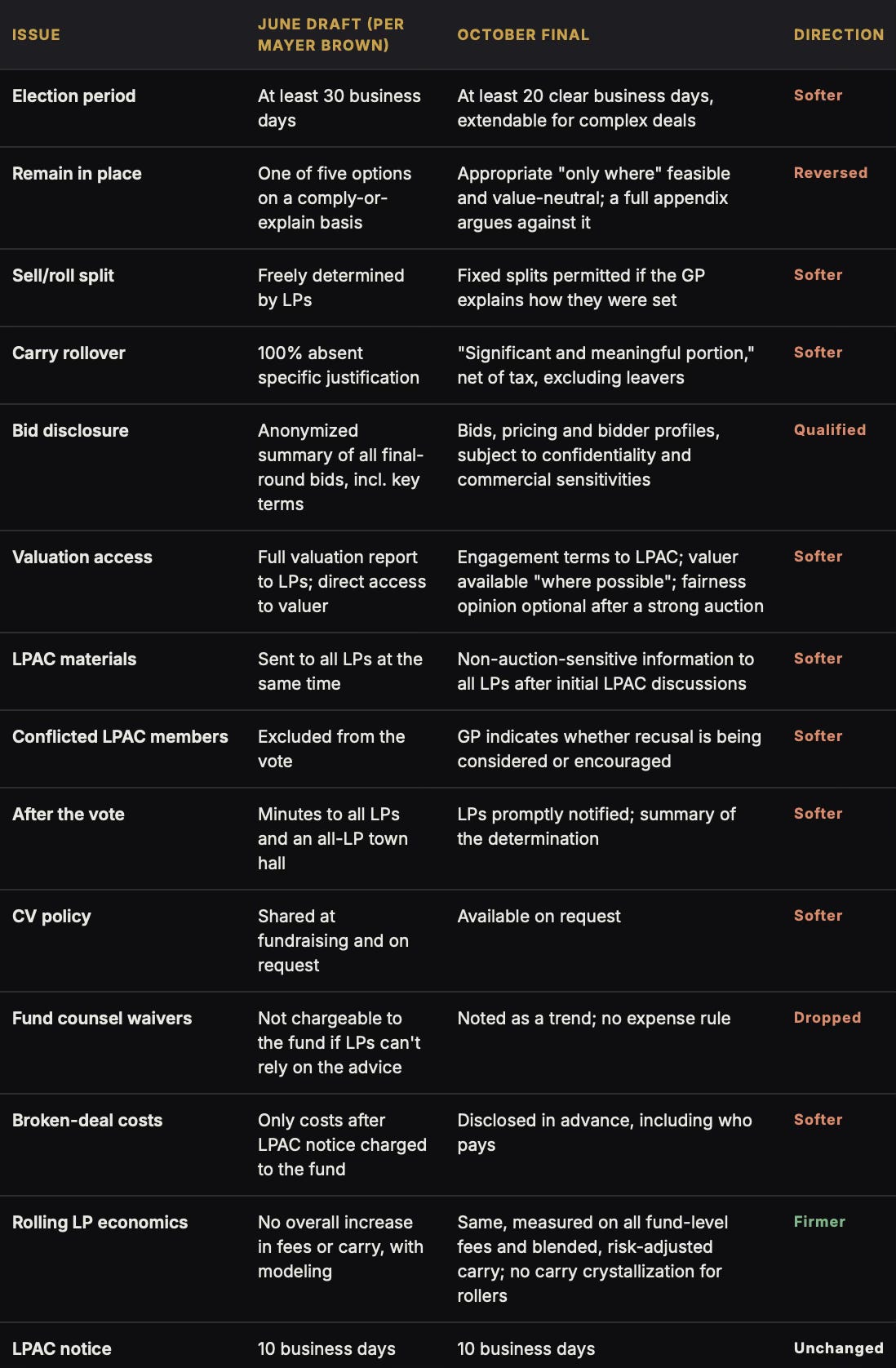
Election periods: back to 20 days
The draft wanted at least 30 business days for LP elections, per Mayer Brown. The final settles on 20 “clear” business days, which is the 2023 level. ILPA now echoes the buyer-side argument: longer windows let valuations go stale and invite MAC clauses, price adjustments and holdbacks. For complex multi-asset deals, its answer is that LPs should speed up their own approvals and write longer windows into side letters.
Remain in place: from option to exception
This is the biggest reversal. The draft listed remain in place among five options GPs had to offer or explain away. The final allows it “only where” it doesn’t hurt pricing, governance or the rest of the fund. A new appendix argues against it. It cites weaker bids, a minority stake that has to be sold later (probably to the CV itself) and two LP pools with diverging interests in one fund.
A strip sale, or a “remain in place” structure, “is liquidity, not an exit.”
ILPA, Continuation Vehicles guidance, October 2026
ILPA keeps the economic protection, since rolling LPs must be no worse off, but drops the structural one. That matters for the Delaware sovereign wealth fund suit (C.A. No. 2025-1389-NAC). Per Mayer Brown’s summary of the complaint, it alleged rollers had no option to stay on existing economics. The no-worse-off test answers that complaint. An LP that wants to stay in the old fund gets no support.
Carry and bids
Our October 9 super carry piece asked whether final-round bid disclosure would survive. It did, with a caveat. GPs must still share bids received, pricing, bidder profiles and the reason for choosing the winner, but now “subject to binding confidentiality limitations and reasonable commercial sensitivities.” Conflicts such as a bidder backing the GP’s flagship fund must be disclosed.
Carry rollover dropped from 100% in the draft to a “significant and meaningful portion,” net of tax. For European whole-of-fund waterfalls, only carry tied to the CV assets should be rolled. Super carry survives. ILPA calls waterfall resets longstanding practice outside the US, including premium carry of 30%, as long as rolling LPs end up no worse off.
What got tougher
The economics test got tougher. Rolling LPs’ fees are compared across all fund-level costs, and their carry on a blended, risk-adjusted basis. Carry can’t be crystallized for rollers. GPs must also show their own economics with and without the CV.
The test is “whether the GP is better off with the CV than without it.”
ILPA, Continuation Vehicles guidance, October 2026
The final also bars rolls conditional on commitments to other GP funds and treats LPs who don’t respond as sellers. It requires the CV to fund the full purchase price. Mayer Brown’s draft summary doesn’t mention these provisions, so they may or may not be new.
Long story short
The draft set minimums for the whole market. The final leaves LPs to win the specifics themselves in side letters and LPAs, including longer election windows, mirror reporting and disclosure templates. Large allocators can negotiate that. Smaller LPs will have to rely on a standard that is firm on economics and flexible on process. The next test is credit, where multi-asset CVs are far more common than in the buyout funds this guidance was written for.