


TPG’s second-quarter print was, on its face, a private equity growth story: $327 billion in AUM, 27% fee-related revenue growth, and a CFO transition getting most of the analyst airtime. But buried in the supplemental fund-performance tables, and in one unscripted answer from CFO Jack Weingart, is a more specific story for secondaries readers: TPG has quietly built out a continuation vehicle capability across three platforms, and its dedicated Asia GP-led secondaries shop, NewQuest, now has enough vintage history to actually assess.
The NewQuest data set
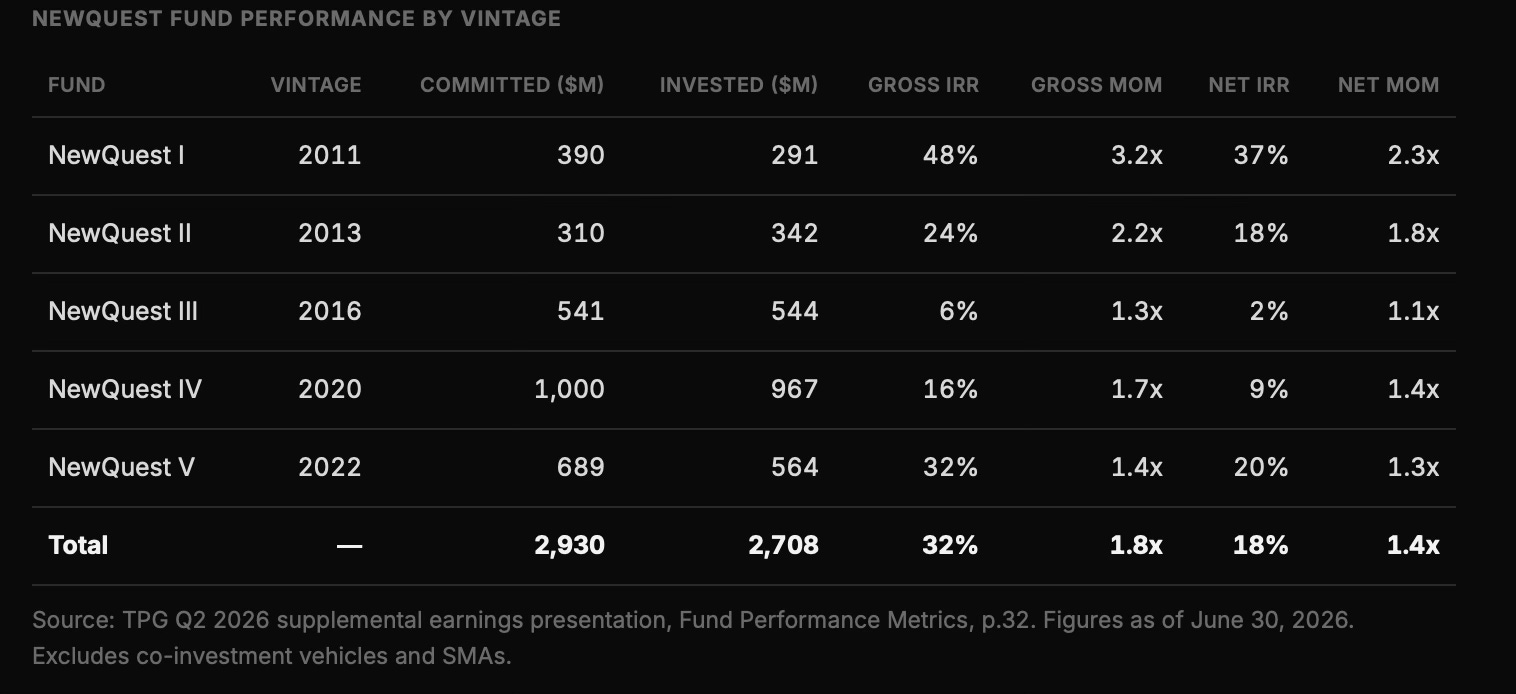
NewQuest sits inside TPG’s Market Solutions platform, alongside GP Solutions and the Peppertree infrastructure business. It’s TPG’s dedicated Asia GP-led secondaries vehicle family, and this quarter’s supplemental deck disclosed fund-level performance across all five vintages for the first time in the detail Secondary Scoop has seen from the firm:
The pattern is the one secondaries watchers will recognize from other GP-led specialists that have now been through a full cycle: the earliest, most mature vintage (NewQuest I, 2011) is comfortably the top performer at a 37% net IRR and 2.3x net MoM, while performance compresses through the middle vintages as capital scaled and Asia GP-led pricing tightened, before ticking back up in NewQuest V’s 2022 vintage — still too young for the metric to fully mature, but tracking a 20% net IRR early.
FOR READERS NEWER TO THE SPACE
NewQuest was built as a dedicated sponsor of GP-led continuation vehicles for Asian mid-market private equity: buying out existing LPs in a fund and rolling the underlying assets into a new vehicle that TPG controls and manages going forward, typically alongside fresh capital from new investors. It sits apart from a traditional LP-led secondaries desk, which simply buys existing fund stakes without restructuring the GP relationship. TPG folded NewQuest into its Market Solutions platform, the same reporting segment that houses GP Solutions and the Peppertree infrastructure business.
Three platforms, three continuation vehicles
Beyond NewQuest’s dedicated book, TPG’s fund performance tables disclose continuation vehicles sitting inside two other platforms, Capital and Credit, giving a rare cross-platform view of how a large-cap manager uses the structure for very different purposes.
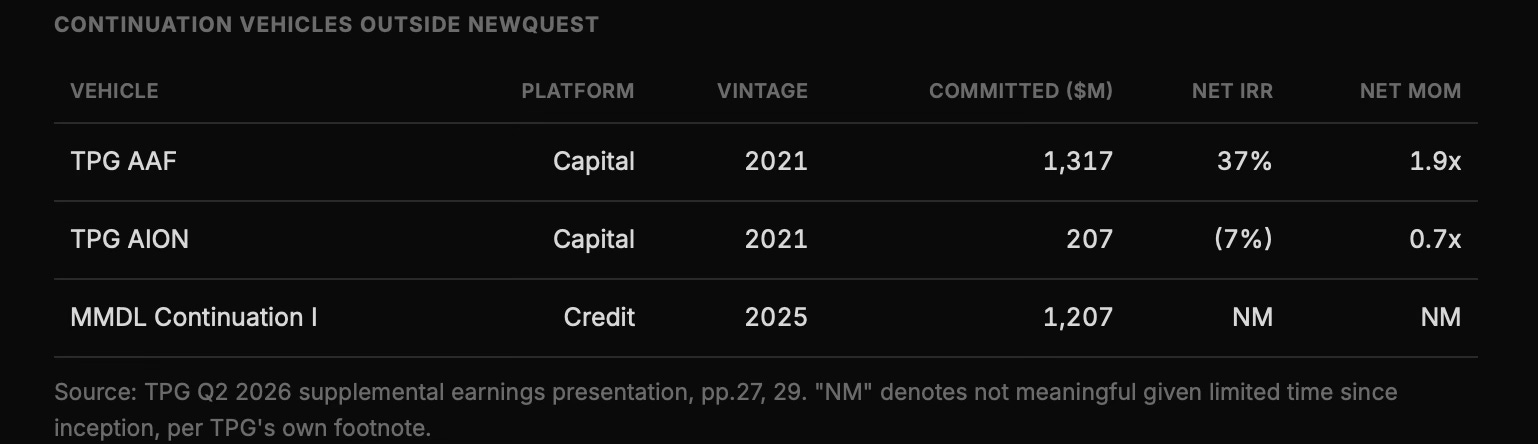
The Capital platform’s two continuation vehicles tell opposite stories at the same vintage year. TPG AAF, at $1.3 billion of commitments, has generated a 37% net IRR and 1.9x net MoM, performance in line with, or ahead of, several of TPG’s flagship drawdown funds of comparable vintage. TPG AION, a smaller $207 million vehicle from the same 2021 vintage, sits at a 7% net loss and 0.7x net MoM, a reminder that CV performance dispersion within a single manager’s own book can be as wide as anything LPs see across the broader market.
On the credit side, MMDL Continuation I, a $1.2 billion vehicle launched in 2025 out of TPG’s Middle Market Direct Lending franchise, is too new to carry a meaningful return yet, but its size alone is notable: it’s larger than four of the seven numbered MMDL flagship funds by commitment.
The line investors should have caught: TDM
The most interesting secondaries disclosure this quarter wasn’t in a table, it came from CFO Jack Weingart answering a question about Growth platform fundraising drivers.
“We have a fund, a digital media fund that was purpose-built for a limited LP base, that we effectively got a continuation vehicle on which crystallized some carry, but also let us continue to manage those assets going forward and continue to earn fees and carry on that.”
JACK WEINGART, CFO, TPG Q2 2026 EARNINGS CALL, AUGUST 4, 2026
Cross-referencing the fund tables points to TDM, a 2017-vintage Growth-platform fund with $1.3 billion committed and $603 million invested, as the vehicle in question. TDM is explicitly named as a driver of Growth-platform realized performance allocations both in the quarter ($19 million of the platform’s $35 million total) and year-to-date ($28 million of $103 million), which is consistent with a fund that recently ran a continuation process and booked a realization event.