


Four years into the distribution slowdown, the secondaries market is on track for another record. Evercore counted $121bn of volume in the first half of 2026, with GP-leds taking 54% of it. The headlines go to the mega-funds and the billion-dollar continuation vehicles. Yvan Chene spends his time at the other end.
Yvan is managing director on Capital Dynamics’ secondaries team, joined the firm in 2015 after five years at Fondinvest Capital in France. His argument is simple. A large share of secondary deals are small, most secondary capital is not, and that gap is where a mid-market buyer with a primary platform earns its returns. The bar on quality, he says, does not necessarily move with price.
We spoke about who is selling, whether continuation vehicles fix the liquidity problem, and the discipline a buyer needs when GP-leds are everywhere.
ON ACCESS
You have been in secondaries since 2010. What has stayed constant?
“I started my career in 2010. I was working at Fondinvest Capital in France for five years, focused on mid-market, but European secondaries at the time. And at that time, you didn’t really have GP-leds, so secondaries were just old school, buying stakes in funds or portfolios of stakes in funds.
Then in 2015, that’s when I joined Capital Dynamics, I wanted to go more global, more international, do what I was still doing in the mid-market, but not only in Europe, also in the US, Europe, Asia. And I figured out that it’s easier to do secondaries if GPs like you, which is still very true these days. And GPs like you if you give them money on the primary side.
It’s an insider business. Let’s say you want to buy a portfolio deal of 60 funds. We’re doing a few of these right now. The broker has to call every single GP [with a] simple question. Are you OK if Capital Dynamics is in the deal? They can refuse.
With a relationship, a buyer can talk to the GP directly and review a deal company by company, line by line, rather than relying on the report alone. OK, when do you expect to exit this company? At which valuation? Is this exit really happening? We know what you put in the report. And that discussion is very value-added versus just the pure report”.
“It’s an insider business.”
Yvan Chene, on why a primary platform matters in secondaries
ON THE DPI DROUGHT
How does the drought show up in your deal flow, and how is the small end different?
“The DPI drought is affecting everybody. It’s really an industry-wide issue. Private equity is not distributing as it should. It’s around 10 to 14 percent of NAV in the last four years, whereas in the past it used to be 25 percent.
So different types of investors are using the secondary market to [take] liquidity matters into their own hands. And that for us is the opportunity.
Now, the small end. What is exciting is that this segment is particularly undercapitalized versus the broader secondary market. The secondary market is very concentrated: Campbell Lutyens counts the top 15 buyers at over 70 percent of 2025 volume. But by the number of deals, a large share is small. Jefferies counts about 41 percent of 2025 deals at under 250 million dollars, yet only 13 percent of volume. So by number, a big part of the market is small, but it doesn’t hit the press. At the small end, there is less capital, and less competition.
On GP-leds, the small end is the same story: by number, most continuation vehicles are $500 million or less, even though the big deals take the headline”.
ON SELLERS
Who is on the other side of your LP deals today?
“By market volume, it’s mostly pension funds and sovereign wealth funds. It’s almost half of the volume. What has changed in the last two to three years is that fund of funds and secondary funds are also selling. That’s 27% of volumes.
The market is on track for a $250 billion to $275 billion in volume this year. But it’s very fragmented. Every deal has had different sellers and different motivations. So it’s a mix of family offices, pension funds, ultra high net worth. Why are they selling? It’s not because they have too much private equity but because they want the liquidity which they’re not getting through the normal channels.
Sellers are now often second-time sellers, third-time sellers, fourth-time sellers. The fact that they tap into the secondary channel multiple times, it tells you about the acute problem in the industry”.
ON GP-LEDS
GP-leds are now more than half the market. Is that cyclical or structural?
“2021 was the year GP-leds, even though they were still a young asset class, became the majority of the market. And this year, 2026, is the first time since 2021 that they’re again the majority of the market. I expect that to continue. It’s possible they get to 60%+ of the market in the next few years, well above where they are today.
If you look at our last funds, we’re still overweight bread and butter secondary, so buying LP stakes and portfolios of LP stakes, but GP-leds are 42-45% of what we do. We’ve done dozens of GP-leds”.
ON CONTINUATION VEHICLES
What separates a good continuation vehicle from a bad one?
“The starting point is complete transparency, market-clearing processes, because you have fundamentally a conflict of interest. You have somebody called the GP who’s sitting on both sides as a buyer and as a seller. So obviously they cannot determine the price. How is the price determined? Market process. What happens is that ultimately the price for single assets is at or very close to NAV.
Then second, the GP needs to have a lot of skin in the game. If you, Mr. GP, are telling us, invest with us, it’s such a great trophy asset. Every asset is a trophy asset. It’s not true. Not every asset is a trophy asset. Skin in the game is essential, and needs to be at least three, four, five percent of GP commitments. If GPs crystallize carried interest through the GP-led, they have to reinvest everything into the new deal. But that’s not enough. We also want them to put in additional cash, new capital, which is a sign of conviction.
If the GP is not top quartile or favoured by my colleagues on the primary platform, we won’t do the deal. Having a robust primary platform allows us to assess GPs, whilst also having a relationship with them.
We like things where it’s more of the same with more runway, more cash, rather than gigantic dreams of rapid growth. You can find even very steady businesses that have good organic growth, for example servicing fridges in Europe for big supermarkets. High single-digit organic growth. We don’t invest in discretionary things, no retail, nothing that is too consumer exposed, especially in Europe”.
“Every asset is a trophy asset. It’s not true. Not every asset is a trophy asset.”Yvan Chene, on GP alignment in continuation vehicles
ON PRICING
How do you underwrite when the GP’s marks and your price diverge?
“NAV is just a number. It’s a GP’s estimate of what these companies are worth. The beauty of our job is we always disagree. But we price. We are pricing agents, essentially.
So we get all the reports, run lots of models, we have the calls with the GPs, and we look at the structure, the competitors to these assets, how they are valued, look at the growth. We have our expected return that we want to clear. And then we come up with a price that make[s] us comfortable. We build in a discount to the NAV to give us a margin of security.
When you do a GP-led, which is often a single asset, then it’s a very intense, very granular underwriting exercise because you only have one company. The data rooms are very, very comprehensive.
We recently conducted a significant piece of work internally based on 15 years of data. Five funds, lots of deals. What we found is that around one third of performance can be attributed to discounts, so it’s good to buy cheap. But the other two thirds comes from growth and value appreciation”.
ON COMPLEXITY
Capital Dynamics says it trades price for complexity. What does that look like, and does a low enough price fix a bad asset?
“Complex deals are without a doubt a lot of work, but this is our sweet spot.
These smaller portfolio deals can still have 50, 60, 100 funds. So who’s going to do these deals? You have to transfer 60 positions from that seller to your fund. And I can tell you that this can take six months and it’s, frankly, a lot of work. Especially over Christmas, trust me! The large funds will not do this because it’s too small for them. And the smaller funds, they don’t have all the good relationships. In each of our funds, we have several of these portfolio deals.
In investing, when you think you understand something, you sometimes don’t, and that’s when you make mistakes.
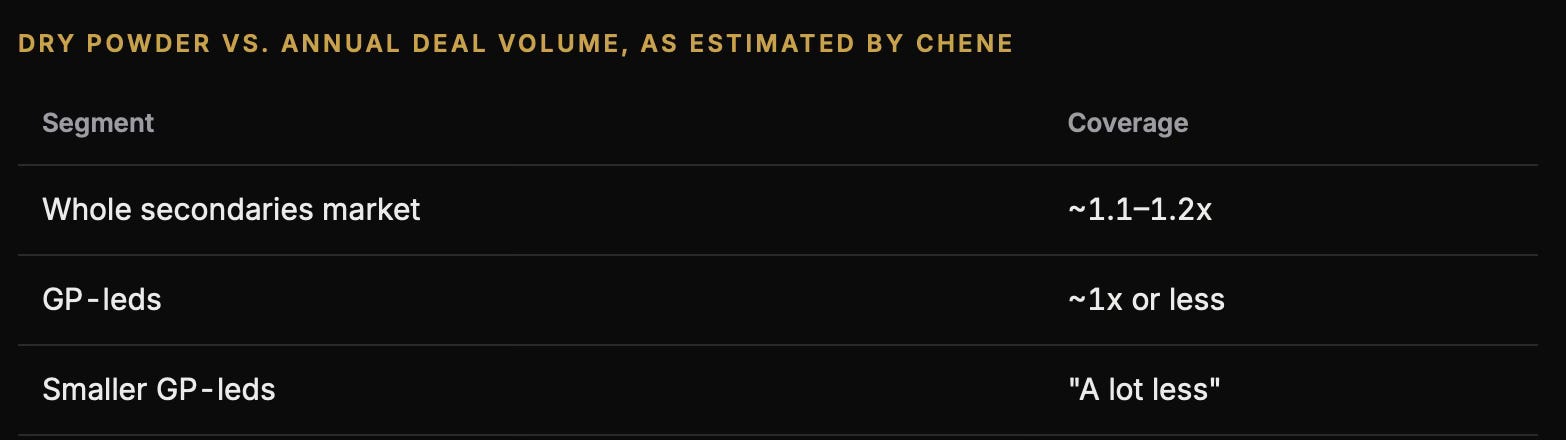
If you take all the capital raised for secondaries, the dry powder divided by annual deal volume is roughly 1.0 to 1.2 times, depending on how you count it. GP-leds look tighter than that, and the smaller GP-leds tighter still. So it’s quite undercapitalized. So if you come to the market with a deal that’s not exciting, no one will pay.
If it’s not good, we don’t touch it, no matter what the price is”.
“If it’s not good, we don’t touch it, no matter what the price is.”
Yvan Chene, Capital Dynamics, on complex deals.
CAPITAL DYNAMICS’ SECONDARIES PROGRAM
Capital Dynamics closed Global Secondaries VI in November 2024 with about $1.1bn of commitments, above its hard cap. The strategy targets smaller, often complex transactions globally, from single LP positions to GP-led structures. Source: Capital Dynamics press release.
The secondaries team is led by Joseph B. Marks, with managing directors Yvan Chene and Mauro Pfister.