


KKR has talked about secondaries since it announced the Arctos deal in February. At an investor conference that month, CFO Rob Lewin called secondaries “probably the largest addressable market” of the three Arctos verticals. On the Q2 call, the GP-led strategy was still something KKR was weighing. On November 9, Lewin’s prepared remarks gave it a year for the first time.
“We are making great progress on a new GP-led secondary strategy that we expect to launch in 2027.”
Rob Lewin, CFO, KKR, Q3 2026 earnings call, November 9, 2026
At BMO’s financials conference the next morning, the wording was more cautious. KKR is “likely to launch a GP-led secondary strategy in 2027,” Lewin said. He described it as a combination of “Arctos’ platform and team and brand and our capabilities, obviously on the asset selection side,” and repeated the “right to win” language he has used since February. He also said, plainly, where things stand:
“Next part of the business hasn’t been built yet, but is really very much consistent with the heritage of the leadership team and management team at Arctos.”
Rob Lewin, CFO, KKR, BMO Financials Conference, November 10, 2026
Six months after closing, KKR says the rest of Arctos is ahead of plan. Lewin said on the call that the business is “tracking well ahead of budget.” The Q3 release lists Arctos Sports Fund III as one of the main sources of private equity capital raised in the quarter. The secondaries vertical is the one piece without a product.
WHAT SITS INSIDE KKR SOLUTIONS
KKR Solutions launched when the Arctos acquisition closed on May 4. It is led by Ian Charles and has three verticals. Arctos Sports buys minority stakes in professional sports franchises. Arctos Keystone provides GP solutions: structured, non-dilutive capital for alternative asset managers. A secondaries business does not exist yet.
Keystone is adjacent to secondaries, not part of them. It provides capital to managers, not liquidity to LPs or continuation vehicles for assets. KKR describes Keystone’s $6bn-plus close as the largest first-time fund in GP solutions. It is not a secondaries fundraise and should not be read as one.
The $100 billion arithmetic
KKR has said since February that it expects KKR Solutions to pass $100 billion of AUM over time. Lewin repeated it on Monday and went further at BMO:
“To be very clear, we would not have done the acquisition if we didn’t think we could do that.”
Rob Lewin, CFO, KKR, BMO Financials Conference, November 10, 2026
Arctos had $20 billion of AUM at the end of June, according to KKR’s Q2 release. Getting from there to $100 billion means adding roughly $80 billion. The fund table in the Q3 release shows what the existing verticals bring:
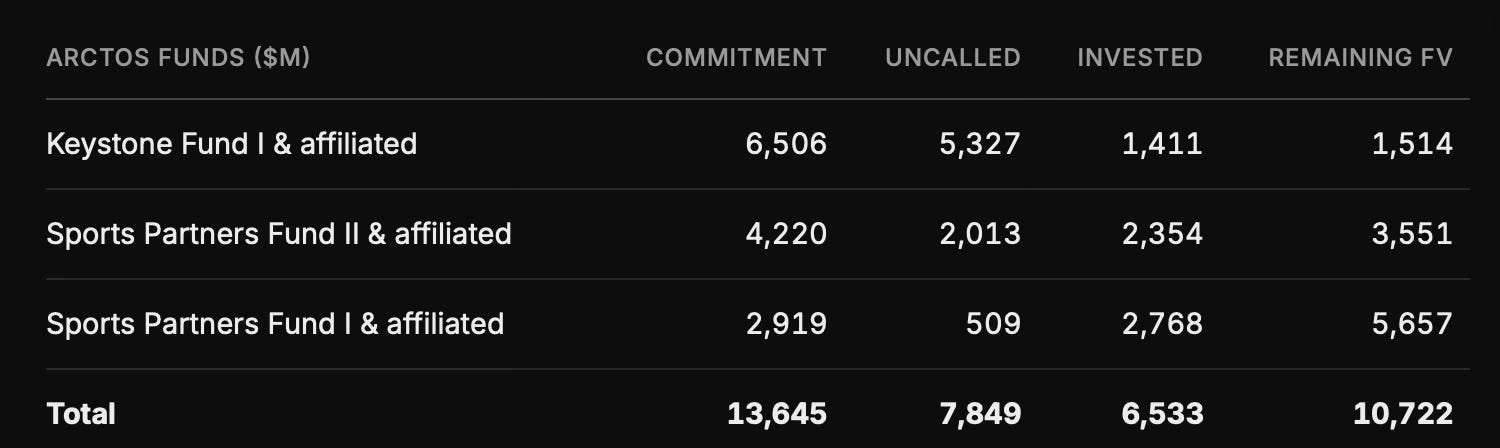
Source: KKR Q3 2026 earnings release, Investment Vehicle Summary – Asset Management, as of September 30, 2026. Totals calculated by Secondary Scoop. Arctos Sports Fund III, launched in Q3, is not yet listed separately.
Sports is growing. Fund III is in market, and Fund II’s remaining fair value is 1.5x its invested capital. Keystone is early: 22% of commitments invested, with remaining fair value of $1.51 billion against $1.33 billion of remaining cost. Neither looks large enough on its own to account for most of an $80 billion gap. That leaves secondaries, the vertical Lewin called the largest addressable market, carrying much of the target. KKR has not split the $100 billion by vertical, so this is our reading, not company guidance.
A late entrant, by design
Launching in 2027 puts KKR into GP-leds after several rivals have closed record funds. CVC closed SOF VI at $10 billion in September. EQT now owns Coller. Hamilton Lane launched its first GP-led-focused vehicle this month. KKR will enter that market with a new fund and no GP-led track record under its own name.
Lewin’s case rests on two things he doesn’t think competitors can easily copy. The first is selection: KKR’s sector teams and portfolio operations underwriting single assets. The second is capital. At BMO he described Arctos’s capital as “as close to permanent capital as it comes in our space,” and said 93% of KKR’s capital is perpetual or locked up for eight years or more. KKR has not said whether the GP-led strategy will be a closed-end flagship, an evergreen vehicle or both. Given that K-Series AUM is now $45 billion, up 55% year over year, it is a fair question.
Lewin set the bar for new strategies in the Q&A. An analyst asked how KKR will keep growing management fees when flagship fundraising slows from 2027. Lewin didn’t mention the GP-led strategy by name, but he described the test any new product has to pass:
“We’re not going to start something new unless it can be really scalable and we think we can be uniquely great at it.”
Rob Lewin, CFO, KKR, Q3 2026 earnings call, Q&A
None of the roughly 15 analyst questions on the call asked about KKR Solutions or secondaries. They spent most of the Q&A on Global Atlantic and the decision to grow insurance again in Q3, on AI infrastructure exposure, and on earnings quality, including the mix of transaction fees, capital markets and performance revenues behind the beat. Others asked how the $3.3 billion from the USI sale will be deployed and how deep the realization pipeline runs after a record year of distributions. The rest covered wealth, the midterms and 401(k) access, private equity value creation and real estate. The firm says KKR Solutions will be a $100 billion business, but analysts haven’t started asking about it yet.
Telling that a $100bn Solutions target is leaning on a secondaries platform the CFO admits hasn't been built. KKR's 2027 date is easy to set, the execution risk is in the sourcing, valuation and LP distribution mechanics that usually take a dedicated team two to three years to get right. Curious whether Lewin is banking on bolt-ons to Arctos rather than building in house.