


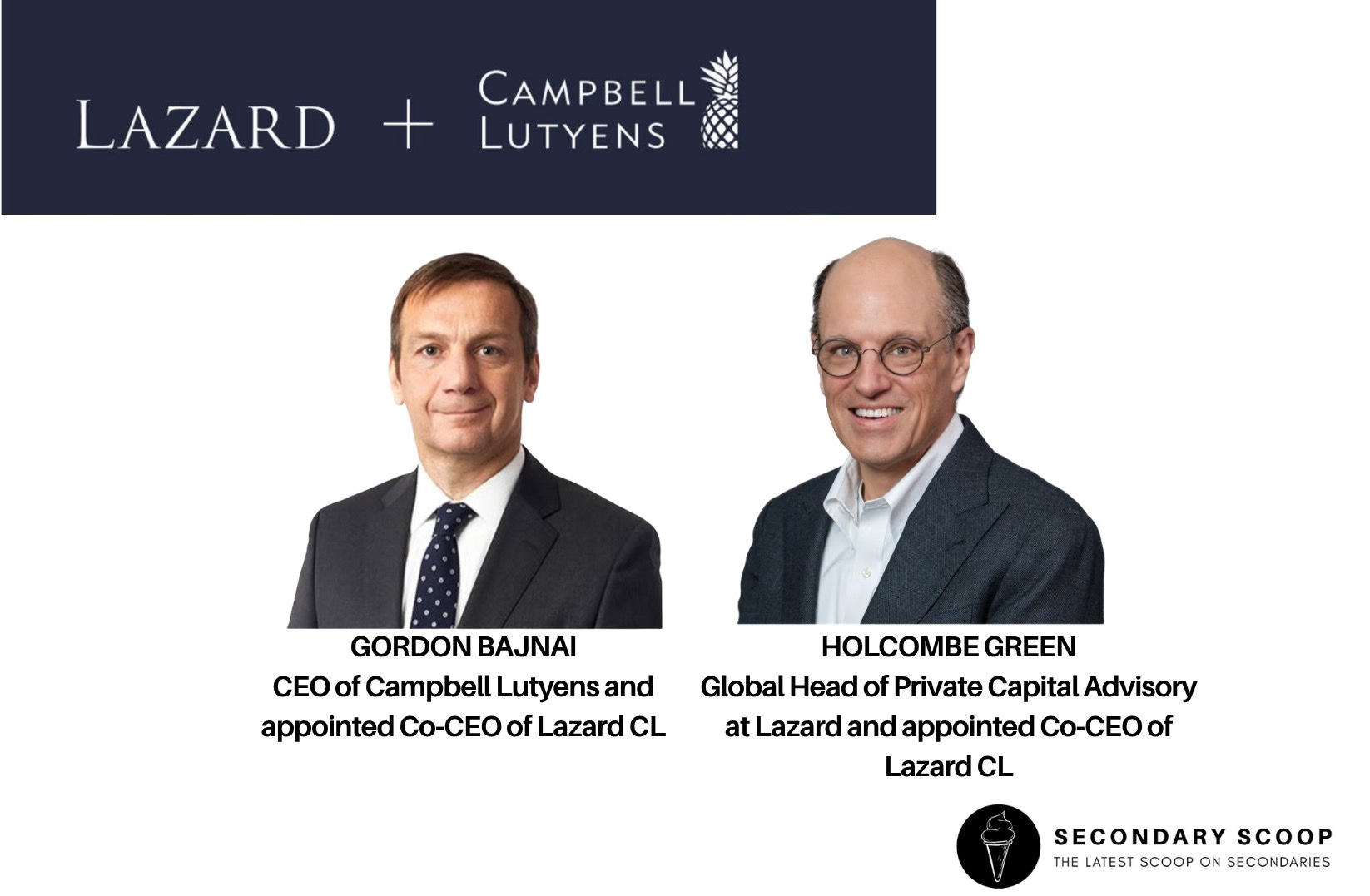
The headline from Lazard’s first quarter 2026 earnings call was impossible to miss: the $575 million acquisition of Campbell Lutyens and the creation of Lazard CL. But for those tracking the secondaries market closely, the more interesting story is what the Campbell Lutyens deal reveals about a much broader strategic repositioning that has been quietly underway at Lazard for years — and is now accelerating on multiple fronts simultaneously.
The Revenue Mix Shift Nobody Is Talking About
Before getting to the deal itself, consider this number: private capital connectivity revenue has grown from approximately 25% of Lazard’s total advisory revenue in 2019 to 40% today. Upon closing of the Campbell Lutyens acquisition, it will hit 50% — while total revenue continues to grow.
That is not a tactical adjustment. That is a structural transformation of what kind of firm Lazard is becoming. And secondaries advisory sits at the center of it.
CEO Peter Orszag was deliberate in framing this on the call: “The acquisition of Campbell Lutyens and establishment of Lazard CL strengthens our ability to deliver for clients at a time when fundraising is increasingly competitive and liquidity solutions are more complex.” The operative phrase is liquidity solutions. That is secondaries language, not traditional M&A language — and it is now driving half of Lazard’s advisory revenue story.
The Campbell Lutyens Deal: GP-Led Meets LP-Led
The strategic logic of the Campbell Lutyens acquisition is best understood through the lens of how the secondaries advisory market has split into two distinct businesses — and how Lazard was only competing in one of them.
Lazard’s existing Private Capital Advisory group has historically been strong on GP-led transactions: continuation funds, GP-led secondaries processes, and capital solutions for general partners. Campbell Lutyens, by contrast, has built its franchise predominantly on the LP side — advising institutional investors on portfolio sales, tender offers, and secondary dispositions.
Orszag described this as a “Lego piece nature” with “very little overlap.” In his words: “We’re now balancing in the secondaries market GP transactions — that are a source of excellence — with LP transactions that are on the Campbell Lutyens side more of the focus.” The combined Lazard CL platform will have over $100 billion in GP and LP secondary transaction volume over the past two years, more than 280 advisory professionals across 18 offices globally, and coverage across private equity, private credit, infrastructure, and real estate.
Lazard CL will be co-led by Holcombe Green, Lazard’s Global Head of Private Capital Advisory, and Gordon Bajnai, the current CEO of Campbell Lutyens, both reporting directly to Orszag.
The Flywheel: When Restructuring Feeds Secondaries
One of the most underreported angles from the call is the connection Orszag drew between Lazard’s restructuring and liability management business and its growing secondaries platform.
The logic works in both directions. When Lazard advises a distressed company on a liability management exercise — whether that is a debt exchange, an uptier transaction, or an amend-and-extend — those relationships naturally surface secondaries opportunities. LPs holding stakes in stressed funds may need liquidity. GPs may need capital solutions to support portfolio companies under pressure. The restructuring team opens the door; the secondaries team walks through it.
The reverse is equally true. Strong LP and GP relationships built through the secondaries and fundraising business generate introductions to restructuring and M&A mandates. Orszag was explicit: “There was a business flow in both directions. This was a core part of the strategic logic of the transaction.” He underlined the point by noting that just before the Campbell Lutyens announcement, he interviewed a senior banker “who was highlighting the importance of the secondary business to his M&A franchise.”
This flywheel is not theoretical. Lazard’s restructuring and liability management business delivered robust growth in Q1, supporting overall results alongside private capital advisory at a moment when pure M&A revenue came in below expectations. The diversification is already working.
Data and AI: The New Moat in Secondaries Advisory
Perhaps the least-discussed but most forward-looking element of Lazard’s secondaries strategy is the data and AI layer being built into Lazard CL from day one.
Orszag identified a structural problem in the secondaries market that most practitioners know well but rarely discuss publicly: “Really nuanced information and data on both GPs and LPs is difficult for most people to obtain.” The combination of Lazard’s existing PCA dataset with Campbell Lutyens’ proprietary LP and GP data — built over nearly four decades and across more than 3,700 institutional LP relationships — creates an information advantage that will be difficult to replicate.
Lazard’s stated intention is to pair this combined dataset with its AI capabilities to “deliver deeper insights for clients” and to advance its goal of becoming the leading AI-enabled independent financial firm. In a market where pricing, process management, and counterparty matching have historically depended on relationship networks and institutional memory, a data-rich platform backed by AI infrastructure represents a genuine structural edge — not just a marketing talking point.
The Talent Signal: Secondaries Is Now a Recruiting Tool
A small but telling detail from the call deserves attention. When discussing Lazard’s hiring pipeline for 2026, Orszag noted that he had personally interviewed a senior banker earlier in the week who cited the importance of the secondaries business to his M&A franchise as a reason for considering Lazard.
That is a reversal of the traditional dynamic. For most of the past two decades, M&A prestige attracted talent to advisory firms, and secondaries was a back-office function or a niche add-on. The fact that secondaries capability is now being cited by M&A bankers as a reason to join a firm — before the Campbell Lutyens deal had even been announced publicly — signals a meaningful shift in how top talent is evaluating platform strength.
Orszag connected this directly to the flywheel thesis: with Lazard CL in place, the firm’s ability to recruit and attract talent will expand further. The secondaries platform is becoming a talent magnet, not just a revenue line.
What This All Means for the Secondaries Market
Four takeaways that go beyond the Campbell Lutyens headline:
First, the 25%-to-50% revenue shift at Lazard is a leading indicator for the entire independent advisory industry. Firms that cannot demonstrate credible secondaries and private capital connectivity capabilities will increasingly find themselves losing mandates — and talent — to those that can.
Second, the GP-led vs. LP-led segmentation of the secondaries advisory market is real and strategic. The firms that cover both sides of the table, without conflicts, will define the next generation of the business.
Third, the connection between distressed advisory and secondaries is becoming a structural feature of the market, not a situational overlap. As more companies navigate complex capital structures and LPs face pressure to manage portfolio exposures, the firms that can move seamlessly between restructuring and liquidity solutions will have a compounding advantage.
Fourth, proprietary data combined with AI is emerging as the new barrier to entry in secondaries advisory. Relationships have always mattered in this market. But the firms that can overlay data intelligence on top of those relationships will consistently win on execution, pricing, and counterparty identification in ways that relationship-only platforms cannot match.
Lazard’s Q1 2026 earnings call was not just about one acquisition. It was a blueprint for what the leading secondaries advisory platform of 2030 will look like.
