


There is a quiet engine running underneath Franklin Templeton’s record-breaking fiscal year 2026. It is not the ETF platform that has doubled in 18 months. It is not the tax optimization business growing at a 72% CAGR. It is not even the AI-powered sales platform built with Microsoft.
It is Lexington Partners — and the booming global market for secondary private equity that surrounds it.
Franklin Templeton’s Q2 2026 earnings call, held on April 28, painted the picture of an asset manager that is firing on all cylinders. But look closely at the numbers and the narrative, and one theme keeps surfacing: the secondaries business is becoming the firm’s most powerful long-term growth driver, and the best may still be ahead.

A Fundraising Machine in Full Swing
Start with the headline numbers. Franklin Templeton raised $13.2 billion in private market assets during the quarter alone, diversified across alternative credit, secondary private equity, real estate, and venture strategies. Fiscal year-to-date private markets fundraising has already reached $22.7 billion — matching the entire fiscal year 2025 total with two quarters still to go.
The firm entered fiscal 2026 with an annual fundraising target of $25-30 billion, already an upward revision from the prior year’s goal. By the second quarter, CEO Jenny Johnson was signaling they expect to come in above $30 billion for the full year. That would represent a new record for the platform.
Secondaries is at the center of that story.
Lexington: On Track for a Generational Raise
Lexington Partners, the secondaries giant Franklin Templeton acquired in 2022, is currently in the market with its next flagship fund. Management declined to disclose specific figures ahead of an expected regulatory filing later in the fiscal year, but the signals from the earnings call were unambiguous.
Lexington contributed “meaningfully” to the quarter’s fundraising. It is “right on track.” Demand for the strategy is strong. And when an analyst asked point-blank whether there was any reason the new flagship could not match or exceed the size of its predecessor — Lexington X, which closed at $22 billion — Johnson did not hesitate: there is no reason to think otherwise.
For context, a fund that matches or beats that figure would make it one of the largest secondaries vehicles ever raised. The secondaries market has been on a structural growth trajectory for years, but the current environment — marked by a massive overhang of unrealized private equity value, LP pressure for liquidity, and a slowdown in traditional exit activity — has created what many practitioners describe as a golden moment for secondary buyers.
Franklin Templeton is not just observing that trend. Through Lexington, it is one of the primary beneficiaries of it.
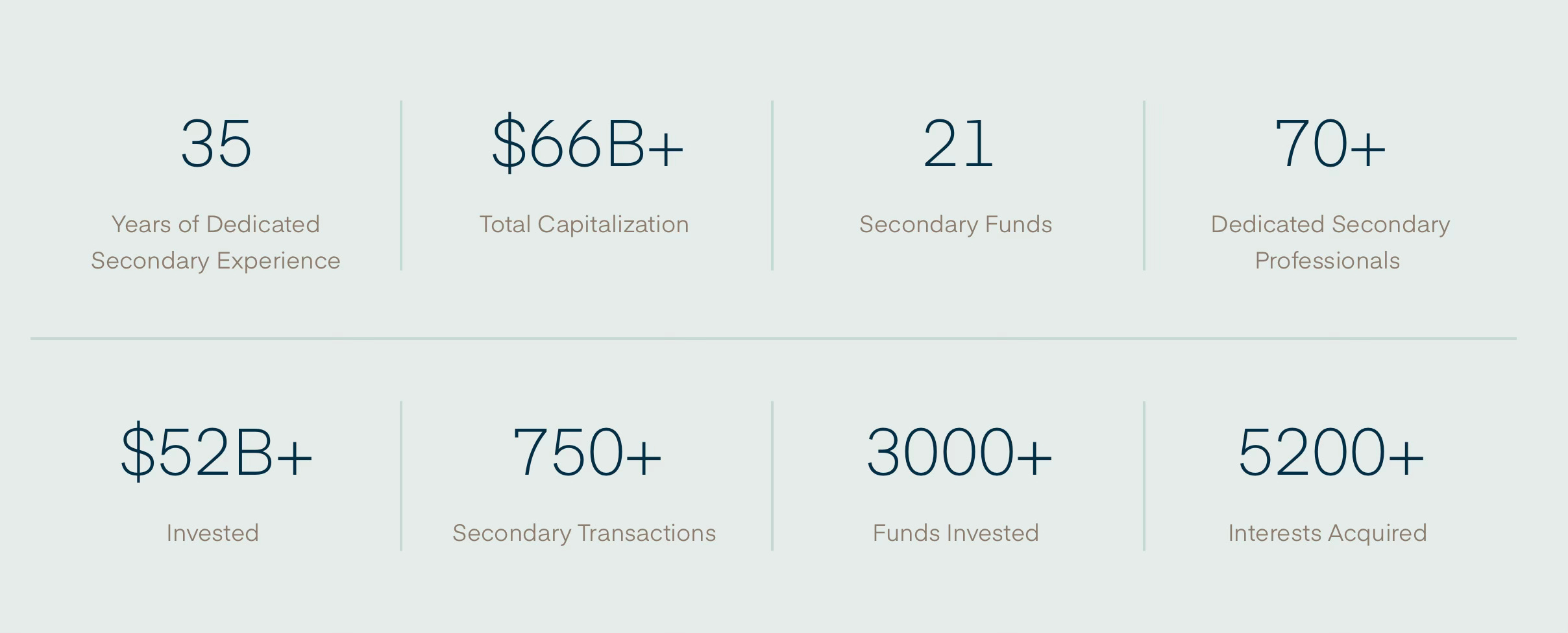
Lexington Partners' Secondaries Business: Key Figures
Why Secondaries? The Macro Case Has Never Been Stronger
Johnson articulated the investment thesis clearly during the call. Investors are increasingly focused on three things: liquidity solutions, portfolio rebalancing, and access to high-quality assets at more attractive entry points. That is a near-perfect description of what the secondaries market offers.
After years of record primary fundraising and limited distributions from private equity managers, LPs across the globe are sitting on large, illiquid portfolios and facing mounting pressure to generate cash for new commitments, rebalance their allocations, or simply right-size their private equity exposure. The secondary market is the mechanism through which that happens — and Lexington, with data on 55,000 private companies and decades of underwriting expertise, is positioned as a premier buyer in that process.
The firm’s secondaries strategy is not just about capturing discounts at entry. As Johnson explained on the call, the initial discount at close has historically represented between 20% and 25% of total return over the life of a secondaries fund. The majority of value creation still comes from the underlying assets — which means selectivity and underwriting quality matter enormously. Lexington’s edge, in management’s view, is the depth of its information advantage and its ability to be selective in a market where not all sellers are equal.
The Evergreen Bridge to Wealth Management
Beyond the institutional flagship, Franklin Templeton is building a parallel secondaries distribution channel through its evergreen product suite — and the traction is notable.
The Lexington-managed evergreen vehicle, designed for the wealth management channel and offered alongside similar structures from Benefit Street Partners (private credit) and Clarion Partners (real estate), is part of a combined platform that has reached $8 billion in AUM across the three strategies. Together, these vehicles are raising approximately $200 million per month — a pace that has remained consistent in recent quarters with no signs of slowing.
This matters for two reasons. First, it represents a structural expansion of the secondaries investor base beyond institutional LPs into the wealth channel — a democratization trend that is still in its early innings across the industry. Second, it provides Franklin Templeton with a recurring, diversified fundraising stream that complements the lumpy, flagship-driven cycle of traditional closed-end funds.
Critically, management noted they have seen zero pressure from redemptions across the evergreen suite. In a market where some managers have faced redemption queues on similar products, that is a meaningful data point.
The Markup Controversy: Lexington’s Clean Record
No conversation about the secondaries market in 2026 can avoid the regulatory and reputational scrutiny that has emerged around valuation practices — specifically, the practice of marking up assets immediately upon close based on the implied discount to NAV.
An analyst raised the question directly during the call. Johnson’s response was measured and instructive. She acknowledged that a specific competitor’s decision to change its valuation policy — and the lack of clarity around how that change was communicated — generated significant market noise. But she was clear that this was not a Lexington issue.
The framing she offered is worth understanding: in a well-run secondaries fund, the discount negotiated at entry is just one component of returns, and not the dominant one. Over the life of a fund, asset appreciation in the underlying portfolio drives the majority of value. A manager that tries to front-load returns through aggressive mark-ups at close is, in effect, borrowing from future performance — and sophisticated LPs know it.
For Lexington, management’s position is that their valuation approach has been consistent and transparent, and the current regulatory attention on competitors does not change their underwriting or reporting framework. On the question of whether the scrutiny is dampening LP demand for the asset class broadly, Johnson was dismissive: the structural drivers of secondaries demand are independent of short-term valuation controversies.
The Numbers Behind the Narrative
The secondaries momentum is showing up clearly in Franklin Templeton’s financial results. Overall alternatives AUM hit a record $282.8 billion in Q2 2026. The alternatives segment generated $12.4 billion in net inflows for the quarter — the largest contributor to the firm’s total $16.9 billion in long-term net inflows.
Adjusted operating income reached $474.6 million, up 8.5% from Q1 and 25.8% year-over-year. Adjusted operating margin expanded to 27.1%, up from 25.0% the prior quarter and 23.4% a year ago. Management is guiding toward margins in the high 29s by Q4 fiscal 2026, with a path to 30%+ in 2027 — ahead of their own plan.
The institutional pipeline of won but unfunded mandates remained strong at $20.2 billion, consistent with the prior quarter, suggesting the fundraising momentum visible in current results has a runway behind it.
What the Rest of 2026 Looks Like
The second half of Franklin Templeton’s fiscal year 2026 sets up as a potential landmark period for the secondaries business. Lexington’s flagship fund filing is expected sometime in the second half — likely the fiscal fourth quarter ending September 2026 — and will give the market its first formal look at the fundraise’s size and progress.
In the meantime, the evergreen channel continues to compound. The institutional pipeline continues to refill. And the macro environment for secondaries — elevated dry powder, limited distributions, LP liquidity needs, and a growing appetite among non-U.S. investors for the asset class — shows no signs of reversing. Management noted that 40% of alternatives fundraising now comes from outside the United States, with APAC at 23% and EMEA at 16%, and that demand for secondaries specifically is part of that international growth story.
Franklin Templeton entered the secondaries market in a meaningful way with the Lexington acquisition in 2022. Three years later, that bet is paying off in ways that are showing up not just in AUM and flow figures, but in the firm’s margin expansion, its competitive positioning in the wealth channel, and its ability to tell a coherent growth story to investors and analysts alike.
The question heading into the back half of 2026 is not whether secondaries will be a record year for Franklin Templeton. Based on what the numbers are showing, it already is. The question is by how much.
This article was written based on Franklin Templeton’s Q2 2026 earnings call transcript and investor presentation dated April 28, 2026. All figures are non-GAAP unless otherwise noted.