


Lexington Partners’ flagship fund will exceed $10 billion by September, Franklin Templeton CEO Jenny Johnson told analysts on the company’s Q3 FY2026 earnings call, the first concrete figure the firm has attached to the fund since it acquired Lexington in 2022. Johnson called the fundraise “very much on track,” with September marking the end of Franklin’s fiscal year.
It’s the number we’d been waiting for. In May, writing about Lexington quietly powering Franklin’s best year ever, we noted that management wouldn’t attach a figure to the flagship, deferring that to a regulatory filing expected later in the fiscal year. Today’s call didn’t produce that filing, but it produced the next best thing, plus a second, less-publicized detail: Lexington’s contribution to the quarter’s fundraising was split across four distinct strategies, including, for the first time on an earnings call, an explicitly named continuation vehicle line.
The number everyone was waiting for
Some context on why “$10 billion by September” matters, and why it should be read carefully. Lexington’s prior flagship, Lexington Capital Partners X, closed in 2024 at $22.7 billion, one of the largest secondaries funds ever raised. In May, when Johnson was asked whether there was any reason the next flagship couldn’t match or exceed that figure, she didn’t hesitate to say no. That framed expectations for a fund in the same size class.
What Johnson disclosed this quarter is narrower than that: a running total, not a final close. “By September, they should exceed $10 billion” describes where the fund stands today, mid-fundraise, not what it will ultimately raise. Fund X took multiple years and several closes to reach its final size. A fair reading of that comment is that Lexington XI is tracking toward, not confirmed at, the scale of its predecessor. The real test comes when Franklin files the regulatory disclosure that will show the fund’s actual committed capital, which management has previously said would land later this fiscal year.
Four strategies, one line item
The more granular disclosure came a beat later in the same answer. Of the $10.3 billion Franklin raised in private markets this quarter, Lexington contributed roughly 40%, call it $4.1 billion, and Johnson was specific about where it came from.
“That 40% is in four strategies. Their flagship fund, their middle market fund, their continuation vehicle, and the perpetual all raised and contributed to that.”
Jenny Johnson, CEO, Franklin Templeton, Q3 FY2026 earnings call
Franklin has talked about Lexington’s flagship and its evergreen (”perpetual”) vehicle before. What’s new is the explicit acknowledgment of a standalone continuation vehicle strategy sitting alongside them as an active fundraising line, not a one-off deal, but a recurring product contributing to quarterly numbers. Combined with the middle-market fund, that’s four separate Lexington vehicles in market simultaneously, which is a meaningfully more diversified fundraising engine than the flagship-driven narrative from May suggested.
WHY THE CONTINUATION VEHICLE LINE MATTERS
Lexington has long been known as an LP-led secondaries buyer: acquiring stakes in existing fund interests from institutional sellers. A dedicated continuation vehicle strategy puts Lexington on the GP-led side of the market too: leading or anchoring the vehicles that GPs use to hold onto trophy assets past a fund’s natural life while giving existing LPs an exit. Large diversified secondaries platforms increasingly run both books in parallel, and Franklin naming the CV strategy as a distinct contributor, rather than folding it into “flagship”, suggests it has grown large enough to be worth calling out on an earnings call.
The fundraising target keeps moving up
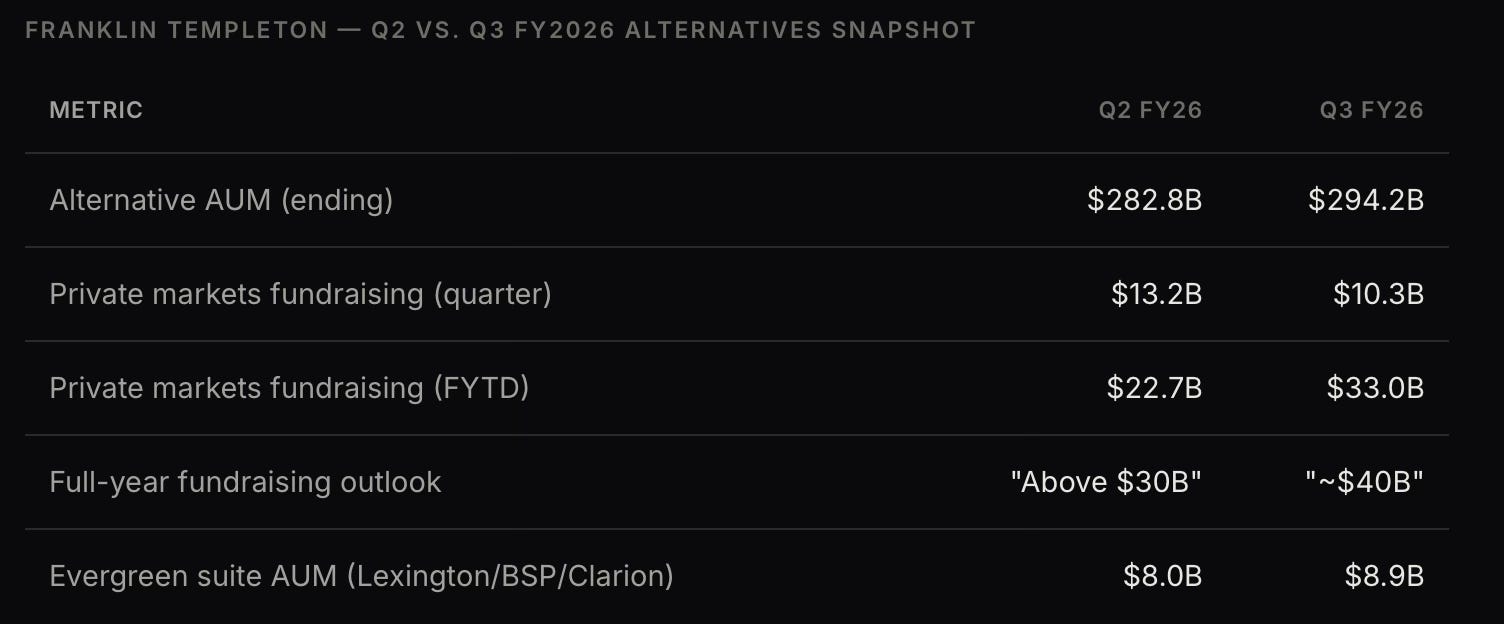
Zoom out from Lexington and the broader private markets story is one of continuous upward revision. Franklin entered fiscal 2026 with a target of $25–30 billion in private markets fundraising. By the Q2 call in April, management was signaling “above $30 billion.” Now, with $33.0 billion already raised fiscal year-to-date and one quarter left, the outlook has moved again, to roughly $40 billion for the full year.
That said, the quarter itself was softer in absolute terms than the one before it: $10.3 billion raised in Q3 versus $13.2 billion in Q2, a reminder that private markets fundraising is lumpy by nature and that quarter-over-quarter comparisons are less informative than the fiscal-year trend.
The evergreen bridge, still compounding
Franklin’s wealth-channel bridge into private markets, the evergreen vehicles co-managed across Lexington (secondaries), Benefit Street Partners (private credit), and Clarion Partners (real estate), reached $8.9 billion in combined AUM this quarter, up from $8 billion at the end of Q2. Franklin didn’t break out redemption activity on this call the way it did in May, when management pointed to zero redemption pressure across the suite.
The wealth channel overall now represents about 20% of Franklin’s total alternatives fundraising, in line with the 20–30% range management has said it’s targeting. This quarter alone, wealth-channel fundraising across evergreen and drawdown structures totaled $3 billion, bringing the fiscal year-to-date figure to $6.6 billion. Jenny Johnson’s framing was blunt: distributing alternatives through the wealth channel is “hand-to-hand combat”, advisor by advisor, which is precisely why Franklin’s existing distribution footprint is doing double duty as a moat.