


Rede Partners published the 17th edition of its Liquidity Index (RLI) a few weeks ago. The twice-yearly sentiment survey that asks 143 institutional LPs across the globe whether they plan to increase, hold, or cut capital deployment to private equity over the next 12 months. The headline number -an overall RLI of 59, up two points- is a modest, unremarkable improvement. LPs are, on average, planning to deploy slightly more capital than they did six months ago.
But going strategy-by-strategy, one number stands out from everything else in the report: LPs planning to increase allocations to secondaries jumped from 14% to 23%, a nine-percentage-point swing. Nothing else in the survey moved that much. Infrastructure, the next-best performer, rose five points. Industrials rose seven. Aerospace and defence, the sector everyone’s been talking about, rose four. Secondaries beat all of them.
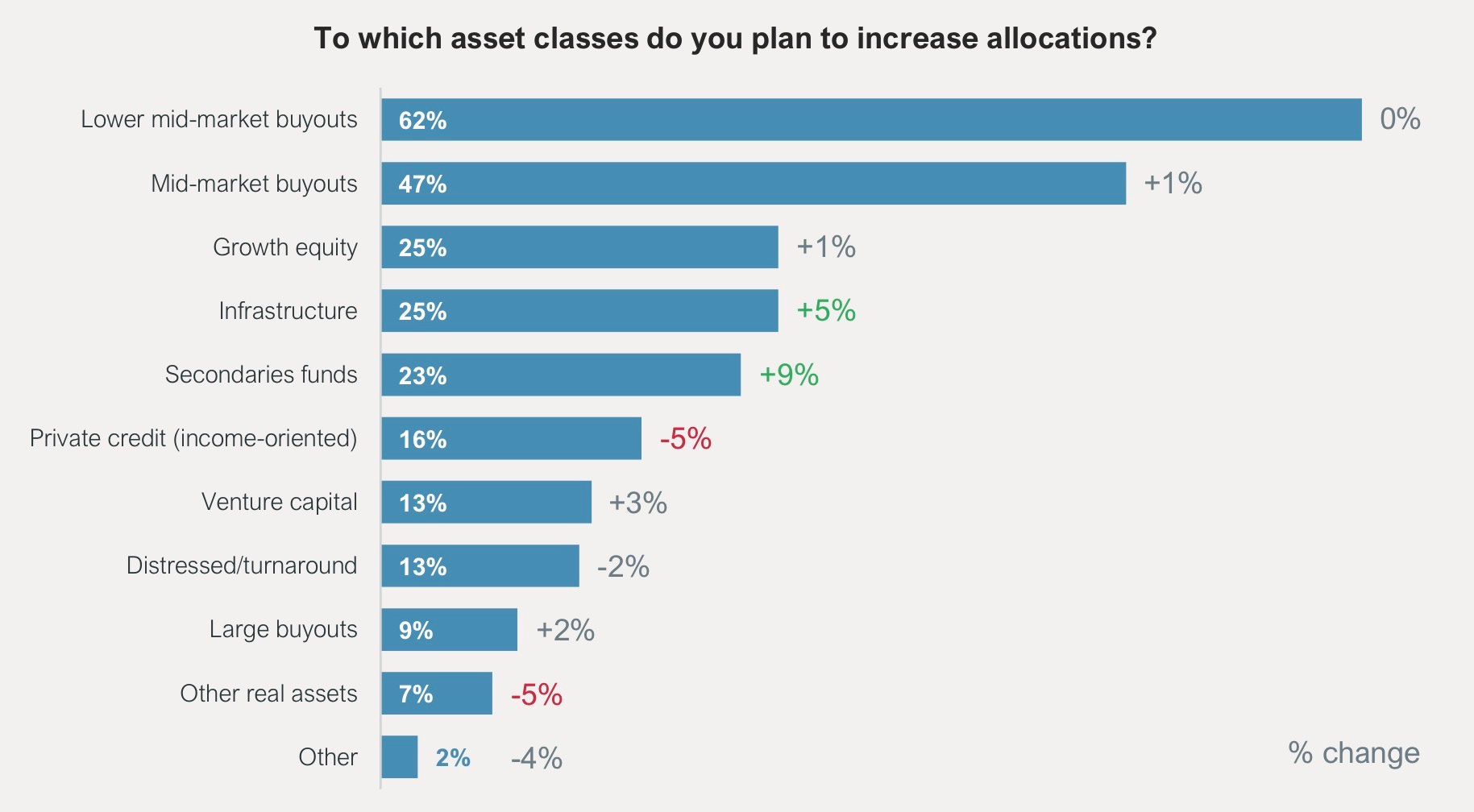
The RLI sub-index confirms it isn’t noise
Rede doesn’t just ask LPs a single yes/no question, it also tracks a dedicated RLI sub-index for secondaries funds and purchases, built the same way as the headline number (diffusion index, 50 = flat, above 50 = expansion). That sub-index rose two points to 63, and 46% of LPs now say they expect to deploy more capital to secondaries over the next year, against just 20% planning to deploy less.
What makes this notable isn’t the two-point rise, it’s where 63 sits in the series. Going back through Rede’s data since the sub-index launched in 2H 2022, the reading has bounced between the high-40s and low-60s: 48, 58, 54, 56, 49, 53, 61, and now 63. This is the highest secondaries reading Rede has ever recorded. LPs have never told this survey they were more enthusiastic about secondaries than they are right now.
Secondaries RLI hits 63, an all-time series high, and the biggest LP allocation swing of any strategy in the survey.
GP-led deals told a similar, if quieter, story. The dedicated RLI for GP-led transactions ticked up from 54 to 56, with the share of LPs planning to deploy more capital rising from 32% to 38%. During 2025, transaction values for GP- and LP-led continuation vehicles rose 41%, and Rede’s LP conversations suggest further increases are expected over the next 12 months.Why now: the DPI math finally makes secondaries the obvious trade
The timing isn’t a coincidence. Rede’s survey also asked LPs to name their top concern heading into 2026 allocations, and the answer wasn’t close: 71% cited the slow pace of exits and distributions (DPI), almost double the next most common concern, managing macroeconomic challenges, at 39%. The backlog behind that number is real: the pool of unrealized PE-backed companies has grown from roughly 13,000 to around 16,000 in the past year, and median holding periods have stretched to about seven years, up from roughly five before the pandemic. A growing population of dormant “zombie” funds, up 16% annually over five years, per TREO Asset Management, is trapping LP capital in vehicles that keep charging fees while delivering nothing back.
Secondaries funds sell themselves directly against that pain point: they’re structurally built to return capital faster than a traditional buyout fund’s J-curve allows, which is precisely what a liquidity-starved LP base is rewarding right now. Rede’s report puts it plainly, the rise in secondaries appetite “comes off the back of strong performance among secondaries funds alongside their ability to deliver DPI faster than traditional buyouts, an appealing prospect in a liquidity-scarce environment.”
It also lands on the back of a record fundraising year for the strategy in 2025, giving LPs fresh vintages to actually deploy into.
Why this lands hardest in Europe
The regional data makes the secondaries story sharper still. Europe is where LP sentiment is moving fastest of anywhere in the world: the inbound RLI for Europe climbed seven points to 67, now the highest of any region, ahead of North America’s 59 and well clear of Asia-Pacific’s 40. Rede is seeing LPs “building European manager coverage for the first time,” deliberately prioritizing meetings with regional GPs to develop a clearer view of the opportunity set after years of portfolios skewing heavily to the US.
On the surface, the fundamentals back that up. European deal value rose 8% in 2025, buyout transactions above €500m rose 19%, and exit values jumped 64% year-on-year. The 2026 IPEM Pan-European Private Equity Barometer found 73% of GPs planning to launch a new fund this year, and 55% of respondents feeling strongly positive about Europe’s prospects, up sharply from just 38% in 2025.
Europe’s inbound RLI hits 67, the highest of any region, even as closed-end fundraising there falls 41%.
But sit that next to one other number in Rede’s report and the picture gets more complicated: fundraising for Europe-based closed-end structures fell 41% over the same period, even as North America’s rose 8%. Deal-making and exits are accelerating in Europe; primary fundraising for new blind-pool commitments is doing the opposite. That’s not a contradiction so much as it’s the European version of the exact dynamic driving the secondaries boom globally, LPs are more willing to underwrite liquidity and known assets than they are to write a fresh cheque into a ten-year primary vehicle, and Europe’s compliance costs and deal-timeline friction (which Rede notes persist despite the European Commission opening a March 2026 consultation specifically aimed at improving institutional investors’ access to EU private capital) only sharpen that preference. For LPs chasing European diversification without taking on a new blind-pool commitment, and for European GPs facing real resistance on primary raises despite a genuinely strong deal environment, secondaries and continuation vehicles are turning into the path of least resistance on both sides of the trade.
The market underneath is getting more sophisticated, not just bigger
Rede flags something worth watching for anyone tracking deal structuring rather than just headline volumes: the investor base for GP-led secondaries is broadening and getting more comfortable underwriting a wider range of risk profiles and transaction structures. The report specifically calls out that “the universe of variations on the CV theme is expanding, with CV2s, RIVs, and ‘legends’ funds gaining prominence”, and suggests this expanding menu of structures may itself be feeding the more positive sentiment showing up in the survey.
That’s consistent with what LPs are separately signalling about GP-led deals more broadly: for most fund managers, the primary use case for continuation vehicles remains returning liquidity to investors, but LPs themselves, per a StepStone/Bain survey Rede cites, remain “lukewarm” about that framing, and market commentators have grown more openly critical of CVs used purely as a liquidity mechanism. Sentiment is rising even as scrutiny of how these deals get done is rising with it, a tension worth watching rather than a contradiction that’s been resolved.
The contrast that makes the story
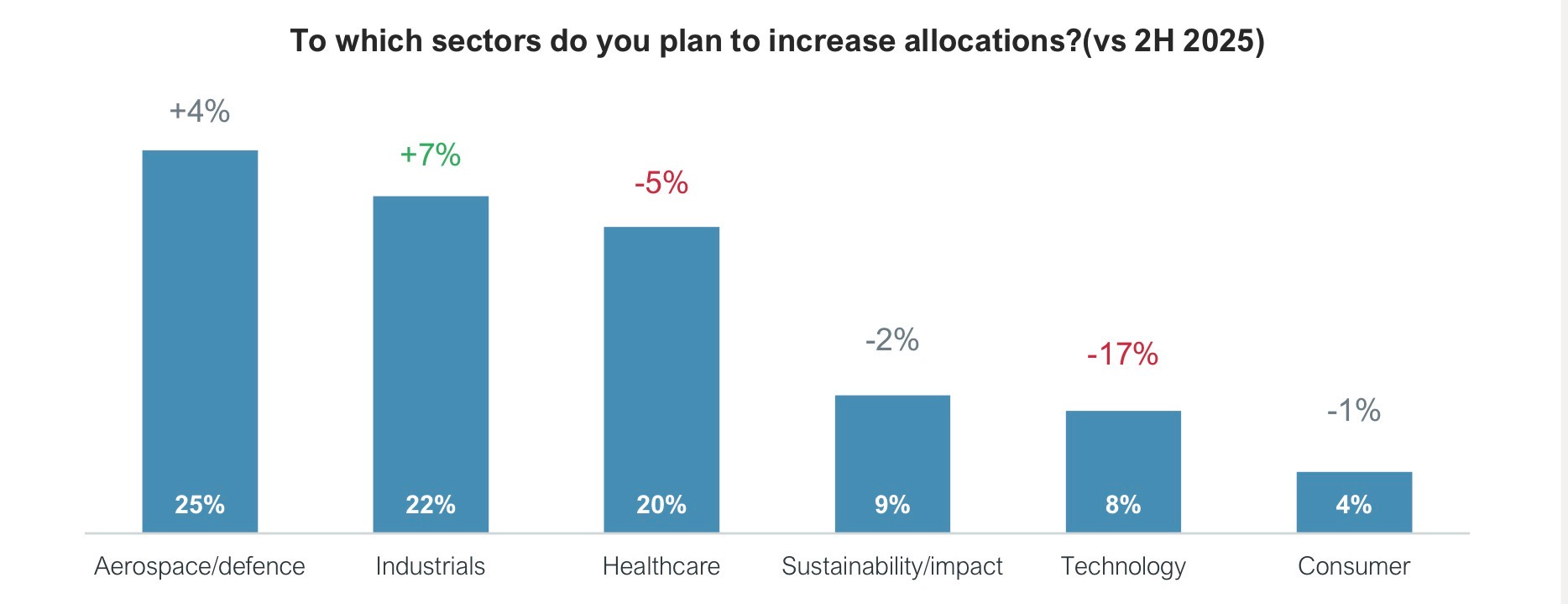
Set the secondaries number against what happened to tech-focused funds in the same survey and the picture sharpens. LP appetite for technology-focused PE funds collapsed 17 points to just 8%, the lowest reading since Rede started asking the question in 2021, driven by fears of a structural repricing of software valuations and a possible AI-specific bubble. In the same six-month window, in the same survey, of the same LP base: conviction in one of private equity’s most-hyped growth stories cratered, while conviction in the market’s plumbing, the mechanism that gets LPs their cash back, hit an all-time high.
That’s the story underneath Rede’s headline number. LPs aren’t necessarily more bullish on private equity broadly; they’re more bullish on the parts of it that can prove they’ll actually return capital. Right now, nothing in the survey proves that better than secondaries.