


Konstantin Sidorov’s London Technology Club is ramping up a $250 million fund targeting secondary stakes in late-stage private tech companies, according to Bloomberg, which reviewed private fundraising documents. The vehicle, raised through LTC’s investment arm, LTC Invest, has already drawn more than $50 million from wealthy individuals and multi-family-office allocators in its first close, and the firm is now in late-stage talks with additional investors to build on that base.
Sidorov, an early Spotify backer, and Revolut chairman Martin Gilbert are both anchor investors in the vehicle. LTC’s broader portfolio already includes stakes in Klarna and Plaid, and the firm’s marquee position, Revolut, backed six years ago, has appreciated more than 900% since entry, aided by at least two secondary share sales along the way. Company filings list Sidorov, Gilbert and LTC Chief Investment Officer Denis Blank as the three directors of LTC Invest Ltd.
The fund itself is structured on fairly conventional terms for the space: a 2% management fee paired with a 20% performance fee, registered in Delaware. Blank, who joined LTC full-time in September 2024 specifically to build out its investment arm after a career that included nearly a decade at Hermitage Capital Management, has been explicit about where the strategy sits: this is a venture secondaries fund, not a diversified private equity one. LTC does not lead investment rounds, instead co-investing alongside existing VC backers, and it’s targeting companies already valued above $500 million with a three-to-five-year exit horizon.
“The VC sector needs a vibrant secondaries market.”— DENIS BLANK, CHIEF INVESTMENT OFFICER, LTC INVEST
That line, given to WealthBriefing, is the clearest statement of LTC’s thesis: unlike buyout and growth-equity secondaries, which have institutional buyers at every size point, fund- and company-level venture secondaries in Europe remain thin. It’s also, almost verbatim, the argument being made right now by a whole cluster of managers building competing vehicles — a bigger cluster than Bloomberg’s story lets on.
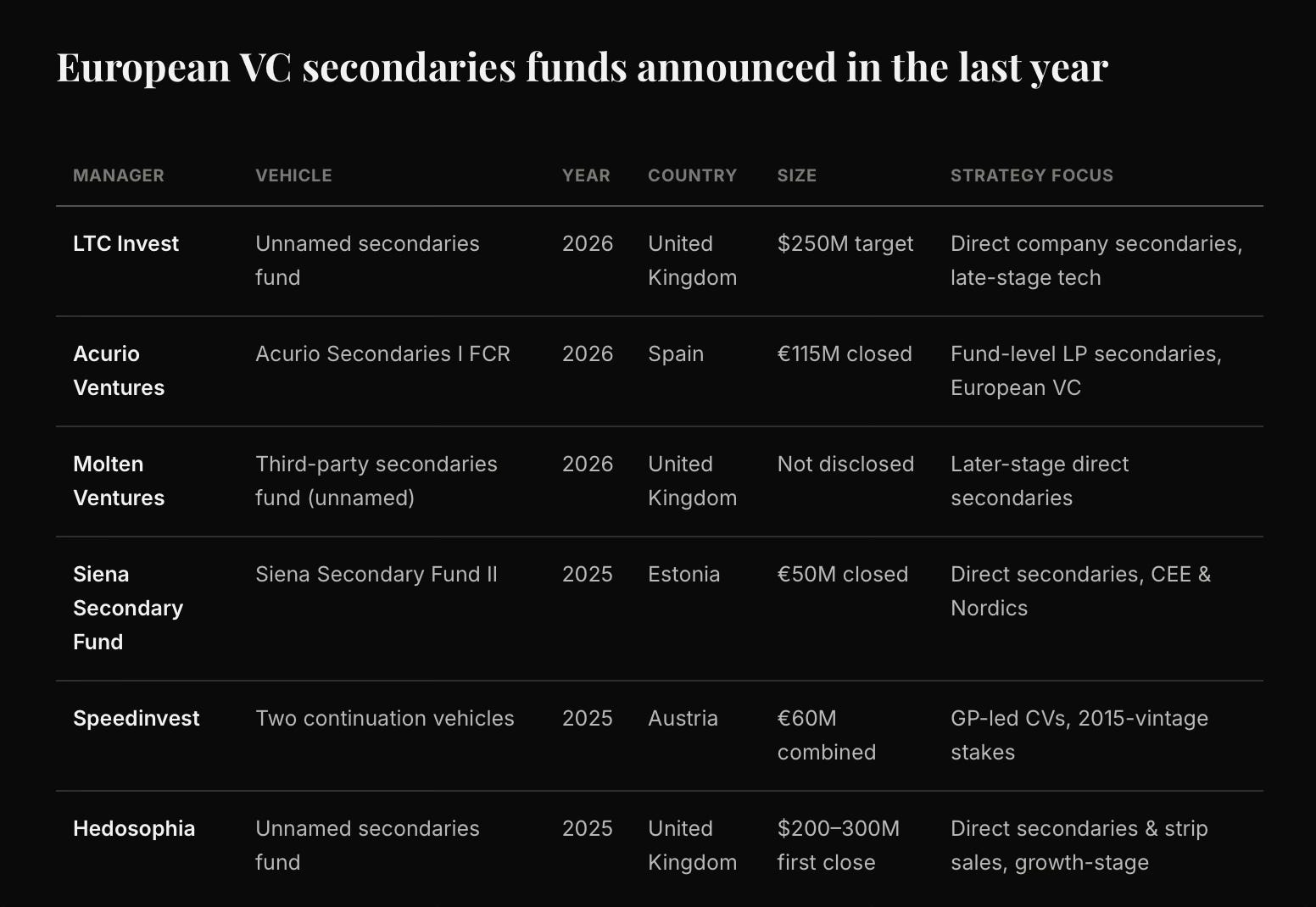
At least six funds the last year.
Bilbao-based Acurio Ventures (formerly All Iron Ventures) closed the most direct comparable to LTC in July: Acurio Secondaries I FCR, a €115 million vehicle that came in above its €100 million target and pushed the firm’s total AUM past €450 million across five vehicles. Acurio buys fund-level LP stakes in other European VC funds, not direct company positions — a structural distinction from LTC’s approach, even though both funds are being raised in the same window and citing the same liquidity gap.
Molten Ventures, the London-listed VC, took a different route: rather than raising a standalone fund immediately, it hired a three-partner team — Malcolm Ferguson and Nick Sando from Octopus Ventures, plus ManyPets co-founder Steven Mendel — in March 2026 to build a third-party secondaries fund alongside its existing balance-sheet strategy, which has already returned a 2.5x MOIC on prior secondary purchases including Seedcamp and Earlybird fund stakes.
Further east, Estonia’s Siena Secondary Fund closed its second vehicle at €50 million in September 2025, backed by the European Bank for Reconstruction and Development and Estonia’s SmartCap as co-leads, plus more than 100 private backers. Siena II is a direct-secondaries fund focused on Central and Eastern Europe and the Nordics — a geography almost entirely absent from the London-centric coverage of this trend.
Vienna-based Speedinvest, meanwhile, closed the first of two planned continuation vehicles at €30 million in 2025, with a second €30 million vehicle following shortly after, moving stakes from its 2015 vintage (a cohort that includes GoStudent, Wefox, Refurbed, Inkitt and Upvest) into new structures. CEO Oliver Holle has said the firm plans to “roll out several continuation funds over the next few years.” Worth noting: the LPs backing Speedinvest’s vehicles include Acurio Ventures and Molten Ventures — two of the managers named in Bloomberg’s “four funds” story are already transacting with each other, not just running parallel strategies.
And in London, Ian Osborne’s notoriously secretive Hedosophia disclosed in April 2025 that it had raised $200–300 million at first close for a fund focused on direct secondary deals and strip sales in growth-stage companies across the US and Europe, with a larger final close still being raised.
Acurio has described its fund as “the first vehicle of its kind dedicated exclusively to European VC fund secondaries.” That claim doesn’t hold up well against the record. London’s Isomer Capital launched a £100 million fund in April 2024 that is majority allocated to exactly that strategy, LP interest stakes in VC funds, run by Joe Schorge and Omolade Adebisi, the latter previously on Coller Capital’s private equity secondaries team. TempoCap, which Sifted has called “one of Europe’s best-known secondaries players,” has been buying direct startup stakes for years. London’s Launchbay Capital reached first close on a $100 million VC secondary growth fund back in January 2024. Geneva-based Giano Capital launched a single-asset late-stage secondary fund in 2023 and had raised €20 million toward it as of that year. And Denmark’s Nordic Secondary Fund, running since 2018, finished deploying its second fund into Nordic and Baltic companies as recently as June 2025.
WHAT IS LTC?
London Technology Club (LTC) is a members-only investment club founded by Konstantin Sidorov in 2018, headquartered at 68 Pall Mall in London’s Mayfair, with additional hubs in Dubai and Hong Kong.
Membership is paid: individual and family-office members pay £8,000/year, corporate members £15,000/year, and “Platinum” members £25,000/year. All tiers include event access, co-investment rights, due diligence reports and 67 Pall Mall club membership.
The club combines networking, education and deal access for family offices, private investors, VCs and institutional investors, with a focus on late-stage tech and disruptive sectors such as AI, blockchain, autonomous driving and robotics. Its Advisory Board includes June Felix (former IG Group CEO), Jim Mellon (Juvenescence co-founder), Peter Brabeck-Letmathe (Nestlé Chairman Emeritus) and Chris Rust (former Sequoia Capital partner).
LTC Invest is the club’s dedicated investment arm, the entity raising the $250 million secondaries vehicle at the center of this story. It operates as an Appointed Representative of Infinity Asset Management LLP, regulated by the UK’s Financial Conduct Authority.