


Moelis & Company has hired Zachary Herr from Evercore to lead its LP Secondaries business. With him, the firm’s secondaries team now covers LP-led deals as well as GP-led ones. Three days later, the Q3 2026 earnings call showed where the build really stands. CEO Navid Mahmoodzadegan said revenue from the seven-MD GP-led team is “not meaningful” yet, with the payoff pointing to 2027. He also said having a continuation vehicle option is already winning sponsor mandates the firm might otherwise have lost.
The hire
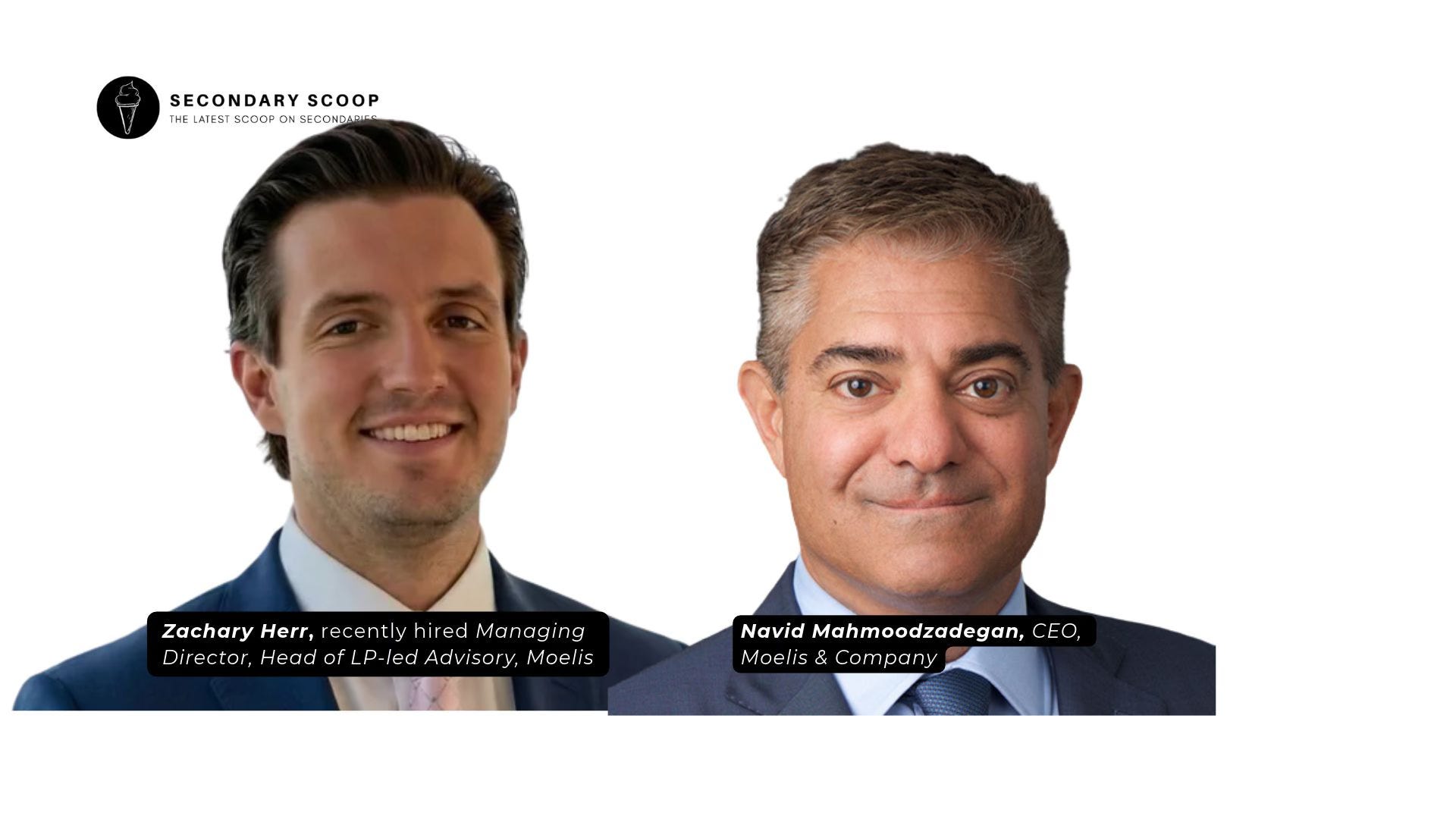
On November 2, Moelis & Company said Managing Director Zachary Herr is leading the firm’s LP Secondaries business from New York, advising limited partners on secondary transactions and structured liquidity solutions.
Herr’s career has run entirely through secondaries advisory, according to the release. He started at Greenhill Cogent, the secondaries arm of Greenhill & Co., moved to Jefferies’ secondaries advisory team, and most recently sat in Evercore’s Private Capital Advisory group, where he focused on LP-led deals. His client list spans public and corporate pensions, endowments and foundations, insurers, family offices and asset managers.
Secondaries Investor reported that Herr was a vice-president at Evercore and will build the LP-led business with three others. Moelis’s release confirms the MD title but does not name the rest of the team, referring only to a “dedicated and growing team of experienced LP secondaries professionals.”
“Zach brings deep expertise in advising limited partners and a strong track record of executing complex secondary transactions for sophisticated institutional investors.”
Matt Wesley, Head of Private Capital Advisory, Moelis, press release, November 2, 2026
A Jefferies alumni network, rebuilt one desk at a time
Look at the names and a pattern stands out. Wesley built Jefferies’ secondaries advisory, primary fundraising and GP-stakes businesses before he joined Moelis to run Private Capital Advisory (PCA). Rich Saltzman, hired in August as Head of GP-led Advisory, built Jefferies’ GP-led practice. Herr spent roughly three years on Jefferies’ secondaries team, from early 2021 to early 2024 according to his FINRA registration history, which overlaps with Wesley’s tenure there. The firms Moelis hires from are rivals for the same mandates: Jefferies, Evercore and, before them, Houlihan Lokey.
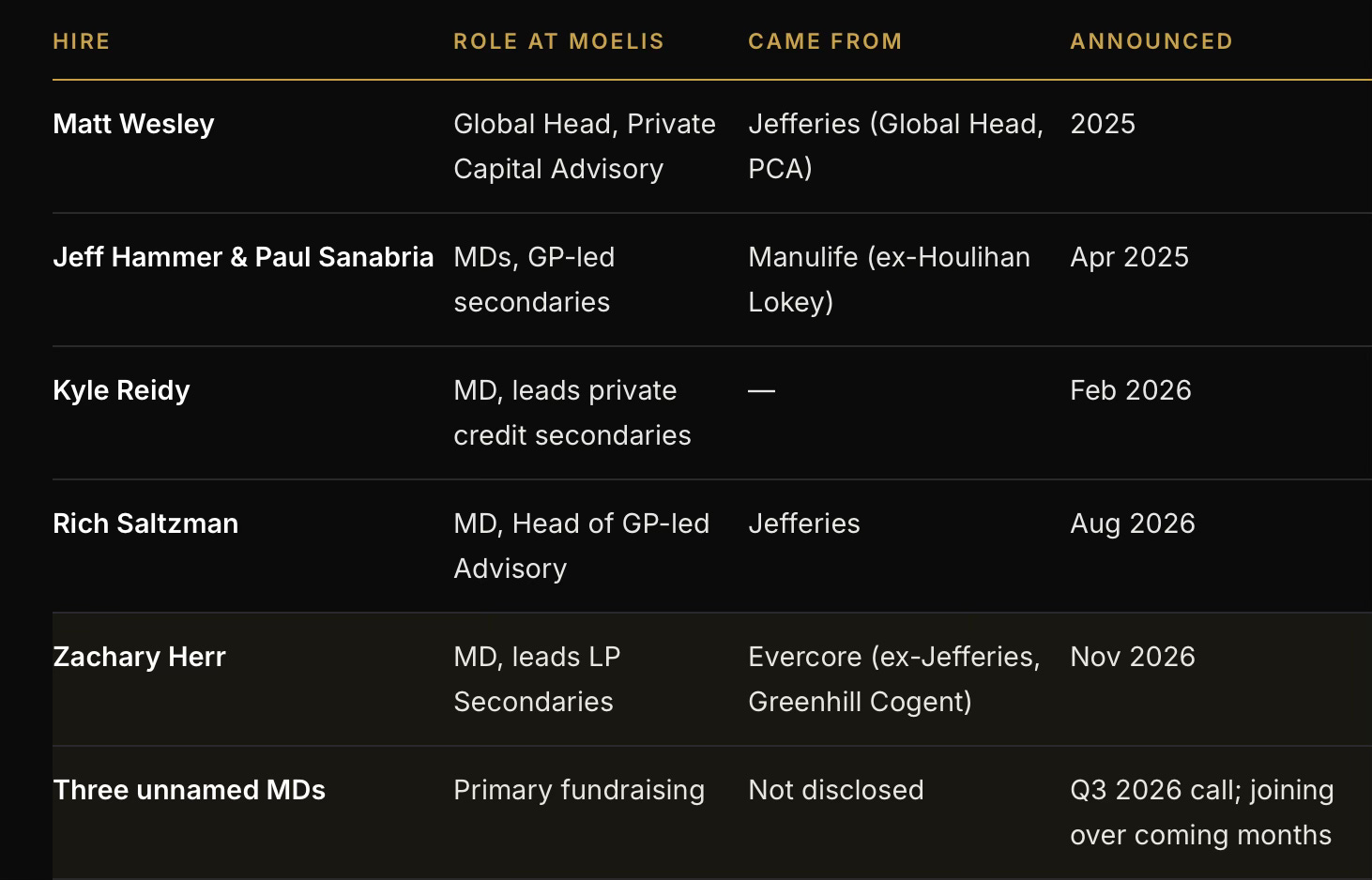
Sources: Moelis press releases (2025–2026); Q3 2026 earnings release and call. Highlighted rows are new since our August coverage.
Herr’s arrival completes the secondaries side of the three-pillar map Moelis has shown investors since at least the spring. Its PCA slide lists “LP Liquidity” alongside continuation funds, equity recaps and NAV loans under Secondary Market Advisory. Until now, the GP-led column had seven MDs behind it and the LP-led column had almost none.
What the Q3 numbers say
Moelis posted third-quarter revenue of $425.6 million, up 13% on an adjusted basis. Revenue for the first nine months reached a record $1.15 billion, up 10%. M&A did the heavy lifting: CEO Navid Mahmoodzadegan said M&A revenue grew 40% year over year in the quarter, and the nine-month mix moved to roughly 70% M&A and 30% non-M&A, from the two-thirds/one-third split the firm usually cites. CFO Chris Callesano listed “a growing contribution” from PCA among the drivers of nine-month growth, alongside M&A and capital structure advisory.
As before, Moelis does not break out PCA revenue, let alone a secondaries line. The most specific figure came in the Q&A. Asked by an analyst how PCA was contributing, Mahmoodzadegan called the build “still relatively early.” He said the GP-led team is the most developed, with seven MDs on active mandates, and that closings are generating some revenue:
“It’s not meaningful this year or this quarter, but as we look into next year, there’s certainly a meaningful pipeline that’s building.”
Navid Mahmoodzadegan, CEO, Q3 2026 earnings call Q&A, on the GP-led secondaries team
He was blunter about the newer desks. “The two other businesses where we have people who’ve hit the ground are the promoted co-investment business and the LP secondary business, and they’re very nascent,” he said. He added that the senior primary fundraising bankers won’t arrive until next year, and that fundraising “will take some time” to show revenue.
Readers who followed the July call may notice a shift in tone. In Q2, management called PCA a meaningful contributor to first-half revenue growth. Both statements can be true: a business can drive a meaningful share of year-over-year growth while still being small in absolute terms. Either way, the November message is clear. Investors should treat the secondaries build as a 2027 revenue story, not a 2026 one.
The real argument: CVs win M&A mandates
The most interesting thing Mahmoodzadegan said about PCA had nothing to do with PCA’s own revenue line. When asked whether PCA was pulling through sponsor M&A work, the CEO described joint pitches in which the sponsor had not yet decided between a sale and a continuation vehicle:
“If we didn’t have that PCA capability, I think there’s a chance we may not have had those mandates.”
Navid Mahmoodzadegan, CEO, Q3 2026 earnings call Q&A
Some of those mandates stayed in PCA and others turned into M&A, he said, adding that in the latter case the revenue “doesn’t even show up in PCA” — but “it’ll have been an opportunity lost if you didn’t have the PCA capability.” In a later answer he tied the firm’s rising share of sponsor wallet, in a year he called “a little sluggish” for sponsor activity, to pairing capital markets and PCA with CSA, restructuring and M&A.
This is one of the clearest statements we have seen from a listed advisory bank that the GP-led option has become part of the sell-side pitch itself. When a sponsor treats a CV as a real alternative to a sale, a bank without a CV desk is pitching only half the decision. For secondaries buyers, that means more continuation vehicle processes will begin as dual-track sale processes run by M&A-led teams, not as standalone secondaries mandates.
Mahmoodzadegan also put PCA alongside CSA at the high-certainty end of his pipeline-conversion spectrum: “A CSA mandate or even a PCA mandate typically has very, very high conversion on deals in the pipeline.” Capital markets work, he said, sits at the other end because it depends on market windows.
Why the LP-led piece matters
GP-led advisory is a sponsor-coverage business, and sponsor coverage is Moelis’s home ground. LP-led advisory is different. The clients are pension plans, endowments, insurers and sovereign funds selling portfolios. Pricing depends on a broad auction among secondaries buyers, and success depends on data, process and buyer-side relationships more than on boardroom access to a GP. Herr’s hire gives Moelis a direct relationship with the seller side of the market, the same LPs its primary fundraising team will soon pitch for commitments.
It also puts Moelis in direct competition with Herr’s two former employers, Evercore and Jefferies, for LP-led mandates. Moelis’s management describes the market backdrop as strong growth, driven in its words by “significant pressure to increase DPI across private market portfolios and growing investor demand for established high quality assets.”
The test now is execution. Moelis has assembled its secondaries bench in under two years, largely by hiring people who previously worked together elsewhere. The Q3 call made clear that the GP-led team is closing deals and the LP-led team is just getting started. The 2027 calls will show whether the pipeline Mahmoodzadegan described turns into a revenue line Moelis is willing to report.