


Montana Capital Partners has made its first Middle East hire, and it tells you more about where secondaries capital is moving than about the person taking the job. Lucas Radal, ex-Ardian, most recently at Mubadala Capital, joins the Swiss mid-market specialist as its first Head of Middle East Secondary Investments, based inside parent company PGIM's Abu Dhabi office. It's a small headcount move with a much bigger subtext: a $5bn secondaries platform that built its name staying out of the mega-deal spotlight is now betting that the next pool of LP capital worth chasing sits in the Gulf.
The move
PGIM’s secondaries platform, Montana Capital Partners (mcp), has hired Lucas Radal as its first Head of Middle East Secondary Investments, a newly created role based in Abu Dhabi. Radal joins from Mubadala Capital, where he was a senior investment executive, and spent the decade before that at Ardian’s secondaries and primaries team (2013–2024), including through Ardian’s own $2.1bn secondaries deal with Mubadala Capital, a transaction he had a front-row seat to from both sides over his career. He holds a master’s in international finance from IAE Aix-Marseille, where he also lectures in private equity.
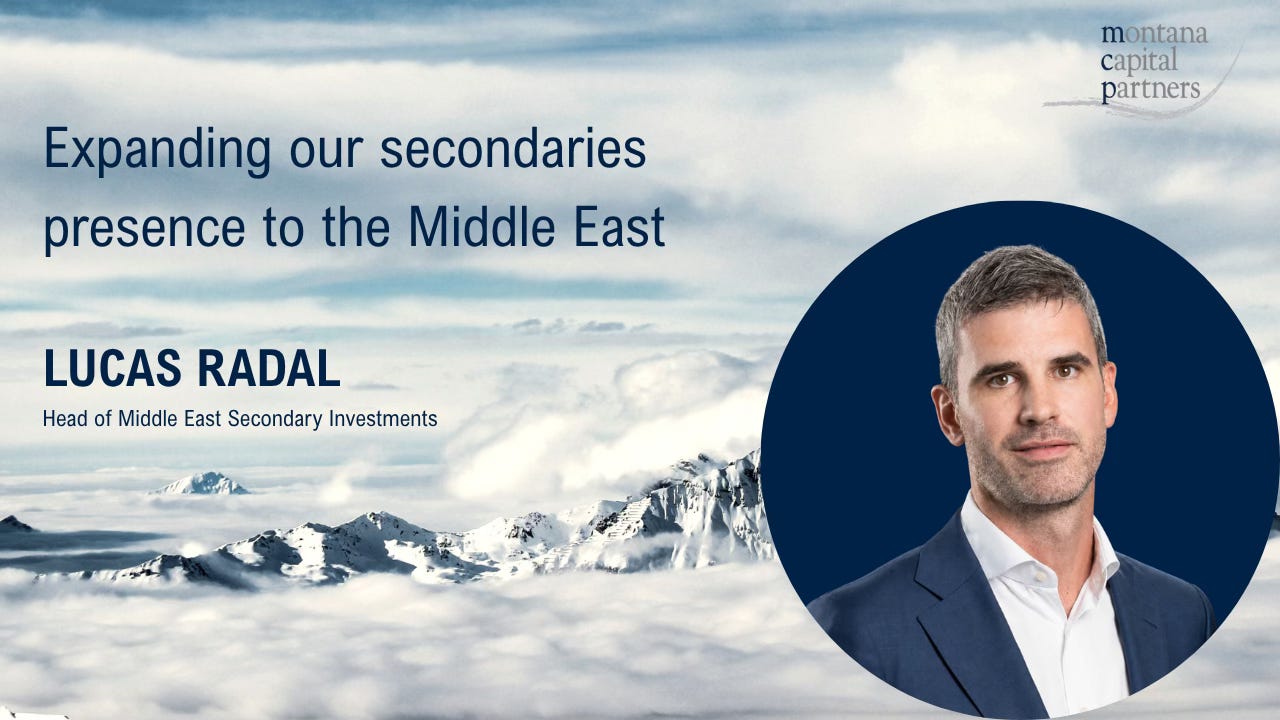
His mandate, per MCP: source and execute secondary investment opportunities globally and support PGIM’s capital-formation efforts in the region. mcp’s own announcement is unusually direct about what this actually is, not a coverage hire tacked onto an existing office, but the firm “expanding the secondaries platform in the Middle East” outright, in partnership with parent company PGIM. CEO Dr. Stephan Wessel called it “a pivotal time in the continued evolution of PGIM’s secondaries platform.”
The firm behind the hire
Montana Capital Partners built its reputation doing the opposite of what grabs headlines: staying deliberately mid-market while Ardian, Blackstone Strategic Partners and Lexington slug it out over billion-dollar single-asset auctions. Founded in Zug, Switzerland in 2011, mcp spent a decade building a book on proactive sourcing and balanced GP-led/LP-led exposure before PGIM (Prudential’s asset management arm) bought the firm in 2021 and slotted it into PGIM Private Alternatives.
The numbers back up the “specialist, not bystander” framing: mcp runs north of $5bn across its platform, with roughly $3.9bn of that sitting in its flagship Opportunity Secondary Program: six vintages in, 140+ transactions completed, OSP VI closing at $1.4bn in February 2026 alone. The team is lean for that AUM, around 45 people split between Zug and New York.
New York is the template worth watching here, but the Abu Dhabi move isn’t a copy of it. mcp opened its own New York office in 2023, hiring a former Newbury director, relocating staff from Zug, because half of its last three funds were already being invested in the US. Abu Dhabi is structured differently: rather than standing up its own outpost, mcp is embedding Radal inside PGIM International’s existing Abu Dhabi office. It’s expansion by attachment, not by lease.
Riding PGIM’s coattails into the Gulf
That distinction matters, because mcp isn’t arriving in the Middle East cold, it’s plugging into ground PGIM has spent two years preparing. PGIM opened its Abu Dhabi office in 2024 and has since inked partnerships with the Abu Dhabi Investment Office (ADIO) and Kuwait’s Kamco Invest. Earlier this year the platform pushed into private credit secondaries with a stated $1bn deployment target over two years. Radal’s hire is the private equity secondaries leg of that build-out finally getting a name and a desk.
The framing MCP is using: Gulf institutions “increasingly using the secondary market to manage private markets exposures, rebalance portfolios, and access liquidity”, describes LPs on both sides of the table: Gulf sovereign wealth and pension capital as sellers looking for portfolio liquidity, and increasingly as buyers and co-underwriters on GP-led deals. MCP wants coverage on both flows, from someone who’s already sat inside a major Gulf allocator.
Why it matters for the secondaries market
This is not an isolated data point. UBS, PGIM, Asante and others have all made discrete Gulf or Middle East secondaries hires over the past year, a sign that global secondaries managers are treating Gulf coverage the way they treated Asia coverage five years ago: not a nice-to-have, but table stakes for anyone raising a global program. For a mid-market specialist like mcp, staffing this before the mega-cap firms have fully saturated it is a bet on being early, not late, to Gulf relationships that are only going to get more competitive to access.
The question worth watching: does Radal’s desk stay a one-person coverage post inside PGIM’s building, or does it eventually earn mcp its own lease the way New York did? Either way, the pattern holds, mcp doesn’t plant flags speculatively, it shows up where its parent and its LPs have already cleared the ground. Abu Dhabi just became the third stop.