


Much of the secondaries conversation in 2026 is about scale: record fundraises, mega continuation vehicles, platforms consolidating. Multiplicity Partners works at the other end of the market. The Zurich firm, which manages the LTO (“longer term opportunistic”) fund family, buys what partner, Andres Hefti, calls the “hairy” deals: residual positions in funds well past their ten-year life, stakes in emerging-market real estate and infrastructure, funds-of-funds that need to close their books, and, increasingly, GP-led transactions in funds that did not perform as planned.
That makes Multiplicity a useful lens on a question this publication keeps returning to: whether secondaries are a portfolio management tool or a distress signal. Hefti’s answer is that the tool matters most precisely where portfolios are messiest. We spoke with him about pricing assets when you don’t trust the NAV, why most deals fail his first filter, and why, in his view, not every DPI is created equal.

Learning secondaries on the worst assets
Multiplicity was born liquidating hedge fund portfolios after 2008, including side pockets and Lehman and Madoff claims. How did that shape the way you approach secondaries?
AH: We have a somewhat different background from the traditional private equity secondaries investors. We started our careers on the hedge fund side around 2000, and we ended up in the secondaries market more by accident. We worked for an alternative investment manager that had to liquidate large portfolios of external hedge fund investments after the global financial crisis. In 2009 we submitted a couple of billion in redemption requests to the underlying hedge funds, and we learned that a few of those funds were illiquid themselves. They had invested in structured credit that defaulted or became very illiquid after Lehman went bust. So in 2010 we started to sell those hedge fund side pockets, the funds that had gated redemptions and the funds that went into liquidation, in what was then a very new market.
We had to learn as we went: how to value accounts that were blocked with Lehman Brothers, how to value the toxic assets held in some of those side pockets. A broad set of things had gone wrong. You had emerging market funds that were gated. You had hedge funds with prime brokerage accounts at Lehman that ended up as insolvency claims. You had funds that had invested in a fraud like Madoff, which was only detected when people withdrew money in the wake of the crisis.
It’s a very different mindset from a traditional private equity investor who is always thinking about EBITDA multiples and EBITDA growth, the mechanics you can apply to every valuation out there. We have specifically looked at odd and special situations from the outset.
You spent six years as an advisor before launching your first fund in 2016. What made you switch sides?
AH: As an advisor and then as an intermediary, we did quite a lot of transactions outside the core mainstream private equity space: illiquid real estate funds in emerging markets, funds that were difficult or that blew up for whatever reason. We often had mandates on very difficult-to-sell deals, “hairy deals” as we called them, and we could not line up any buyer, even when we had a really motivated seller.
One example: a $3 billion fund-of-funds holding probably $10 or $15 million of NAV in year 13 or 14, in a real estate fund. We simply could not convince anyone on the planet to buy those residual positions. They couldn’t find a buyer to dissolve the fund-of-funds vehicle, and they were not price sensitive. They would have accepted almost any price. That got us thinking, and it led us to start our first fund in 2016 with the idea to provide liquidity where others don’t.
Why couldn’t you find a buyer?
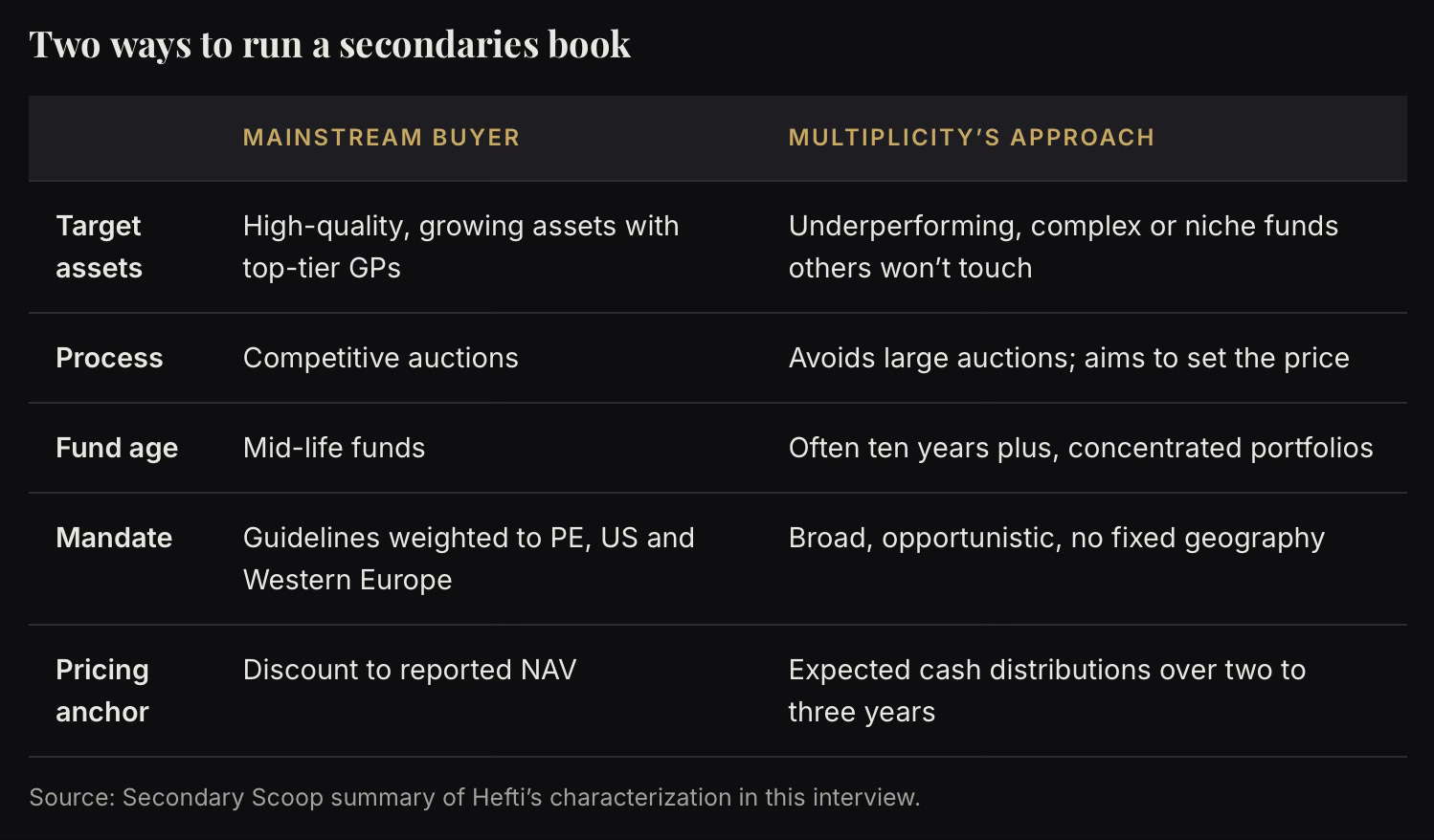
AH: It’s still true to some degree today that the very vast majority, probably 90 to 95% of secondaries investors, are looking to cherry pick good funds with high-quality, growing assets and top-tier GPs that have been top performers for a long time. It’s in the nature of things that not everybody can be a superstar, and some funds are just not performing so well. That is not something the more established secondaries buyers want to touch.
We started in the wake of the financial crisis, and we saw quite a lot of investors make a fortune investing in very toxic assets in 2009 and 2010. For us, the credo is there’s no bad assets, there’s just bad prices. Ten years ago there was really nobody like that out there. By now there may be two or three other investors taking a truly opportunistic approach: if they can buy cheaply enough, even a not-so-good fund may still be a great investment.
“The credo is there’s no bad assets, there’s just bad prices.”
ANDRES HEFTI, MULTIPLICITY PARTNERS
But toxic assets in the crisis really were bad assets. Doesn’t that challenge the credo?
AH: For the original investor, for sure. To give a simplified example: say an investment of 100 has been marked down to 20 cents on the dollar. If we buy at 10 cents and later recover 30 cents, that is a good investment. Those are real numbers. We have bought quite a few assets that we saw as materially overvalued, at huge discounts, and then recovered much less than the reported NAV. It was still a good investment.
There are, of course, investments that will return nothing. There have been transactions where we may even have applied a negative value to something, just so the seller could take it off the books. But that’s really the exception. There are funds where we believe it’s quite likely nothing comes back, and we don’t need to waste time on those. And there are many funds that have not performed well where we believe the reported NAV is way too high, but where 60 or 70% of it may come back over the next three or four years. We would want to buy that at 20 or 30 cents on the dollar.
Price maker, not price taker
So providing liquidity where others don’t means buying what others won’t, at a price you believe is fair.
AH: Exactly. One of our mantras is that we want to be a price maker, not a price taker. So we stay away from large auction processes. I’m absolutely not suggesting there’s anything wrong with going after great assets that are growing and working with great GPs, but there are already probably 150 or 200 secondaries shops doing exactly that. We never felt we needed to be one more player going after great funds.
We focus either on complex deals, where something may have gone wrong in the past that others just don’t want to touch, or on very niche areas. If you look at secondaries market volume of $200 billion last year, probably about $160 billion, or 80%, was in private equity. There is a bit in venture, in infrastructure, in real estate, in real assets, in whatever niche assets you have. But by and large it’s private equity. Slice it regionally and you have at least 70% in the US and Western Europe; the rest of the world is much less liquid. A US buyout fund is typically ten times more liquid than an Asian real estate fund, or, God forbid, an infrastructure fund in Africa. It’s going to be extremely difficult to find a buyer for a niche asset like that.
Where do you focus geographically?
AH: We have no real focus. Intermediaries often ask us what is on Multiplicity’s wish list. My answer is always that our wish list is what no one else has on its wish list. We try to focus on deals where we’re pretty convinced no one else is really interested.
“Our wish list is what no one else has on its wish list.”
ANDRES HEFTI, MULTIPLICITY PARTNERS
Is that because other buyers aren’t interested, or because their mandates won’t let them look?
AH: I would say 80% of secondaries players have rather strict guidelines in their LPAs, or at least in their investor presentations, on how much they are allowed to do in private equity, in the US and Western Europe and in other places. They typically don’t have much capacity to do anything outside that. Our investment mandate is very opportunistic, broad and flexible. We couldn’t say it would always be one exact niche, but we knew there would always be transactions sitting in a gap in the market where no one else is interested. That’s why the fund is called LTO, for longer term opportunistic.
The main focus, 80 to 90%, is buying LP interests. Occasionally we have done direct distressed and special situations investments, but we found buying stakes in existing funds to be very fertile ground, along with more and more GP-led transactions in niche or special situations areas.
Three filters and a motivated seller
If you’re buying an LP stake in an older fund, presumably there are still good assets alongside the write-offs?
AH: Not always. We are particularly focused on older funds, quite often ten years plus, and they’re often quite concentrated by then. Maybe it was a good fund with ten companies and eight were sold. Now it has one that is hardly surviving and one that is in a turnaround, or some other issue, with the taxman or whatever.
Then where is the attraction?
AH: Every investment we look at goes through three filters. First, we look at whether it’s a competitive deal. If it’s a US buyout fund or a well-performing Scandinavian buyout fund, so many buyers are hunting for those positions that we don’t waste a second on it.
Second, once we understand it’s a niche deal, an African infrastructure fund or an underperforming Polish real estate fund where we believe no one is really interested, we focus only on situations with a motivated seller. Sometimes we see deals where the seller is just looking for someone to buy at a small discount, although they know it’s going to implode very soon. We’re not interested in tactical sellers trying to get out of a bad investment early enough. We focus on motivated sellers: a pension fund merging with another one that needs to clean up the book, or, a very typical example, a fund-of-funds at the very end of its life. If you invested a billion and you’re sitting on $10 million in year 15, and it may take another five years to get that last percent back, it’s not that painful to take even a 70% discount on that last little piece.
Third, if a deal passes the first two tests, we only invest if we have high conviction that money is coming back in the next two to three years. Of 100 deals, maybe 70 are kicked out by the first filter, then another half by the second, and maybe ten make it through. We’ve looked at some venture funds where we truly don’t believe a single cent comes back in the next five years, so we don’t pursue those. But there are cases where a fund has gone through a rough patch and is turning around. It has spent five years paying down debt and has now deleveraged the company enough to pay out money or sell it. We focus only on investments where there is a very robust exit story for how we get money back in two to three years.
THE MULTIPLICITY SCREEN
Is it competitive? Mainstream positions, such as US or well-performing Nordic buyout funds, are dropped immediately. Hefti estimates about 70 of every 100 deals fall out here.
Is the seller motivated, not tactical? Motivated sellers have structural reasons to exit, such as a pension fund merger or a fund-of-funds winding down. Tactical sellers trying to offload a position before it deteriorates are avoided.
Is cash coming back in two to three years? Only deals with a credible, near-term exit story proceed to pricing.
“You cannot eat NAV”
How do you price an asset when you don’t trust the NAV?
AH: We never really take the NAV as a starting point. By doing our own research, looking at all the available information and talking to the GP, we try to understand how many dollars we should get back in the next two or three years. We discount that expected recovery back to today, and that’s how we arrive at our price. We don’t care much about the reported net asset value. That’s for the accountants. We always say you cannot eat NAV. We are really after actual cash, and DPI is king from the outset. Buying at a huge discount isn’t exciting for us at all. If we think we’re going to get 20 cents on the dollar back in two years’ time, we’ll probably pay 10 cents on the dollar. That’s still a good investment.
“We always say you cannot eat NAV.”
ANDRES HEFTI, MULTIPLICITY PARTNERS
It’s about understanding the underlying assets, and we’re absolutely laser focused on the exit. About 80% of our conversation with the GP centers on it. You have three companies left: when do you think you’re going to sell them, and to whom? Why haven’t you sold them already? The fund is in year 12, so they should have been sold five years ago. What went wrong? Maybe it was COVID. But COVID was five years ago, so why haven’t you recovered yet? Then we ask about the key premises of the exit plan, the milestones needed to make the asset sellable to that particular buyer, and plan B. Are they willing to sell at a relatively moderate exit price, or are they still hoping for a very high exit value? In the end, it’s about having true conviction that the exit story is credible and robust.
To flip it around, what we really don’t do is IPO stories. A typical IPO story depends on strong growth continuing for an extended period, and on a benign market where IPOs are happening. At the very least the second part can’t be controlled by anyone on this planet. We have heard hundreds of times a GP say they are absolutely convinced the company will IPO in 12 to 24 months. We all know how rarely that happens.
GP-leds for the less-than-stellar fund
You started as an LP-led specialist. How has the mix changed?
AH: We started really as an LP-led specialist buying tail-end portfolios, typically positions that had some difficulties or were niche. Over the past three or four years, GP-leds have become more and more important. In our current fund, almost half of our investments were a GP-led transaction in some form or shape.
In many funds that have been extended three or four times, the members of the LPAC are aware that GP-leds are a common tool to create liquidity and allow LPs in old funds to finally exit. We even see LPACs supporting or motivating the GP to go out and find a liquidity solution, including in funds that have not developed so well. So we see more and more GP-led transactions in less-than-stellar funds.
At IPEM, one of the main challenges raised about secondaries was transparency: knowing what you’re actually buying. How often does that stop a deal for you?
AH: Declining a transaction because there wasn’t enough transparency is quite an exception. With a fully flexible mandate, we have looked at fund-of-funds, and when you buy a stake in an existing fund-of-funds you may not get much transparency, because the manager is prohibited from sharing too many details on the underlying funds for confidentiality reasons. But in 90% of cases transparency isn’t an issue, and in GP-leds we typically have all the transparency we want. In a GP-led we also make sure the GP's interests are aligned with ours, which gives us a good sense of their true beliefs.
How do ticket sizes differ between the two?
AH: In LP-led transactions we’re often buying diversified portfolios of tail-end positions, so a single transaction may involve ten different LP interests, and the purchase price can be higher. Most of the GP-leds we do are multi-asset. As a small player, we wouldn’t do much more than $10 million for a single asset, and maybe $15 to $20 million for a multi-asset deal.
Who backs a strategy with no no-brainers
A strategy built on complexity must be harder to raise for. What kind of LPs back it?
AH: By design we’re different from the mainstream, so it’s a strategy that is more difficult to explain than a me-too strategy. We grew the LP base from friends and family, through our network and by word of mouth. It takes a certain trust in us as the GP that we do the right thing. Some of our investments may sound a bit adventurous. We even have a slogan: we never do no-brainers.
We’re also not providing a beta return. Some investors say they want private equity beta exposure, so they buy a broadly diversified secondaries fund that should move with the private equity industry. We can’t offer that. So it’s a more complex sell, and we have grown primarily through people who knew and trusted us before: Swiss family offices and Swiss private investors, quite a lot of them with backgrounds in financial markets, private markets or special situations investing. They understand our philosophy.
If existing LPs drive much of each new fund, what do those re-ups tell you about what investors value?
AH: We’re in a fortunate position, because we’re returning capital quite rapidly. Our funds are relatively short duration. We are now managing our fourth fund, and the first three have each returned their invested capital to investors, net of fees, within around four years of final close. Fund IV is developing well. So a lot of the money LPs need for a new commitment can be funded from distributions on the older funds.
We have also been very cautious in growing our fund sizes. We wanted to build a strong track record and make money through our carried interest, and our first three funds are all in carry territory. We do want to grow, and we see particularly good potential in GP-led transactions.
“DPI is king from the outset.”
ANDRES HEFTI, MULTIPLICITY PARTNERS
Your funds are domiciled in Jersey. How does that play with European LPs?
AH: Jersey is well accepted by investors in Switzerland, the UK and, I would say, the Benelux, at least by Dutch investors; we have a few. We don’t have much of an LP base in the Nordics yet, but regulatory-wise there’s no issue. Luxembourg is much more accepted and popular in Germany and France, so we do have some difficulty explaining to German or French investors why we are in Jersey. We need to show them it’s an equivalent jurisdiction to Luxembourg.
We chose Jersey for the quality of its fund administrators and service providers, at a cost that suits a fund of our size. As a small player, we want to limit the administrative cost burden.
The tail is getting bigger
Exits slowed again in the first half of 2026, yet secondaries volume keeps growing. Where will your next sellers come from?
AH: I’m not particularly good at making predictions. But there is so much money trapped in funds that are ten years and older. Nowadays I think more than 95% of all funds take materially longer than ten years to fully liquidate. And the 2016 vintage was just much bigger than the 2006 vintage, because the private markets industry grew so much. So tail-end fund assets are ballooning massively. At the same time, there is awareness that a secondaries market exists, and that GP-leds and continuation funds are a tool. So there will be plenty of tail-end liquidity solutions in the GP-led market. GP-leds may still be dominated by trophy asset deals for a few years, but the tail-end continuation fund in year 13 or 14 is going to be very important for us.
Mainstream financial media often frames secondaries less as a portfolio management tool and more as a way to engineer liquidity, or even to flatter returns. Is that fair?
AH: I know the aspect you mean. Some DPI is shown through continuation funds, and a lot of investors would say that is not very high-quality DPI. They would rather see a real exit. An IPO is a proper exit: new money comes in from the public market and goes to the original investors. Then there is the sale from one buyout firm to another [a secondary buyout], where no new money is created for the private equity universe as a whole. Then you have solutions like NAV loans, which are basically kicking the can down the road, and dividend recaps. Those are lower quality than GP-led transactions, where the asset stays with the same manager and no new money really comes into the universe. I think it’s a very fair point that some LPs don’t see every DPI as being of the same quality.
About Multiplicity Partners
Founded: 2010
Headquarters: Zurich, Switzerland
AUM: $230M+
Current fund: LTO Fund IV $160M
LTO capital raised: $250M+ since 2016
Transactions completed: 500+
Strategy: Private markets secondaries & special situations
Focus: Tail-end LP interests, complex and encumbered assets, niche strategies and GP-led secondaries
Multiplicity Partners is an independent Zurich-based investment firm focused on private markets secondaries and special situations. The firm targets smaller, complex and overlooked transactions that typically fall outside the mandates of mainstream secondaries buyers. Its LTO fund series follows a deep-value, shorter-duration strategy focused on generating cash distributions, with investments underwritten around visible exits and cash flows over a two-to-four-year horizon.