


Record secondary volume tends to raise the same question every year: growth, or crowding? Adam Freda, Co-Head of Secondaries at 50 South Capital, argues it’s the former, and his firm has the kind of track record that gives the argument real weight: two decades in the market, a fifth dedicated secondaries fund closed oversubscribed last year, and a buyer base that, by Freda’s own account, still can’t keep up with seller demand.
Northern Trust doesn’t run a secondaries desk under its own name. The exposure sits one layer down, inside 50 South Capital Advisors, the Chicago-based alternatives subsidiary of Northern Trust Asset Management, a firm with a longer secondaries history than most names that come up first in the market’s coverage. It’s a similar shape to the story about Partners Group this week: a large, patient secondaries book operating quietly inside a much bigger, better-known parent, rarely mentioned in the same breath as Coller Capital, Ardian, or Lexington Partners despite genuine scale and staying power.
50 South laid out its house view on the state of the market this year, in a report by Adam Freda, Managing Director and Co-Head of Secondaries, published through Northern Trust Asset Management. The core question it answers: does record transaction volume mean the secondaries market is getting crowded, or does it simply mean the opportunity is expanding alongside it? Freda’s case for the latter draws on the firm’s own multi-decade dataset, and on what two decades of underwriting secondary transactions has taught 50 South about how this market actually behaves.
Why 50 South doesn’t see a bubble
The report opens with the question every institutional allocator is asking: does the market’s rapid growth signal a bubble? Freda’s answer starts with turnover: the share of total private markets NAV that actually changes hands on the secondary market each year. That figure has held in a tight band, he argues, even as headline dollar volume has climbed to successive records. The logic: secondaries are a derivative of the much larger primary market, so as private markets NAV grows, the pool of assets available to trade grows with it. Record dollar volume, in this framing, reflects a bigger denominator — not a speculative rush to trade.

Persistent excess supply of this kind is uncharacteristic of a bubble.
ADAM FREDA, 50 SOUTH CAPITAL
The report backs that up with a demand-side observation: today’s market favors buyers, not sellers. More institutions want liquidity through secondaries than there is well-capitalized capital to meet them, citing Evercore’s 2025 Secondary Market Report and conversations with sell-side advisors suggesting a meaningful share of assets marketed in 2025 didn’t ultimately clear. The buy side itself remains small: roughly 100 dedicated secondary funds operate globally, and the realistic pool of bidders on any single deal is typically far smaller than that, since most GPs approve only a handful of known counterparties for a given process. Industry dry powder, on 50 South’s estimate, covers only about a year of purchasing capacity against available supply, a dynamic the report says keeps disciplined managers selective rather than forcing them to chase weaker deals.
On returns, the report identifies three repeatable sources: pricing (LP-led stakes typically trade at a discount to NAV, an immediate value at entry; GP-led deals price closer to par and lean instead on asset quality and the sponsor’s forward plan), seasoning (secondary buyers acquire assets already several years into their ownership cycle, skipping the early-year drag of a new primary fund), and selectivity, the natural result of buyers outnumbering sellers. Those same dynamics, the report notes, tend to produce the best entry points during downturns, 2022 being the clearest recent example, when public markets sold off sharply while private valuations lagged, forcing over-allocated sellers to transact at discounts that reflected market stress rather than weak fundamentals. Across a multi-decade history, the median secondary fund has delivered approximately 14% net IRR, per Cambridge Associates, a track record the report frames as structural rather than a product of favorable timing.
How 50 South underwrites GP-led risk
GP-led continuation vehicles now make up roughly half of secondary market volume, and the report spends real space on how 50 South evaluates them. The clearest signal of deal quality, in Freda’s telling, is GP alignment: a sponsor rolling its own interest and committing fresh capital into the continuation vehicle, rather than cashing out entirely, is the strongest indicator of genuine conviction in the asset’s forward plan. Because the sponsor sits on both sides of a GP-led transaction by design, the market has built governance mechanisms to manage that conflict directly.
GOVERNANCE MECHANICS THE REPORT POINTS TO
Competitive process: well-run GP-led deals are intermediated by an investment bank, with pricing established through third-party bidders rather than the sponsor setting its own terms.
LP choice preserved: existing LPs can exit at the transaction price or roll into the new vehicle on equivalent terms, no investor is forced out at a price they find unacceptable.
Independent checks: LP advisory committee approval, and in many cases an independent fairness opinion, are standard in well-governed deals.
Position sizing: 50 South and disciplined peers typically cap any single holding at around 2% of fund NAV, well below the 10 to 15 companies a traditional concentrated buyout fund might hold.
That last point ties directly to the report’s answer on concentration risk. Assets moving into a continuation vehicle have typically been owned by the sponsor for several years already, the operational risks that tend to surface early in a buyout’s life have usually already played out by the time the deal reaches a secondary buyer. The report cites Morgan Stanley Private Capital Advisory data putting transaction-level losses on GP-led continuation funds at roughly 8%, against an approximately 17% loss rate for primary buyout funds, a gap the report attributes to that combination of tighter position sizing and de-risked, more mature assets.
Evergreen versus drawdown
The report closes on a portfolio-construction question this newsletter has tracked since Lazard flagged rising evergreen and ‘40 Act adoption among secondary investors: how should an allocator choose between an evergreen vehicle and a committed drawdown fund for secondaries exposure? 50 South’s answer draws a clean line. Evergreen structures suit investors seeking broad, continuously available exposure, but the need to manage ongoing subscriptions and redemptions tends to tilt those portfolios toward more widely available LP-led deals, with returns that track the broader private equity market. Drawdown funds, without that redemption obligation, can concentrate capital in higher-conviction opportunities, an advantage the report says is most valuable precisely during market dislocations, when evergreen vehicles need to preserve liquidity right as drawdown funds are best positioned to lean in.
Who 50 South is, and how it got here
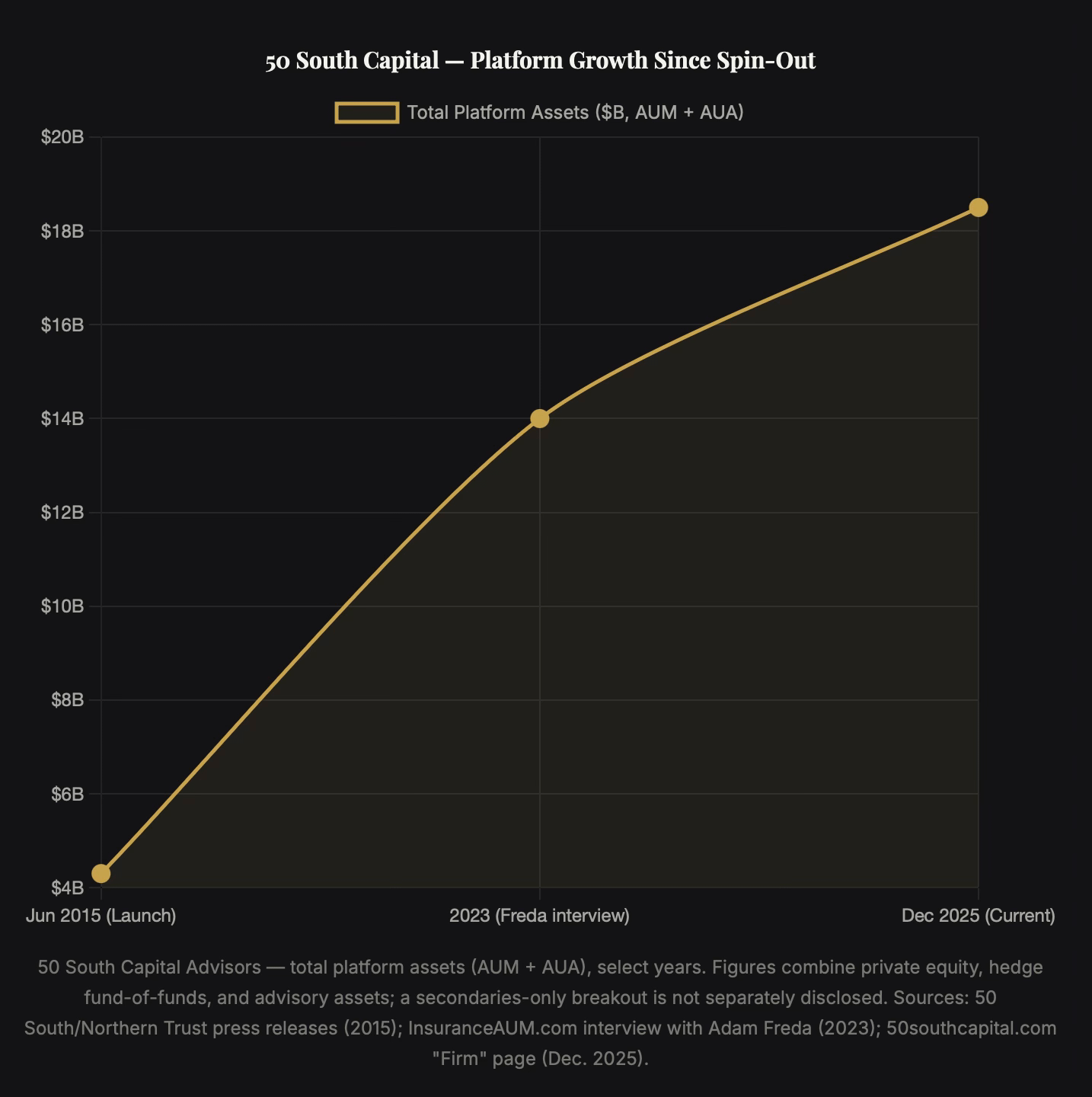
50 South traces its lineage to October 2011, when Northern Trust combined its private equity and hedge fund platforms into an internal unit called the Northern Trust Alternatives Group. That group was spun out and rebranded in June 2015 as 50 South Capital Advisors, the name borrowed from the firm’s Chicago headquarters address, with roughly $3.0 billion in assets under management and $1.3 billion in assets under advisement at launch, or about $4.3 billion combined.
Growth has come steadily since. By a 2023 interview, Freda described the firm at roughly $14 billion total, split between a $2 billion hedge fund-of-funds book and $12 billion in private equity. As of December 31, 2025, per 50 South’s own site, the firm reports approximately $13.1 billion in assets under management and $5.4 billion in assets under advisement, about $18.5 billion combined, and a meaningfully larger advisory footprint than two years earlier.
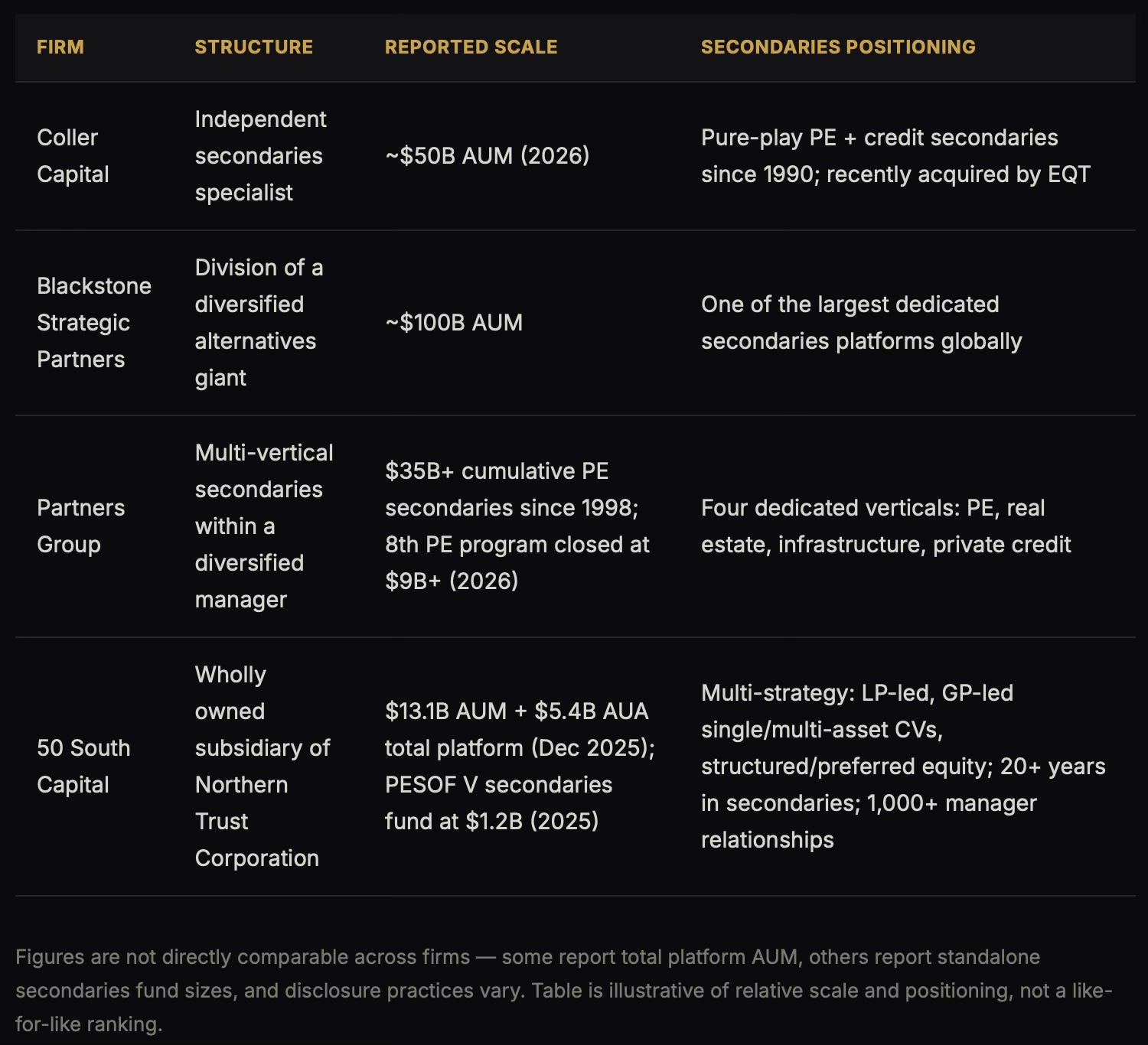
The clearest proxy for the secondaries book’s own scale is fund-level: Private Equity Strategic Opportunities Fund V (PESOF V), the firm’s fifth dedicated secondaries vehicle, closed in July 2025 at $1.2 billion — oversubscribed above its original target. It closed alongside Private Equity Core Fund XI (PECF XI), the eleventh vintage of 50 South’s broader flagship program, at $893 million, blending primary commitments, secondaries, and co-investments across U.S. and European small- and mid-market buyouts plus select early-stage venture exposure. The pairing mirrors a structure this newsletter has already flagged at Partners Group: a core program supplies deal flow and manager relationships that feed the dedicated secondaries fund, and vice versa.
“[PESOF V represents] the culmination of over 15 years of experience investing in the secondaries market,” Freda said at the fund’s close, a track record the firm’s own research puts at over 20 years today, including more than a decade specifically in GP-led transactions.
HOW 50 SOUTH COMPARES ON SCALE
The bigger platform behind it
Northern Trust Corporation’s second-quarter 2026 results, reported July 22, give a sense of the scale 50 South sits inside, and a signal that secondaries fundraising is a live priority at the parent-company level, not just a 50 South talking point. On the earnings call, CEO Michael Grady told analysts the wealth-management alternatives platform “added funds to our platform across secondaries, buyout, venture, and growth strategies” during the quarter, with capital raised in the first half of 2026, plus deals currently in process, “approaching 80 percent of last year’s full year total.” That figure spans the whole alternatives shelf rather than secondaries alone, but it lines up with 50 South’s own disclosure that PESOF V and PECF XI investors spanned “wealth, family offices, intermediaries, consultants and institutions”, the wealth channel is an active, growing distribution pathway for the firm’s secondaries products, not an afterthought.
The same materials show alternatives momentum across two other parts of the bank: in Asset Servicing, assets under administration across hedge funds, private capital, and semi-liquid structures combined surpassed $1 trillion in the quarter; in Asset Management, the segment that houses 50 South’s own fundraising, management flagged “fundraising across secondaries and custom alternatives” as a driver “broadening the Alternatives platform.” Taken together, it’s a picture of a bank leaning into alternatives distribution from three directions at once, at the same moment 50 South is fresh off its most successful secondaries close to date.