


Yesterday, Pantheon opened an office in Abu Dhabi Global Market and hired Firas Mallah as managing director and head of Middle East. Mallah joins from Sagard, where he was managing director and head of MENA, and brings more than 23 years in capital formation and investor relations in the region. He will be based in Abu Dhabi and report to Florence Dard, Pantheon’s chief client officer.
The brief is fundraising. Mallah will lead capital formation with sovereign wealth funds, family offices and financial institutions. The office takes Pantheon to 13 locations across four continents. The firm says it has worked with clients in every Gulf country for nearly two decades, so this is a move from flying in to being on the ground, not a first contact.
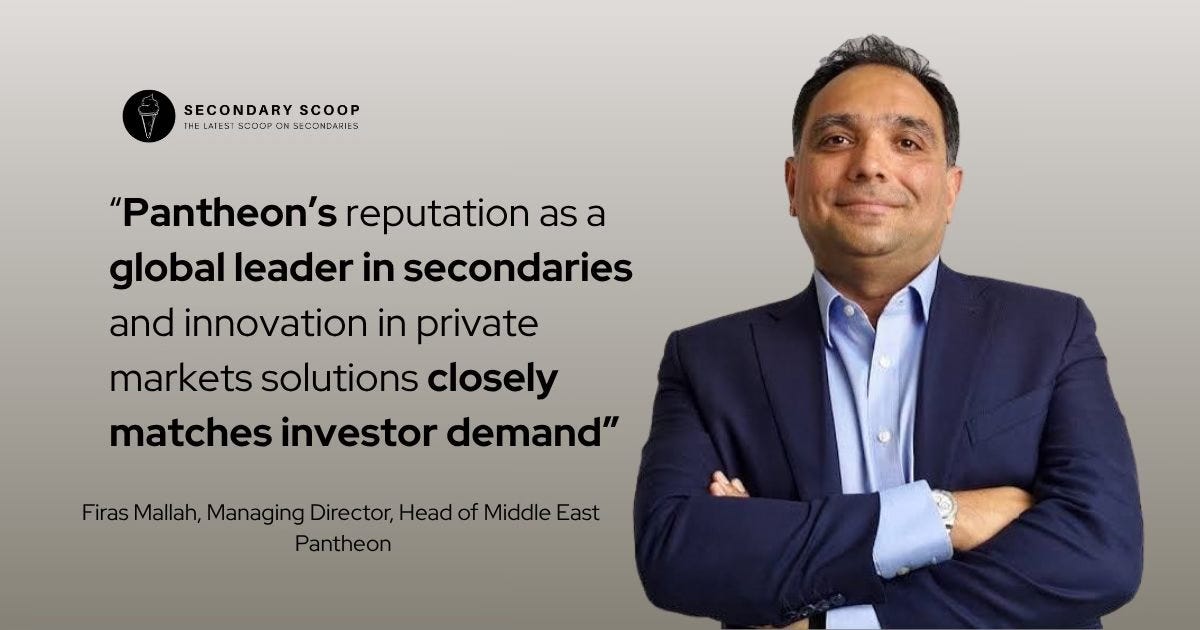
“Pantheon’s reputation as a global leader in secondaries and innovation in private markets solutions closely matches investor demand.”
Firas Mallah, managing director and head of Middle East, Pantheon
Mallah's other line from the announcement frames the client: "The Middle East is one of the fastest-growing sources of capital in private markets, and investors here are increasingly sophisticated about how they want exposure to the asset class." Pantheon says investor demand in the region is building across private equity, infrastructure and private credit, including secondaries.
EQT went first, with secondaries in reserve
A week earlier, on September 23, EQT launched a Middle East platform with its first office in ADGM. Jimmy Mahtani chairs the Gulf operation and Smiyet Belrhiti, head of Middle East and senior executive officer, runs the office. Bloomberg reported more than 10 professionals on the ground at launch.
The difference from Pantheon matters. EQT’s Abu Dhabi team covers private capital, infrastructure, capital raising and business operations. Secondaries, now the Coller-built franchise inside EQT, is not staffed locally. EQT says the platform will draw on its real estate and secondaries capabilities as opportunities develop. Pantheon is leading with secondaries. EQT is keeping them on the shelf.
“Abu Dhabi is a place where EQT has had the privilege of developing close ties over the past three decades with senior leaders at the largest regional investors.”
Jean Eric Salata, chair, EQT Group
The wider wave
Pantheon and EQT are the secondaries-relevant names in a crowded month. Funds Global MENA lists EQT, Sixth Street, Barings and Bain Capital among managers that have recently grown in the UAE. On the same day as Pantheon, Singapore’s Temasek said it plans offices in Riyadh and Abu Dhabi in the first half of 2027, subject to statutory approvals. Temasek is an investor, not a fund manager raising from Gulf LPs, so it belongs to a different story. It still adds to the pull of the region.
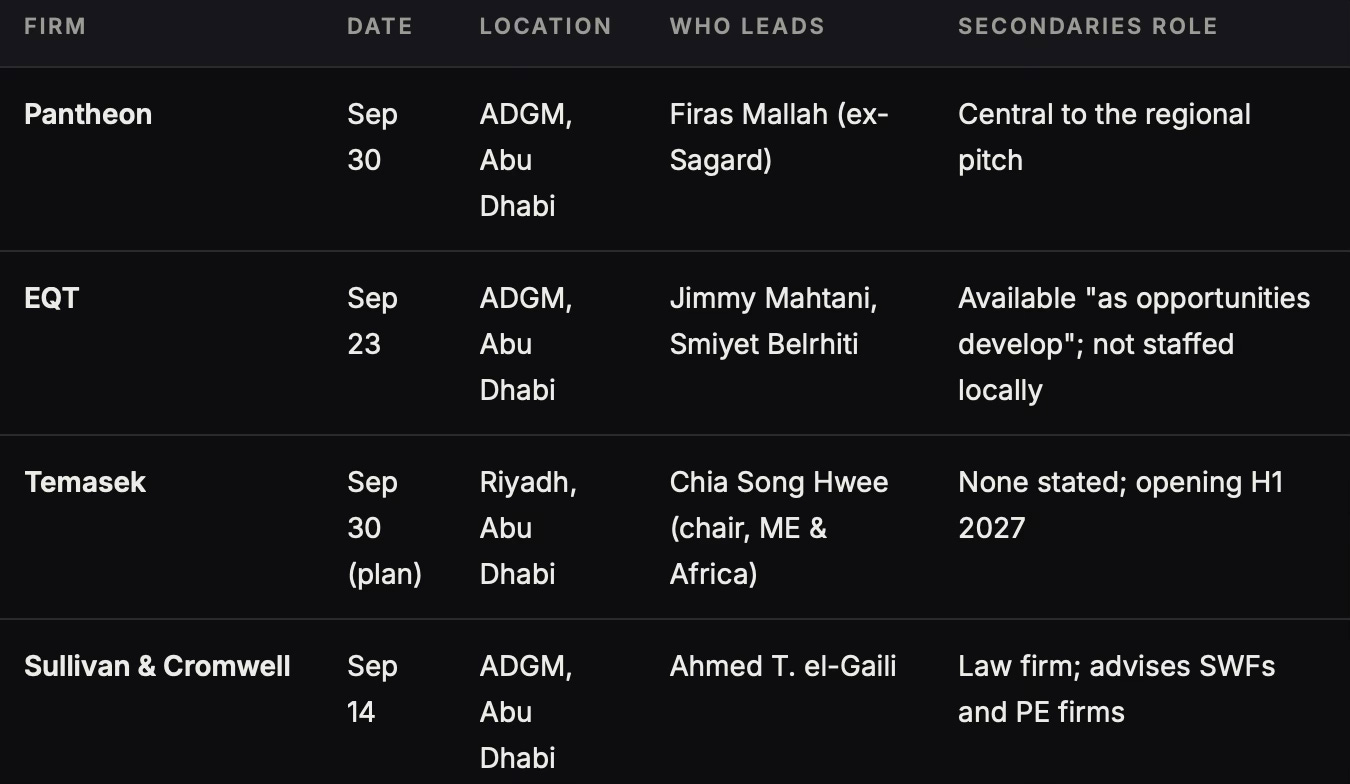
Sources: company announcements and press coverage, September 2026.
The hub numbers explain the rush. ADGM reported 190 fund and asset managers at the end of the first half, up 23% year on year, with assets under management up 54%.
Why secondaries fit the Gulf right now
Gulf institutions are not just a source of primary commitments. They are building secondaries exposure on purpose, across asset classes, and they show up on both sides of the trade. That makes a firm with a large secondaries franchise a natural partner rather than a niche product pitch.
The clearest signal is how Abu Dhabi’s two biggest sovereign investors have set up dedicated secondaries vehicles with specialist managers. In March 2023, Mubadala formed a joint venture with Ares to invest in global credit secondaries, with about $1bn of initial deployment. In March 2026, ADIA launched a real estate secondaries platform with Ardian.
“This new platform reflects our confidence in both the growth potential of real estate secondaries and the strength of the long-standing relationship between ADIA and Ardian.”
Mohamed Al Qubaisi, executive director of real estate, ADIA
Mubadala’s head of credit investments, Fabrizio Bocciardi, framed the Ares deal the same way at the time, pointing to “the growing demand for diversified credit secondaries opportunities.” Credit and real estate are two of the newer corners of the secondaries market, and in both cases Gulf capital chose to commit early through a dedicated vehicle rather than wait for a fund.
Deal flow points the same way. On the buy side, ADIA bought into the King Abdullah University of Science and Technology endowment’s portfolio sale of roughly $1bn or more, with Jefferies advising, as PEI Secondaries Investor reported on September 22. On the sell side, the Abu Dhabi Investment Council, a separate entity from ADIA, shopped a portfolio of fund stakes worth more than $2bn in March, according to the same publication.
Kuwait has been explicit about where it sees value. Sheikh Saoud Salem Al-Sabah, managing director of the Kuwait Investment Authority, told the Qatar Economic Forum in May 2025 that “the opportunities in private equity are in secondaries and special situations.”
Put together, the Gulf now looks a lot like the rest of the large-LP world. Sovereigns use secondaries to reshape exposure, buy mature assets at a discount and recycle capital. That is a portfolio management habit, not a distress signal, and managers who can serve both sides of it are the ones moving in first.