


Pantheon announced today the final close of Pantheon Global Secondaries Fund VIII and associated vehicles (PGSF VIII) at $6bn, against a $3.5bn target. It follows PGSF VII, which closed at $3.25bn in November 2023 on an initial $2bn target, and PGSF VI, which closed at $2.2bn in August 2020. In two vintages the flagship has grown roughly 2.7x.
The mandate is unchanged in its essentials: global, mid-market, buyout-focused, blended across LP-led and GP-led transactions, and diversified by vintage, GP and geography. The pitch is access to “hard-to-access GPs” through relationships built on Pantheon’s primary and co-investment business.
“The depth of our GP relationships and access to extensive data across private equity funds and companies amassed over decades enables us to have conviction and be disciplined about the assets we buy and the partners we back, particularly in the mid-market where access and selection matters most. We enter this next phase with strong conviction in our ability to keep identifying compelling opportunities for our investors.”
-Amyn Hassanally, Partner and Global Head of Private Equity Secondaries, Pantheon
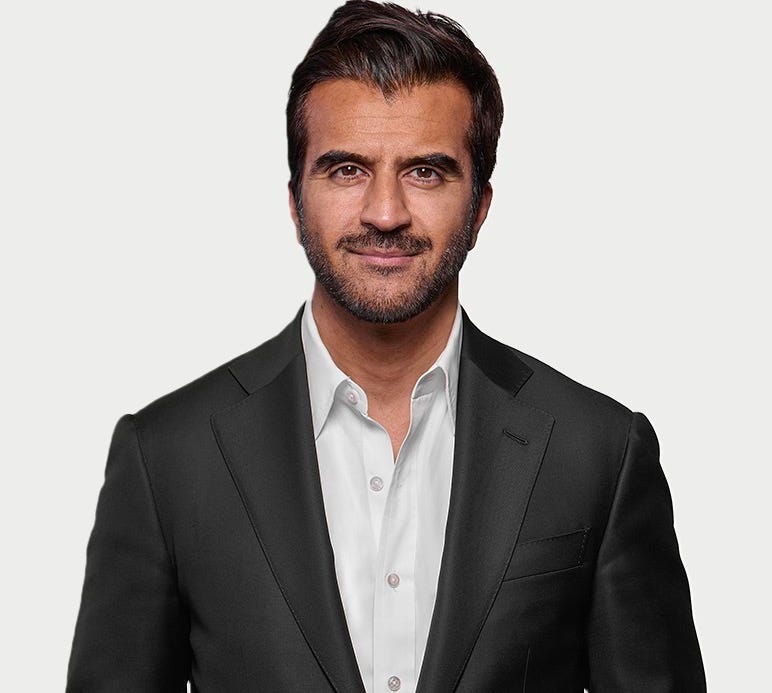
Pantheon’s PE secondaries franchise is led by Amyn Hassanally, partner and global head of private equity secondaries. He spent 17 years at Coller Capital in London and New York, rising to investment partner and global co-head of investment execution, before joining Pantheon.
The Coller background matters more today than it did when he moved. His former firm now sits inside EQT as the group’s fourth segment, making it one of the platforms Pantheon competes against for both deal flow and LP capital.
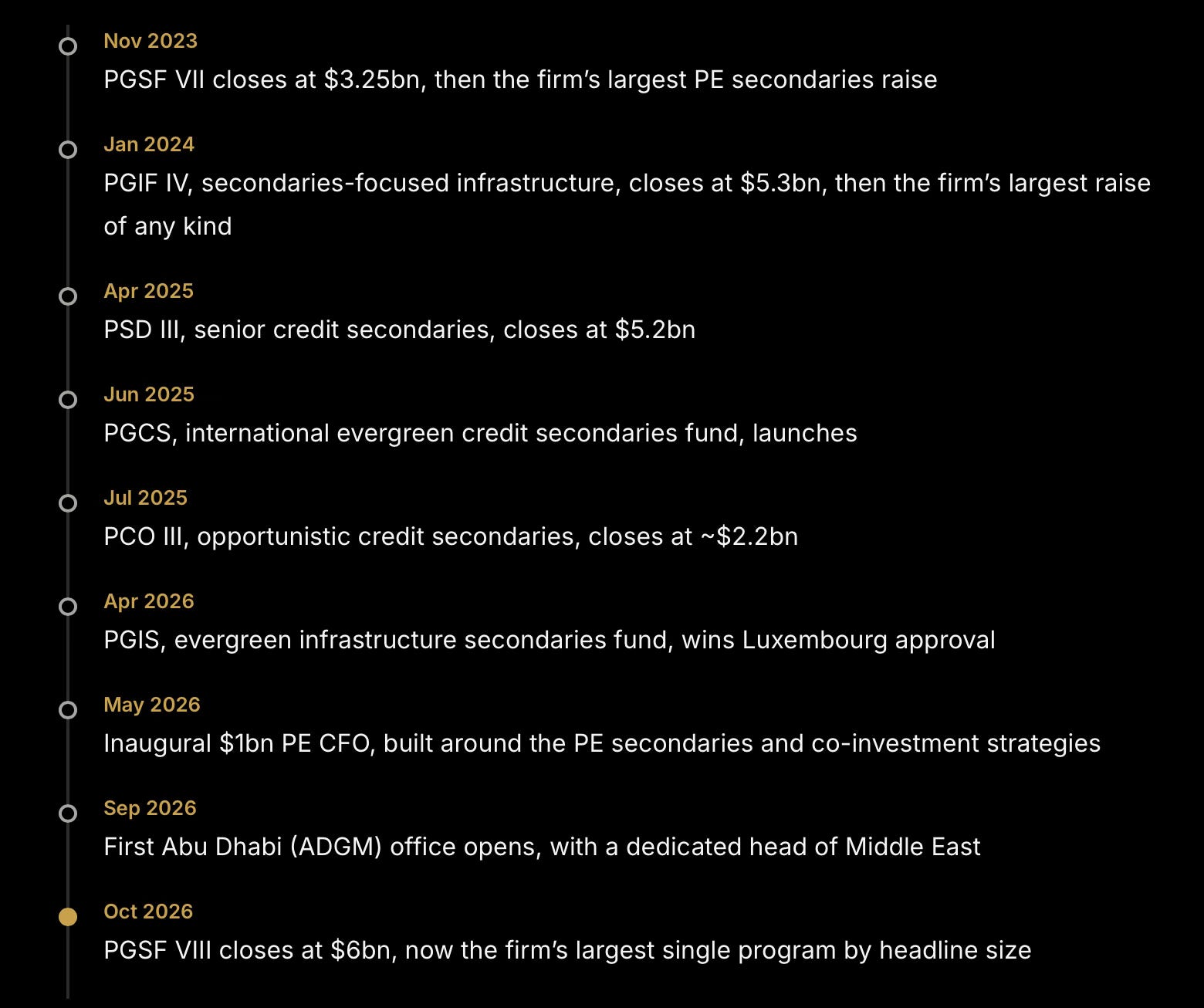
Taken alone, the close is a strong fundraise. Taken with everything Pantheon has shipped since November 2023, it reads as the moment the platform’s center of gravity visibly moved to secondaries.
How the machine was built
Pantheon is a multi-strategy house, not a secondaries specialist. It still runs primaries and co-investments. But in the past three years, each asset-class team has raised a record secondaries program, and the firm has wrapped those programs in structures aimed at buyers it did not previously reach.
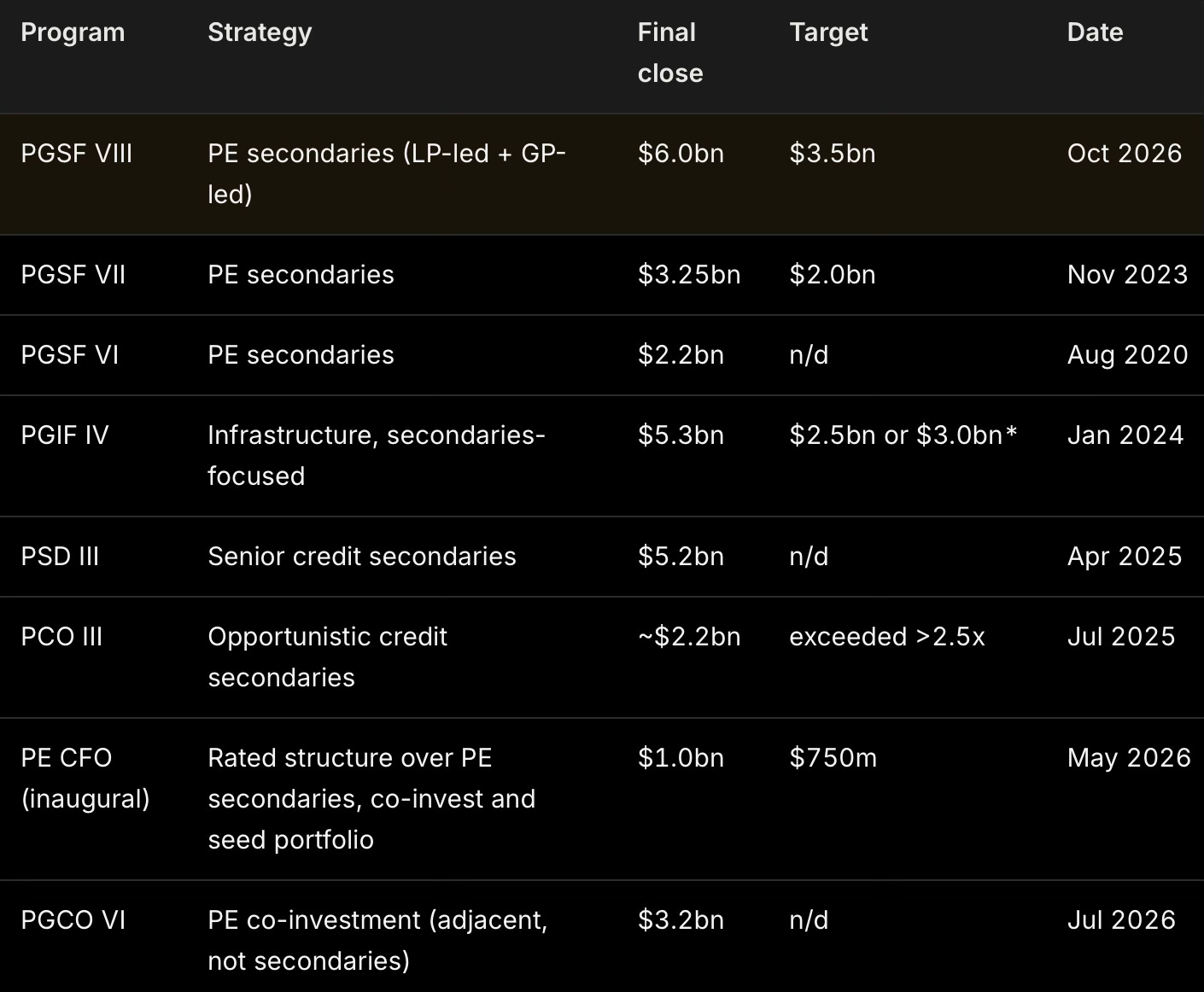
Sources: Pantheon press releases; Secondaries Investor (PGSF VI, PGSF VII target); IREI and Crain Currency (PGIF IV target). *See disclosures. n/d = not disclosed in sources reviewed.
The full secondaries strategy
Private equity secondaries: the original engine
The oldest franchise, goes back to 1988. The edge Pantheon sells is information: decades of primary commitments give it data on funds and companies before they trade. During the PGSF VII raise, Secondaries Investor reported the fund would mainly buy into funds run by North American and European managers where Pantheon already held primary commitments, targeting a 15% to 18% net IRR and a 1.5x to 1.7x net multiple. Terms for PGSF VIII have not been made public. The franchise managed $13.5bn as of May 2026, before today’s final close.
Infrastructure secondaries: the first-mover claim
Pantheon raised its first fund including infrastructure secondaries in 2010 and had invested roughly $7.6bn in the segment by early 2024. PGIF IV was 75% deployed at final close, with more than 90% of capital committed to LP portfolio and GP-initiated deals. On the GP-led side, Secondaries Investor reported on October 2 that Pantheon backed Meridiam’s $4bn-plus infrastructure continuation vehicle alongside Ares and GIC.
“As true infrastructure investors—not generalists—we’re scaling with precision…”
Andrea Echberg, global head of infrastructure, Pantheon (April 2026)
Private credit secondaries: the fastest-scaling line
A dedicated strategy since 2018. The third generation of senior (PSD III) and opportunistic (PCO III) programs reached $8.3bn in aggregate; PCO III alone was nearly 4x its $590m predecessor. Pantheon has positioned the strategy for insurers on capital efficiency. It also shows up repeatedly on the buy side of the GP-recycling credit deals we have tracked, including Goldman Sachs’ €1.4bn credit vehicle backed by Pantheon and Temasek.
“Private credit secondaries are entering a new phase of maturity and growth…”
Rakesh (Rick) Jain, global head of private credit, Pantheon (July 2025)
Structured access: the CFO
The May 2026 CFO, arranged with Evercore, packaged exposure to the flagship PE secondaries and co-investment strategies plus a seeded portfolio into a rated structure, closing at $1bn against a $750m target with insurers among the buyers. Bloomberg placed it alongside similar structures from Neuberger Berman, Vista, Dawson and Carlyle AlpInvest. For Pantheon it opened a capital-efficient route into its secondaries strategy for balance-sheet investors.
Wealth access: the evergreen suite
Internationally, Pantheon now runs evergreen vehicles across all three secondaries asset classes: Pantheon Global Private Equity (PGPE), Pantheon Global Credit Secondaries (PGCS) and Pantheon Global Infrastructure Secondaries (PGIS). In the US, the AMG Pantheon funds cover private equity, credit and infrastructure. The firm sized the whole evergreen and listed platform at about $15bn in April 2026, including Pantheon International Plc and Pantheon Infrastructure Plc.
Distribution: the Gulf and Asia
The newest gear. Pantheon opened its first ADGM office in September and hired Firas Mallah from Sagard to lead Middle East capital formation, which we covered on September 30. Today’s release names new LPs from Asia and the Middle East as a distinguishing feature of PGSF VIII, without naming or sizing them. The timing suggests the office was opened with this fundraise already in motion rather than to start it.
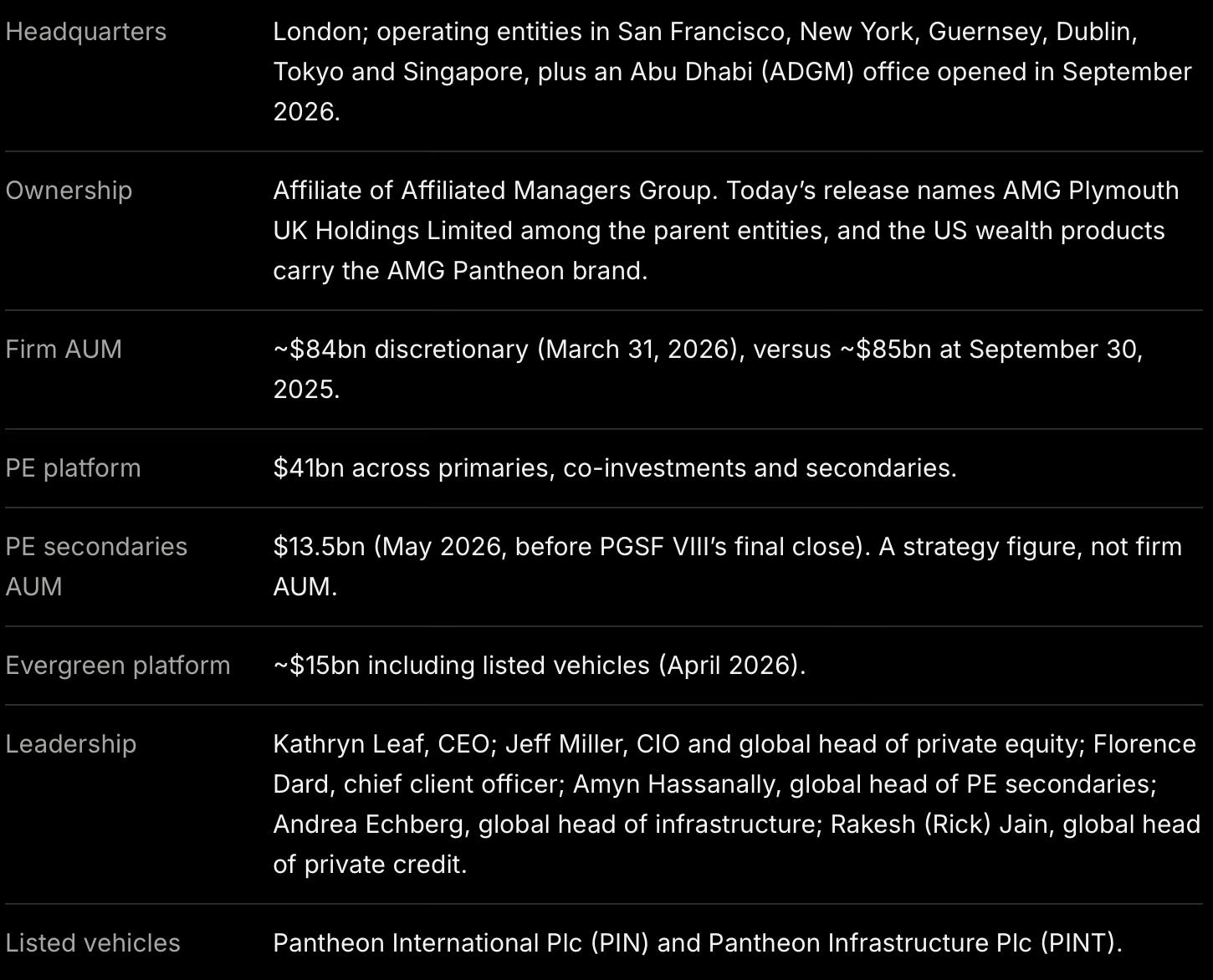
Company profile
Where this sits in the market
A $6bn close is not mega-fund territory. CVC Secondary Partners closed SOF VI at $10bn in September, and the largest flagships run well above that. But Pantheon has deliberately positioned below the mega-funds, and its step from $3.25bn to $6bn in one vintage is steeper than CVC’s move from $5.8bn to $10bn. What sets Pantheon apart in the platform-versus-specialist debate is breadth rather than size: few managers run institutional and evergreen secondaries programs across PE, infrastructure and credit at once. The next vintage will show whether the sourcing advantage that built the machine survives the scale it has produced.