



When Rede Partners published its April 2026 report on the private equity opportunity in Poland, it was framed as a case for primary investment. The macro story is compelling — GDP above $1 trillion, growth running at three times the EU average, a $1.5 million-strong ecosystem of family-owned SMEs whose founders are approaching retirement age. But read between the lines, and what emerges is an equally compelling secondaries story: a market whose structural features are quietly assembling the conditions for a liquidity event that has not yet arrived.
Poland is the hub for private equity across the Central and Eastern Europe region, dominating transactions by value in 2024. PE firms have been established there for two decades. Yet the market remains conspicuously underpenetrated by international fund managers, and the LP base has historically been anchored by Development Finance Institutions rather than the diversified institutional pools that characterize more mature European markets. That combination — growing deal activity, limited LP diversity, and constrained exit infrastructure — is a familiar precursor to secondary market development.
The DPI Problem Is Real — and LPs Are Saying So
The most telling signal in the Rede report is not in the data — it is in the investor quotes. Multiple limited partners interviewed explicitly acknowledged that “consistent DPI generation has been hard” in the Polish and CEE market. That admission, from the LP community itself, is precisely the friction that creates secondary market demand. When distributions do not arrive on the expected schedule and fund lifecycles stretch, LPs look for alternative liquidity paths. In a market where IPO and trade sale activity is only now beginning to thicken, the secondary market is often the only viable route.
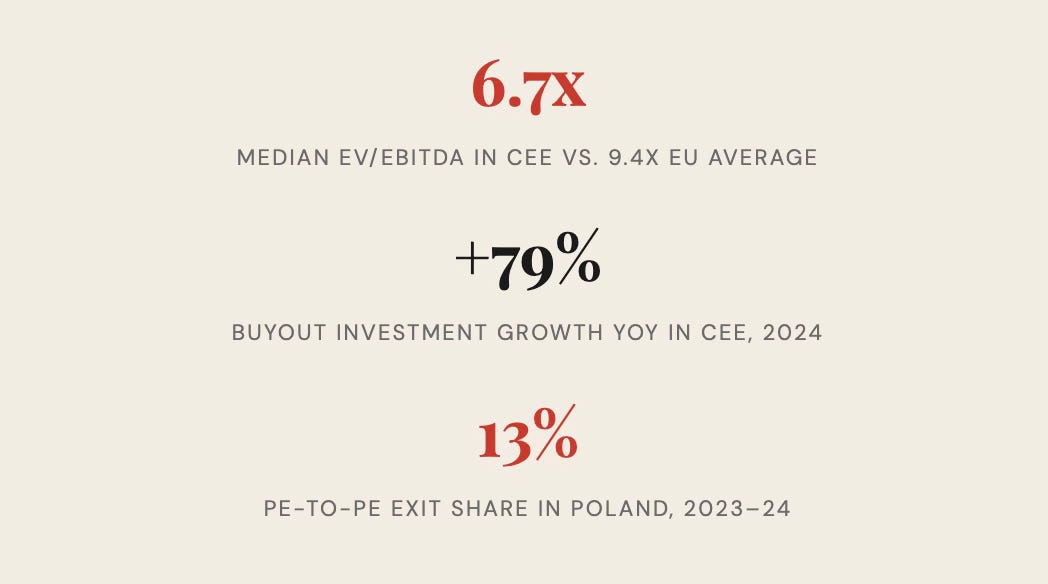
The exit data supports this reading. Sponsor-to-sponsor transactions — the category most directly connected to secondary market activity — represented only 13% of Polish PE exits in 2023 and 2024. The dominant exit routes were trade sales (45%) and public offerings (37%), with IPOs like Żabka and Diagnostyka generating headlines but not the consistent, scalable liquidity that institutional LPs require across a diversified portfolio. For LPs sitting in earlier-vintage CEE funds whose assets have not yet found buyers, the secondary market represents the only realistic path to capital return.
Entry Multiples That Secondary Buyers Should Know
The 30% discount between CEE deal multiples (6.7x EBITDA) and the broader European average (9.4x) is relevant to secondary buyers for a reason that goes beyond the obvious. When underlying portfolio companies were acquired cheaply, NAV marks are — in theory — more conservative and the buffer against secondary discount erosion is structurally wider. Secondary buyers pricing off NAV in funds with significant Polish or CEE exposure are, in effect, gaining access to assets that were themselves bought at a meaningful discount to Western European comps.
That discount exists for a reason: the GP landscape is thin. Rede’s own research indicates that only four players are operating in the midcap (€200–500 million) space across all of CEE. A shallow GP supply means limited price discovery, longer hold periods as GPs await the right buyer, and reduced competition at auction — all factors that secondary buyers can exploit when acquiring LP stakes or working through GP-led processes.
The Succession Wave as a Pipeline Driver
Poland’s 1.5 million family-owned SMEs, many founded in the immediate aftermath of the fall of Communism in 1989, are entering a generational transition. The founders are aging; their children, many of whom left for Western Europe and are now returning in a documented “reverse brain drain,” do not always want to run the family business. This succession dynamic has been a defining feature of Nordic PE market development — and the Nordics are today one of the most active secondaries markets in Europe.
“You have a lot of businesses that were started post fall of Berlin Wall and Communism, so if you roll the clock forward, you have a lot of generational change situations.”
LIMITED PARTNER, QUOTED IN REDE PARTNERS POLAND PE REPORT, APRIL 2026
The Nordic parallel is instructive beyond the succession angle. In the Nordics, as PE-backed mid-market businesses scaled and attracted a wider buyer universe, sponsor-to-sponsor deal volume rose steadily — overtaking family-to-sponsor transactions in 2025. If Poland follows a similar trajectory, the conditions for a functioning secondaries market — sufficient deal volume, maturing fund vintages, and a broader LP base seeking liquidity — would emerge within the next five to seven years. Secondary buyers who build relationships and pricing frameworks now would have a structural advantage when that moment arrives.
What the Market Still Needs
The honest assessment is that Poland is not yet a secondaries market — it is a market whose structural features are pointing in that direction. The GP base is too small, LP diversity is limited, and exit volumes, while growing (buyout exits rose 13% between 2019–21 and 2022–24), remain modest in absolute terms. The Warsaw Stock Exchange is reopening as an exit route, which is positive for DPI but reduces the pressure that would otherwise push LPs toward secondary solutions.
What would accelerate secondaries development in CEE is precisely what the Rede report documents as currently lacking: more international fund managers entering the market, greater LP diversity beyond DFI anchors, and continued growth in buyout deal volumes that creates larger and more liquid secondary positions to trade. Each of those conditions is, by the report’s own account, beginning to move in the right direction.
For secondary market participants, the question is one of timing. Poland in 2026 has the structural DNA of a market that will need secondary solutions — the succession overhang, the DPI gap, the entry multiple cushion, and the thin GP landscape. The deal flow is not yet there at scale. But in a market where being early is often the precondition for being well-positioned, the conversation is worth starting now.
Source: The Rede View on the private equity opportunity in Poland