

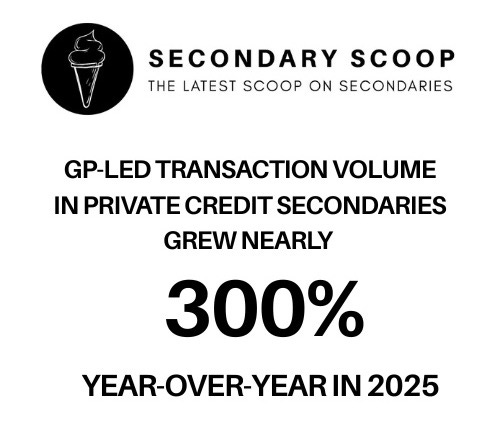
Let’s put a number on it: GP-led transaction volume in private credit secondaries grew nearly 300% year-over-year in 2025. Not 30%. Not 50%. Three hundred percent.
That figure, from Evercore’s annual secondaries market report, is the kind of stat that makes you stop and ask whether you’re reading it correctly. You are. And it reflects something deeper than a hot market — it reflects a structural shift in how credit managers think about portfolio construction, capital recycling, and liquidity.
How we got here:
The private credit market grew explosively between 2018 and 2024. Direct lending AUM roughly tripled. The number of BDCs, separately managed accounts, and closed-end credit vehicles multiplied. As those portfolios matured, a natural secondary market began to form — GPs looking to clean up older vintages, recycle capital into higher-yielding opportunities, and provide liquidity to LPs without waiting for natural loan payoffs.
What accelerated the GP-led side specifically was the same dynamic reshaping PE secondaries: continuation vehicles. In credit, that looks slightly different. Instead of moving a prized software company into a new vehicle, a credit GP might create a continuation fund around a portfolio of performing direct loans managed by a blue-chip sponsor. The economics are attractive for buyers — seasoned cash-flowing assets, predictable returns, and insulation from interest rate volatility.
Some of the landmark deals from 2025 illustrate the scale: Benefit Street Partners’ $2.3B continuation vehicle, TPG Twin Brook’s $3B deal, and Crescent Capital’s record $3.2B CV — the largest private credit secondaries transaction ever completed. These are no longer niche deals. They are institutional-grade transactions that belong in the same conversation as the biggest PE continuation vehicles.
The fundraising side is just as telling:
Ares raised $7.1B for its credit secondaries strategy. Coller Capital closed $6.8B last year. These aren’t opportunistic vehicles — they’re permanent capital allocations to a segment that buyers believe is durable. The Ropes & Gray Q1 2026 update projects that overall secondaries fundraising could top $200B raised over the next 12 months, with private credit strategies among the key drivers.
What changes now that everyone is paying attention:
The risk of success in any secondaries sub-market is the same: competition compresses returns. When a segment is niche, information advantages are wide, pricing is inefficient, and disciplined buyers can generate outsized risk-adjusted returns. When Goldman Sachs, Ares, Coller, and Blackstone are all building dedicated credit secondaries platforms, the information edge narrows.
That said, private credit secondaries remain structurally more complex to underwrite than PE secondaries. Loan portfolios require credit analysis at the underlying borrower level. GP relationships, covenant structures, and documentation quality vary enormously. The buyers who built genuine credit underwriting capabilities early — not just repurposed PE secondaries teams — will have a durable advantage as the market matures.
For LPs considering allocations: private credit secondaries now offer something rare — yield-oriented returns with a secondaries premium and a structural discount available at the time of purchase. The J-curve is minimal. The entry point into seasoned assets removes early-life uncertainty. For allocation committees still sitting on the sidelines, the 2025 data is now hard to argue with.
The number to watch in 2026: Whether GP-led credit secondaries volume doubles again, or whether the 300% YoY growth normalizes as the market catches up to itself. Either answer is informative.
Sources: Evercore 2025 Annual Secondaries Report, Ropes & Gray Q1 2026 Secondaries Update, PitchBook