


PitchBook’s latest European PE Breakdown, published October 6, includes a table of every European secondaries fund close recorded this year. Add it up and the year’s fundraising looks very different quarter by quarter. Nine funds have closed on €21.6bn. Five of them, totaling €19.1bn, closed in Q3.
The first half was quiet by comparison. Q1 produced two closes worth €2.0bn: Montana Capital Partners’ MCP Opportunity Secondary Program VI and Arcano Secondary Fund V, the one Spanish manager on the list. Q2 produced two closes worth €532m combined. Q3 alone raised 7.4x as much as the first six months.

European secondaries fund closes by quarter, 2026 YTD. Source: PitchBook; quarterly sums by Secondary Scoop.
Concentration at the top is just as sharp. CVC Secondary Partners’ Secondary Opportunities Fund VI accounts for 40% of the year’s total on its own. Add Clipway’s debut fund and two managers hold 66% of everything European secondaries vehicles have closed in 2026.
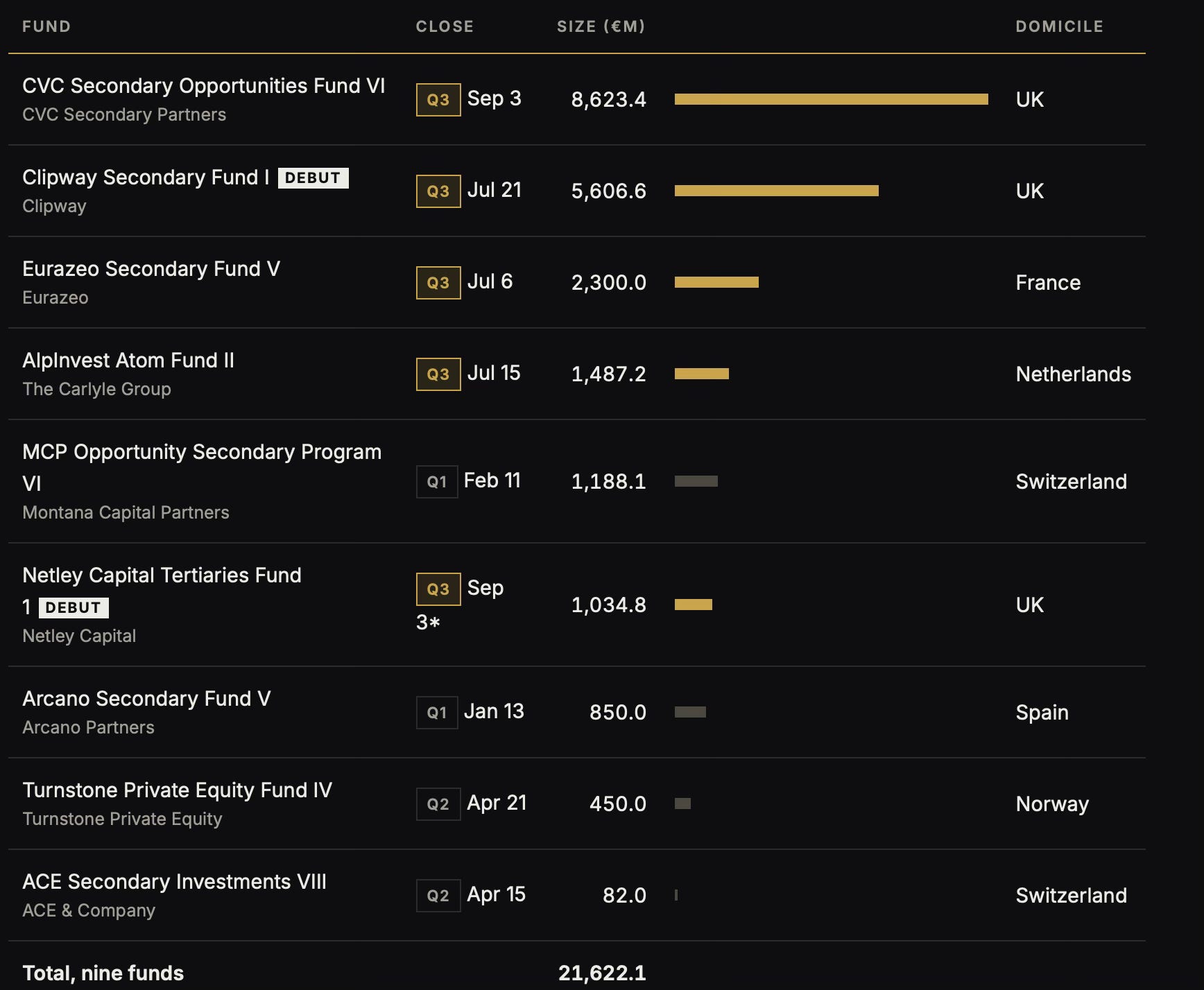
Source: PitchBook, "Secondaries funds closed YTD," geography Europe, as of September 30, 2026. Close dates and domicile as reported by PitchBook. *Netley says its fund reached final close in July and announced it on September 3; see sourcing notes. Debut labels per the managers' own announcements.
Two of Q3’s five closes came from first-time managers
The same PitchBook report says European first-time PE fundraising has stalled at a series low of €1.5bn across seven funds, and that established firms took 88.5% of all European PE capital raised this year. Its explanation is that LPs short on distributions re-up with managers they already know.
Secondaries ran the other way in Q3. Clipway and Netley Capital, both debut funds and both London-based, raised €6.6bn between them, about 35% of the quarter’s secondaries capital. Clipway’s €5.6bn alone is nearly four times PitchBook’s figure for all first-time PE fundraising in Europe this year. PitchBook does not say how it classifies secondaries vehicles in its first-time count, but on these numbers they appear to sit outside it.
Neither manager is a first-time team in the usual sense. Clipway is run by managing partners Vincent Gombault, Ingmar Vallano and Benoit Verbrugghe and announced a final close of $6.4bn on July 21, which it calls the “largest-ever debut secondaries platform”. The fund drew 186 LPs and targets diversified LP-led deals in North American and Western European buyout funds. Netley is led by managing partner Caspar Berendsen. It launched in September 2025 with $315m and says its debut fund “was oversubscribed and closed at an extended hard cap”, taking total committed, deployable capital to about $1.2bn.
TERTIARIES, BRIEFLY
Netley buys LP interests in secondaries funds and continuation vehicles, with underlying exposure to mid- and large-cap buyout funds. It is the only tertiaries vehicle in PitchBook’s 2026 European table.
At launch, Netley estimated that tertiaries could eventually reach up to 10% of secondaries volume, mirroring the roughly 10% ratio of secondaries to primary activity. That is the manager’s own projection.
Location matters here too. By PitchBook’s domicile tags, the three UK funds account for €15.3bn, or 71% of European secondaries capital closed this year. That mirrors the deal side of the same report, where the UK & Ireland took 42.1% of European PE deal value in Q3 while France fell 38.7% quarter on quarter.
The backlog behind the bid
PitchBook’s exits section explains why buyers keep raising. Sponsors struck 2,253 new deals in Q3 against 435 exits, so portfolios are growing almost six times faster than they are being sold down. Distributions as a share of NAV have fallen below 20%, against a 10-year average of 27%.
The inventory numbers point the same way. Europe now has a record 14,803 PE-backed companies, and 11% of them have been held for more than nine years. The median holding period for companies that do sell fell to 6.7 years from 7.1 in 2025. PitchBook reads this as a split market: assets that can be sold are moving faster, and everything else is piling up. It names that backlog as the reason continuation vehicles and NAV-based deals are being used more often.
Q3’s single-asset CV closes fit that pattern. PitchBook cites vehicles from Bregal Unternehmerkapital, Exponent Private Equity and G Square Healthcare Private Equity, the last built around Pharmacy2U.
Big quarter, small slice
PitchBook adds a caveat to its own secondaries section. Secondaries took 12.6% of European private capital raised YTD and continuation funds took 3.2%, against 29.4% for traditional PE.
There is a second tension in the report. Its private capital by strategy chart shows 2026 secondaries fundraising well below the 2025 bar, which was the largest in the series. We are reading that from the chart rather than a stated figure, and there is a full quarter still to come. Even so, the 2026 story so far is one of concentration in a few large closes rather than broad growth in secondaries fundraising.
PISCES is becoming a VC secondaries venue
PitchBook also tracks the UK’s Private Intermittent Securities and Capital Exchange System, which has moved from regulatory milestone to live trading this year. The LSE’s Private Securities Market completed its first trade on March 25, in a tradable investment company holding secondary shares in Oxford Science Enterprises’ venture portfolio. Asset Match joined the LSE and JP Jenkins as an approved operator on April 22, notably without the quantitative admission thresholds the LSE applies.
Two employee liquidity deals followed in July. Wayve completed an $85m employee tender on the LSE’s platform, which PitchBook calls the largest PISCES transaction to date. PitchBook reports that it priced at a 10% discount to Wayve’s last round, with ARK Invest, Liberty Street, G Squared and Launchbay Capital among the buyers. We have not independently confirmed the discount or the buyer list.
Moneybox also ran a PISCES sale, and here the figures need a correction. PitchBook describes it as a roughly £800m secondary sale. Moneybox’s own July 13 announcement puts its valuation at about £800m and the sale at up to £45m of shares for long-serving employees, run through Crowdcube on the LSE’s Private Securities Market.
PitchBook’s broader point holds either way. These deals solved employee liquidity without a listing, which is why some in the market now argue PISCES could delay IPOs rather than lead to them. For secondaries buyers, that means a regulated venue for late-stage VC paper. For Europe’s IPO pipeline, it means one more reason to stay private.