


The Financial Times ran two stories in two days that read as a pair. On November 22, it reported that co-investors are frustrated at being forced out of companies that buyout firms sell into their own continuation vehicles, often at prices they think are too low. On November 23, it described the rush into hybrid capital: structured money that sits between debt and equity, which buyout firms now use to return cash to LPs without selling outright.
Both pieces describe the same problem. There are assets their owners can’t sell at the price they want, and there are LPs who want cash. CVs and hybrid capital are two answers to it. They suit different situations, and they go wrong in opposite directions.
Two ways to move a stuck asset
A CV changes who owns the asset and keeps the manager. A hybrid deal keeps the manager in the asset, often as a minority holder, and brings in an outside investor whose money comes with priority rights.
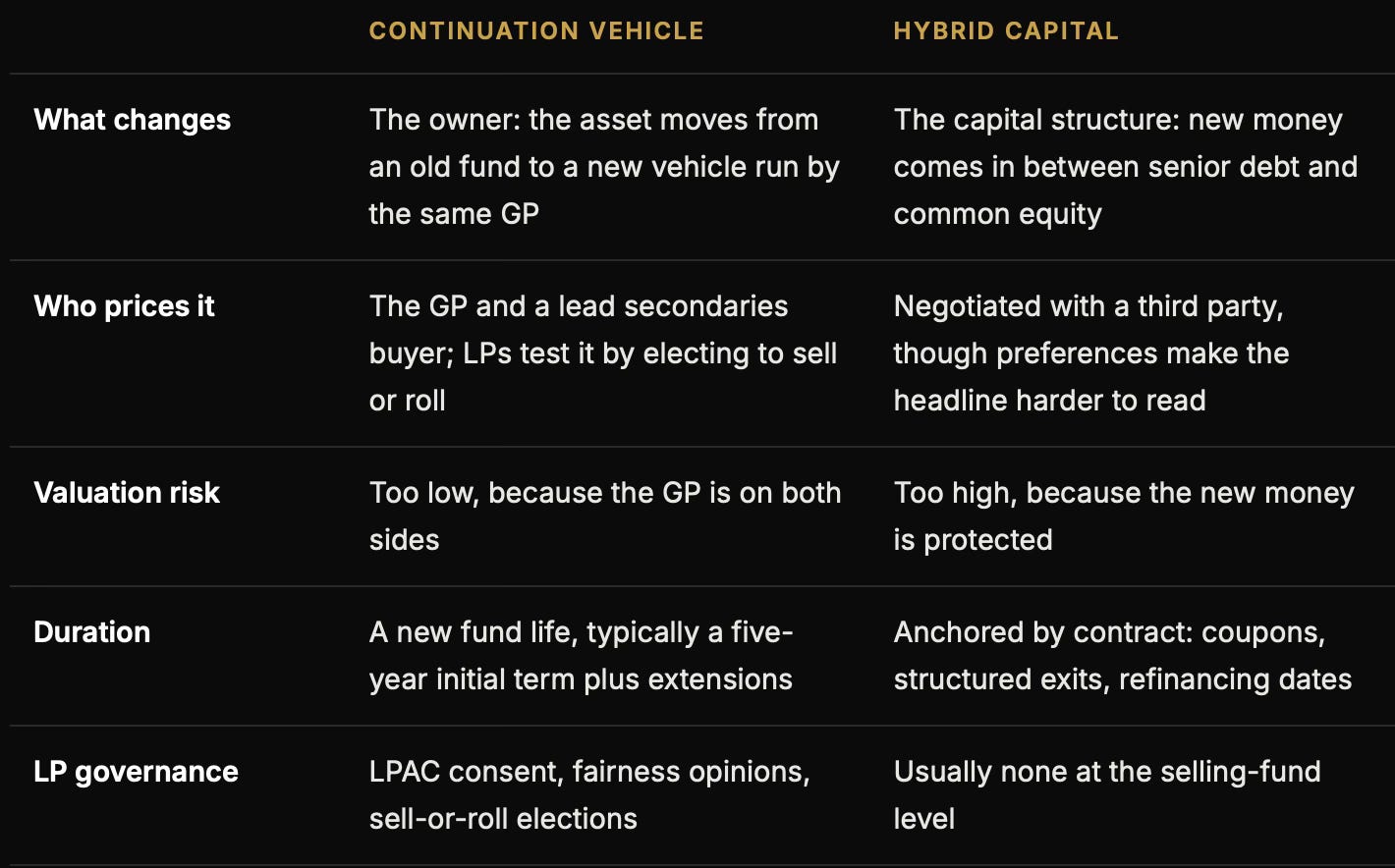
Source: Secondary Scoop analysis; CV term data from Morgan Lewis’ Annual Continuation Vehicles Report 2026.
Both markets are growing. Jefferies counted $62 billion of GP-led volume in the first half of 2026, 53% of all secondaries activity. In hybrid capital, Apollo closed Hybrid Value Fund III at about $6.5 billion in May, against $4.6 billion for Fund II in 2022 and $3.3 billion for Fund I in 2019. Warburg Pincus closed its first Capital Solutions fund at more than $4 billion in 2024, double its target, and has been reported to be seeking $5 billion for the second. GTCR has just started investing from its first Capital Solutions Fund.
Apollo’s own results show why. In its third-quarter 2026 release, Hybrid Value returned 18.0% gross over twelve months against 2.0% for flagship private equity. On the earnings call, Marc Rowan described the hybrid shift as risk management:
“In the equity business, the way we take risk down, we reduce leverage, we move toward hybrid structures.”
Marc Rowan, Chairman and CEO, Apollo, 3Q 2026 earnings call
Complement, not substitute
Hybrid managers don’t pitch their product as a replacement for secondaries. In a July 2026 paper, Capital that Fits, Bain Capital Special Situations argues that hybrid capital can sit in several allocation buckets at once: as a credit diversifier, an opportunistic solution, or, in its words:
“an equity complement with shorter duration than traditional private equity”Bain Capital Special Situations, “
Capital that Fits: Understanding Private Market Hybrid Strategies,” July 2026
Bain’s “complement” refers to private equity portfolios, not to secondaries, and on secondaries the paper draws a contrast. It says secondaries depend on a market-clearing function, while hybrid duration is usually anchored by contract and depends less on third-party liquidity. Put simply, a CV needs secondaries buyers to show up at a price. A hybrid deal writes its exit path into the documents.
That difference is why the two are better seen as complements. A CV suits a strong asset where the GP wants more time and the market will fund it. Hybrid capital suits situations where common equity can’t clear: a valuation gap, a refinancing wall, or an owner who won’t sell control. Sometimes it does the same job a CV would. One of the inflection-stage examples Bain lists is Power Home, described as capital provided to generate sponsor liquidity in a large US home-remodeling platform.
Mirror-image valuation risk
The conflict in a CV is well known: the GP sets a price at which it is both seller and buyer. The FT’s co-investors say they are being pushed out at that price, often without the option to roll. The paper points to one public example. Packaging entrepreneur Michael Maillis is suing a founder of HIG Capital. He alleges he was pushed out of his minority stake when HIG sold part of Maillis Group to another of its own funds, at a price it had rejected from an outside buyer. The FT describes it as a cross-fund deal with similar dynamics to a CV. HIG declined to comment. A person familiar with the firm said the deal was backed by a bank fairness opinion and that HIG is seeking to have the case dismissed.
In a hybrid deal the risk runs the other way. Because the new investor is protected by a preference, it can agree to a headline valuation that common equity alone wouldn’t support. In the Kelvion deal described below, the FT reports that Apollo’s priority on proceeds let it pay more than it otherwise would have. The FT also notes that hybrid structures can let existing owners avoid facing up to the true value of challenged assets. One hybrid dealmaker told the paper that equity values on many of these deals are stretched.
WHY A PREFERENCE LIFTS THE HEADLINE
If the hybrid investor is paid first, up to an agreed return, its downside is largely covered. That lets it accept a higher headline valuation than an ordinary buyer would. The seller’s retained stake takes the risk and, if things go well, a larger share of the upside. So the headline valuation says less about what the common equity is worth than a normal sale price would.
Bain’s paper gives illustrative ranges for how the layers stack: a contractual target return of 9–13%, an incremental upside target of 6–10%, a liquidation preference of about 1.0–1.5x, seniority below 60% loan-to-value and diluted ownership of 10–30%. These are Bain’s targets, not reported results.
Neither structure gives you a clean arm’s-length price for the common equity. A CV’s price is set by insiders and checked by LP elections. A hybrid deal’s price is backed by real third-party money, but the terms flatter the headline.
Kelvion: the case for the hybrid route
The best example so far is Kelvion, the German heat-exchange maker that Triton bought from GEA in 2014 for €1.3 billion including debt. Triton restructured €600 million of the company’s bonds in 2019 to keep control. According to the FT, a trade sale fell through and Apollo initially thought Triton’s asking price was too high.
The deal that eventually happened was a hybrid one. Apollo’s funds took a majority stake with priority on proceeds up to an agreed return. Triton kept a minority stake that would earn a disproportionately large share of any value above that. Bloomberg reported a valuation of about €2 billion ($2.3 billion) including debt when the deal was signed in August 2025, and it completed in January 2026. In August 2026, Apollo agreed to sell 100% of Kelvion to SLB for about $3.4 billion in cash plus about $0.7 billion of assumed debt, roughly $4.1 billion in total. Triton’s minority stake goes to SLB as well, and the deal is expected to close in the first half of 2027. Data centers are now Kelvion’s largest and fastest-growing segment.
In dollar terms, enterprise value rose about 1.8x between the two signings, though part of that comparison reflects the euro-dollar exchange rate. Now compare a CV. If Triton had moved Kelvion into a continuation vehicle at a €2 billion mark, the LPs who sold would have missed that rise, which is exactly what the FT’s co-investors complain about. Through the hybrid route, Triton’s LPs got cash and the fund kept a stake in the upside. Triton counts the deal among ten realizations across its mid-market funds since 2024, delivering about €7.3 billion of proceeds.
What isn’t public: the preference terms, the return hurdle, how much cash Triton’s LPs received in January, and how the $3.4 billion will be split between Apollo and Triton. Until those numbers are known, there’s no way to say who got the better deal.
Where the lines blur
Hybrid capital isn’t only a rival to secondaries. It is already being counted as part of the market. Willkie Farr estimates that preferred equity and other structured solutions made up about 16% of GP-led volume in the first half of 2026. In October, Ares closed its first Global Structured Solutions fund at $4.2 billion. The fund provides preferred equity to managers and is led by Nate Walton, Ares’ head of secondaries. 17Capital reports $8.4 billion of preferred equity deployed across 86 investments, alongside its NAV lending business. In larger CVs, junior and preferred capital increasingly fills the gap above what secondaries buyers will fund.
The bigger crowding risk is inside hybrid capital itself, not between hybrid and secondaries. Bain’s paper says that if a lot of capital moved into the strategy without more attractive deals to match, pricing could tighten and documentation could weaken. The FT heard a similar warning from the market: one dealmaker said far fewer high-quality, growing buyout-backed businesses seek hybrid deals than people expect. Bain’s answer is that the strategy takes capabilities that are hard to assemble quickly. That is also, of course, the argument a large incumbent would make.
Software is the next test
Software is where both tools are being tested. GP-led buyers turned away from technology in the first half of 2026 amid AI and valuation concerns, according to Jefferies and Ropes & Gray. Hybrid money is stepping in, but mainly as a lender. In October, GTCR co-led a $200 million second-lien term loan for Thoma Bravo’s Sophos, alongside a refinancing of the company’s $2.45 billion first-lien loan. Earlier, private credit lenders had turned down the refinancing even with a substantially higher yield on offer, and Thoma Bravo said it would not put in new equity. The FT presents Sophos as a possible model for other sponsor-backed software companies.
“This transaction reflects our ability to work alongside existing owners and management to structure bespoke capital solutions.”
Jason Prager, Managing Director, GTCR
A second-lien loan is junior debt rather than a structured equity solution, so calling it hybrid capital stretches the term. It does show the direction, though. For software assets that are hard to put into a CV at their current marks, the money on offer is moving down the capital structure, not up.
Who sets the price, and who keeps the upside
For an LP, both structures raise the same two questions: who set the price, and who keeps the upside. CVs now come with a governance playbook. There’s LPAC consent, fairness opinions, sell-or-roll elections and ILPA guidance on process, and the economics are converging. In Morgan Lewis’ review of 169 CVs, 97% charge a management fee of 1% or less and 79% use tiered carry.
Hybrid deals at the portfolio-company level come with none of that. LPs in the selling fund usually don’t vote on them. The preference and hurdle terms are rarely disclosed, and there is no comparable public data on hybrid fees. Apollo won’t even say which pools make up the more than $100 billion it counts as hybrid. Bain itself writes that a contractual floor does not eliminate bad underwriting and only helps if it is enforceable.
As we’ve argued before, both tools are normal portfolio management, not signs of distress, and used together they cover more situations than either does alone. The difference is that one of them now has to explain itself to LPs, and the other mostly doesn’t yet.
Governance arrived in continuation vehicles because LPs had a point of entry, LPAC consent and sell-or-roll elections. Hybrid terms are set at portfolio company level, where most LPs in the selling fund have no such entry. Reporting on preference and hurdle terms in the side letter looks like the only place an LP can write itself in, and I would expect that to become a standard ask.