

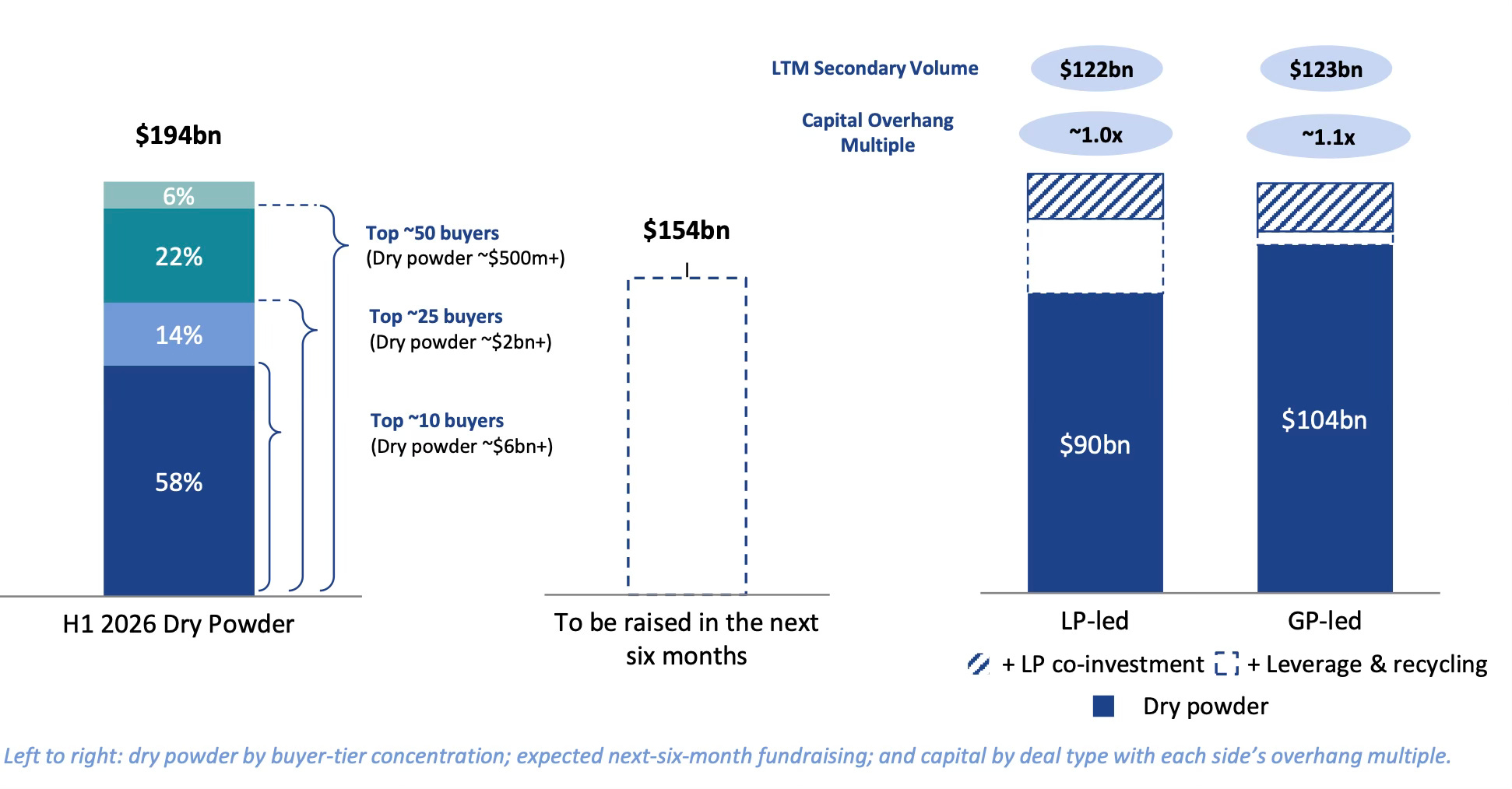
Evercore’s H1 2026 Secondary Market Review will get covered for its headline number: $121 billion of volume in the first half, up 19% year-over-year and the strongest first half on record, putting the market on pace for $250-260 billion by year-end. That framing is accurate, but it buries the more interesting story on page five. Secondary dry powder fell from $215 billion to $194 billion in six months, and the capital overhang multiple, total available capital divided by last-twelve-months volume, has compressed to roughly 1.0x. That is the tightest cushion this market has carried in years, and it changes what “record growth” actually means for anyone raising, buying or selling in this space.
From surplus to just-in-time capital
For most of the secondary market’s history, the defining feature of buyer capital was its abundance relative to opportunity. Dry powder sat as a static pool, built up over successive fundraising cycles, waiting to be deployed. Evercore’s data shows that dynamic breaking down. At 1.0x overhang, available capital roughly matches one year of volume, enough to sustain today’s pace, but with almost no slack if fundraising falters or deal flow accelerates further. The report is explicit that the $154 billion H2 fundraising target isn’t an ambitious stretch goal; it’s the amount required just to keep the market moving at its current speed.
A “record” quarter of GP-led supply is not simply evidence of a booming, capital-rich market, it is evidence of a market converting capital into deals faster than it is being replenished. The implication cuts both ways. For LPs and family offices allocating to secondary funds, it argues for urgency: capacity is genuinely scarcer than headline dry powder figures suggest, and access to top-tier managers matters more when the buyer base isn’t sitting on excess reserves. For GPs and sellers, it argues the opposite: a tightening capital base gives well-positioned buyers, particularly the roughly ten firms holding the bulk of dedicated capacity, real pricing leverage on anything short of best-in-class.
Where the slack is actually coming from
The market isn’t relying on dedicated secondary funds alone to fill that gap, and this is where the report’s other threads connect back to the capital story. Evergreen vehicles have gone from a niche product to mainstream infrastructure: 53% of buyers now operate one, and secondary-focused evergreen AUM has reached roughly $130 billion, with $11 billion of expected inflows over the next twelve months earmarked specifically for secondaries. These vehicles don’t replace flagship fundraising, they typically finance only a minority of any purchase price, but they smooth the cycle, giving buyers capital in hand between traditional raises exactly when a 1.0x overhang leaves no room for a pause.
Credit and infrastructure secondaries are doing something similar from a different angle: they’re expanding the total addressable pool of dedicated capital rather than recycling the existing one. Credit secondary deal value hit $20 billion in H1 alone, already surpassing all of 2025, with $31 billion of dry powder and 90%+ of buyers planning to raise more within a year. Infrastructure volume rose 33% to $12 billion, backed by $22 billion in dry powder that’s up 10% year-to-date even as overall market dry powder fell. Both are effectively new capital formation, not redeployment of the same $194 billion — which is precisely what a market running at 1.0x overhang needs to keep expanding.
The GP-led side is pricing conviction, not diversification
The other angle worth pulling out is what’s happening to return logic inside GP-led deals. Single-asset continuation vehicles now account for 53% of GP-led volume, up sharply from last year (SACV transaction volume rose 88% YoY), and the majority price at or above NAV. Normally, paying full price or a premium would compress forward returns. Instead, buyers are underwriting SACVs to average gross multiples of ~2.3x over four years, meaningfully higher than the ~1.9x targeted for multi-asset continuation vehicles, ~1.8x for single LP interests, and ~1.7x for diversified LP portfolios.
That is a real inversion of how secondaries traditionally priced risk. Diversified portfolios used to command the premium multiple for the diversification itself; now the highest return targets sit with the most concentrated, single-company bets, because buyers get the deepest diligence access and the clearest view of the exit path. Layer in that more than a third of GP-led deals now include super-carry terms, giving sponsors greater upside participation to win competitive processes, and the picture is a market where capital is being priced less like a portfolio-rebalancing tool and more like direct, high-conviction equity investing with a continuation-vehicle wrapper.
The one segment still waiting
If there’s a counterweight to the “capital is tight” thesis, it’s venture secondaries, where volume has stayed flat at $5 billion for a full year despite $10 billion of dedicated dry powder sitting largely idle: capital that exists but isn’t finding a home. The “SaaSpocalypse” repricing in public software bled into private marks in early 2026, widening bid-ask spreads and pushing buyers out of processes. Buyers there are demanding 20%+ net IRRs and creating what the report calls a K-shaped pricing environment: top-quartile AI-adjacent franchises clearing near par, everything else trading at steep discounts with a hollow middle. Venture is the one part of this market where dry powder abundance, not scarcity, is the live issue, a useful reminder that the capital-tightening story is a private equity, credit and infrastructure phenomenon first, not a universal one.
The takeaway
The headline framing a record first half, on track for a record year is true and worth reporting. But the more durable insight for anyone advising GPs, LPs or startups on secondary-market positioning is that the market has quietly shifted from a capital-surplus business to a capital-velocity business. Growth now depends on continuous, parallel fundraising, recycling and new-entrant capital formation rather than a deep static reserve. That single shift explains why evergreen structures are proliferating, why credit and infrastructure secondaries are scaling so fast, why SACV pricing looks more like direct dealmaking than portfolio liquidity management, and why venture, still sitting on unused dry powder, remains the market’s clearest outlier.