


Super carry has gone from deal-room jargon to headline in a single year. Bloomberg ran it this week. PitchBook covered it in August. Every major secondaries advisor now has a number for it.
The trouble is that those numbers are not the same number. Evercore, PJT Park Hill, Lazard and William Blair each count a different universe on a different basis, and at least one law firm has used the label for something far broader. What they agree on is direction: premium carry is spreading fast through GP-led secondaries.
Why it surfaced in secondaries rather than primaries is structural.
Carry stops being a convention
In a primary fund, 20% is a vintage-level convention, fixed at fundraising against a blind pool. A CV has no such anchor. Economics reset at transfer, and the lead buyer negotiates them against a single, fully diligenced asset whose upside the sponsor understands better than anyone at the table.
That turns carry into a live variable in every GP-led process, priced alongside the purchase price, sponsor rollover and the governance package. Super carry is what that variable looks like when the asset is strong enough to command it.
TIERED CARRY: THE STRUCTURE SUPER CARRY SITS ON
Most CVs do not pay a flat carry rate. They use a ladder: a lower rate at modest returns, stepping up as the vehicle clears higher return thresholds. Morgan Lewis found tiered carry in 79% of the 169 CVs it advised on in 2025-26, typically with a full GP catch-up at each tier. In 60% of those, the sponsor had to clear both an IRR and a multiple-of-invested-capital threshold to reach the next rung.
Super carry is what happens when the top rung of that ladder goes above 20%.
What counts as super carry
There is no market standard. Most sources draw the line at 20%, the old primary-fund convention. Evercore’s glossary defines super carry as “terms where carried interest can exceed 20%.” William Blair uses the same test. PJT, as reported by Bloomberg, counts anything above a standard 12% to 20% range.
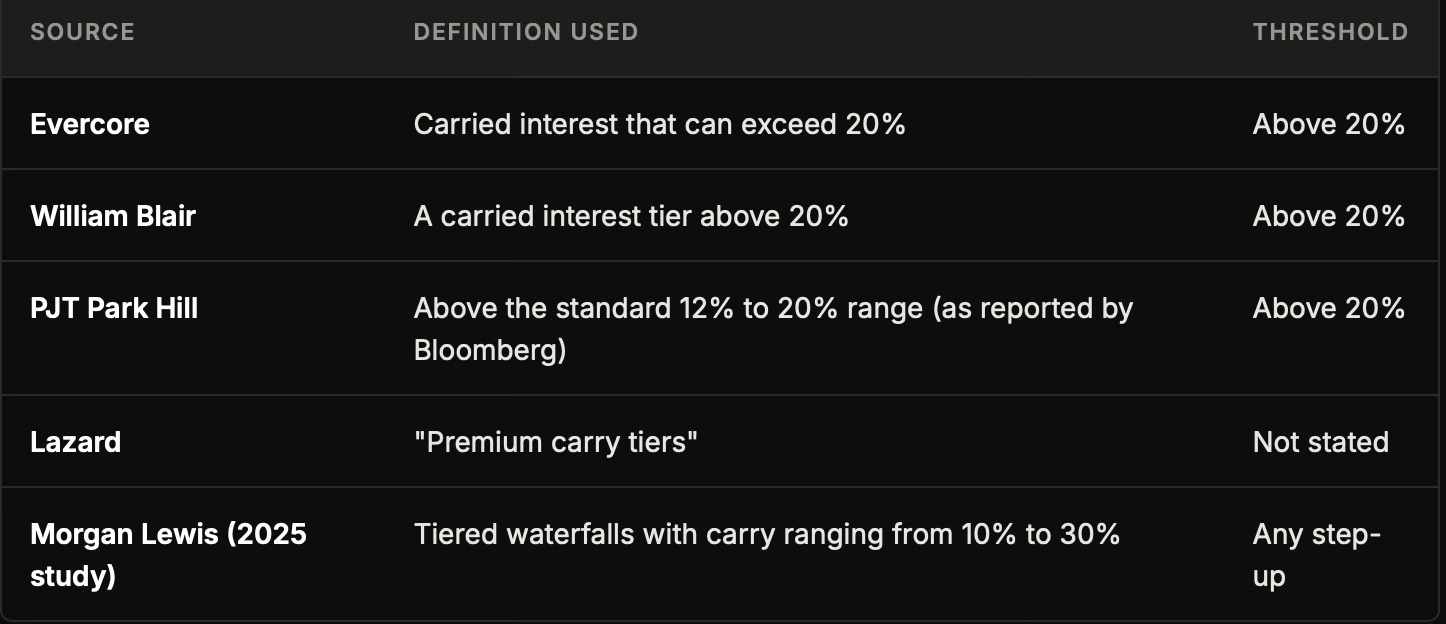
Sources: Evercore H1 2026 Secondary Market Review; William Blair 2026 Secondary Market Report; Bloomberg, Oct. 7, 2026; Lazard Interim 2026 Secondary Market Report; Morgan Lewis Continuation Vehicles Report 2025 press release.
The outlier matters. In its 2025 report, Morgan Lewis described 75% of CVs as having a tiered waterfall with super carry. Under that broader reading, almost any step-up qualifies. Its 2026 report drops the label and simply reports tiered carry. Those figures measure something far wider than the advisors’ 15% to 39%, and should never be read side by side as the same statistic.
How it works in practice
Super carry is almost always conditional. Bloomberg reports that some buyers require a 30% IRR, a 3.0x return on invested capital, or both, before the top tier applies. The highest carry rate Morgan Lewis observed in its 2025 study was 30%.
The table below is illustrative only. It assumes a $100 million CV, a ladder that pays 10% below 2.0x, 20% from 2.0x and 30% from 3.0x, and a full catch-up at each tier, so the applicable rate falls on all profit.

Illustrative arithmetic by Secondary Scoop, not a market-standard structure. Ignores preferred return mechanics and fees.
Two things follow. First, investors earn more in absolute terms at every step, which is the core of the alignment argument. Blue Owl, one of the backers of Percheron Capital’s Big Brand Tire vehicle, told Bloomberg it supports structures “paying sponsors more only when investors earn more.”
Second, the sponsor’s share of each incremental dollar jumps sharply near the top. Moving from 2.4x to 3.2x adds $80 million of profit in this example, and the GP takes $38 million of it. That is the trade investors are making: a much larger slice of the outperformance in exchange for a stronger incentive to deliver it.
The hurdle level is the crucial detail. Buyers target roughly 2.3x gross over four years on single-asset CVs, according to Evercore. William Blair puts the net target at 2.2x for 2025. A 3.0x super tier therefore pays only if the asset clearly beats the buyer’s own underwriting case. One dealmaker told Bloomberg his firm expects only a fraction of these agreements ever to trigger.
Why it lives in secondaries
Super carry is not a secondaries invention. Accel-KKR already takes it on its primary funds, according to Bloomberg, and PitchBook points to Bain Capital’s B-class LP interests, which carry a 30% profit share offset by a lower management fee. But the secondaries market is where it has become visible and measurable, for four structural reasons.
Every CV is a fresh negotiation. Primary fund terms are set once per vintage. A CV resets economics on every deal, so carry can move asset by asset.
The assets are trophies. Single-asset CVs reached $34 billion in H1 2026, up 88%, per Evercore. Campbell Lutyens has them at 62% of GP-led volume, up from 48% in 2025. Sponsors are bringing their best companies, and the best companies command terms.
Price has little room left to rise. Lazard says 23% of single-asset CV volume priced above par in 1H 2026, up from 8% in 2025. Campbell Lutyens has 69% at par or better. When price is already at NAV, carry becomes another lever for winning a deal.
Buyers are competing for allocation. Lazard’s surveyed buyers hold about $77 billion earmarked for H2 GP-led deals, against a $61 billion first half. Evercore says investors increasingly offer super carry to differentiate bids in competitive processes, concentrated in the highest-quality assets.
That last point turns the usual narrative around. Super carry is often framed as sponsors extracting more. Evercore’s description is of buyers volunteering it to win. Both happen. Several investors balked at Parthenon Capital’s terms on Kroll Bond Rating Agency before HarbourVest agreed, and lead buyer Coller EQT rejected Lightspeed Venture Partners’ 25% proposal on a multi-asset venture CV, according to Bloomberg’s unnamed sources.
How much of the market has it
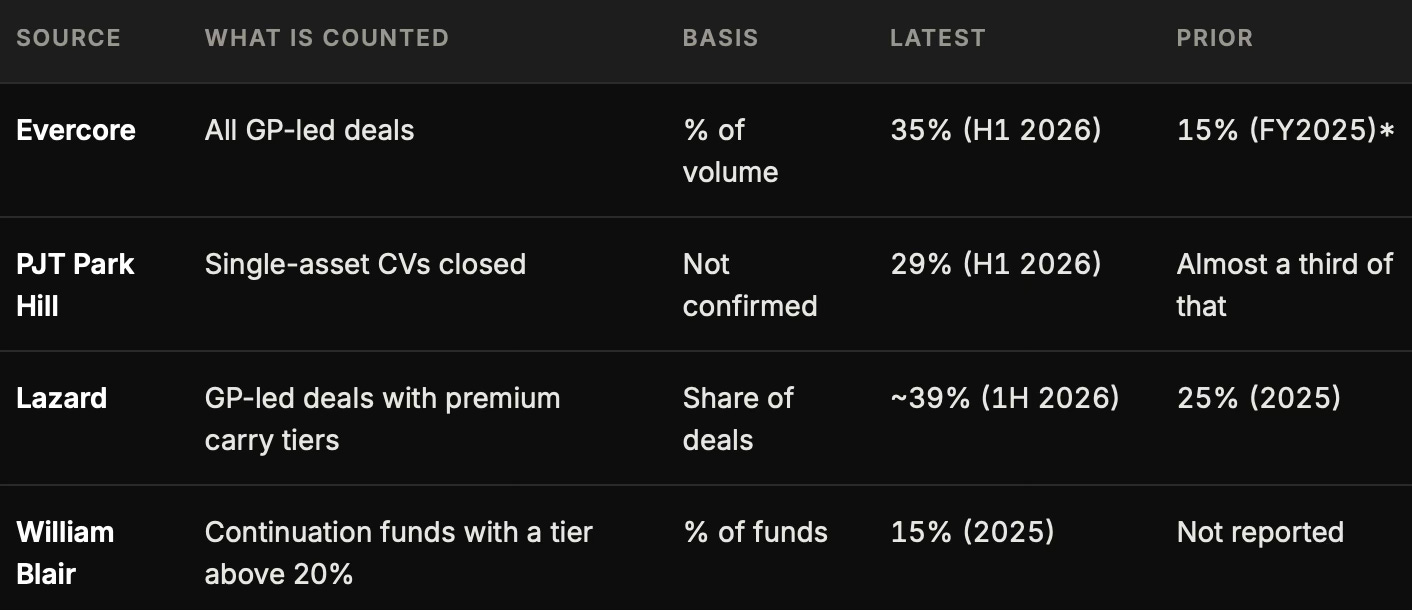
*Evercore’s FY2025 figure as reported by PitchBook; the H1 2026 review shows only the current figure. PJT figure as reported by Bloomberg; the report is not publicly available. Jefferies and Campbell Lutyens do not quantify super carry in their H1 2026 reports.
Read the table for direction, not precision. Evercore weights by dollars, so a handful of large trophy deals can move its share. William Blair counts funds. PJT looks only at single-asset deals. Each dataset also reflects the advisor’s own deal flow. Still, four independent sources pointing the same way is a stronger signal than any one of them.
Who pays for it
Every CV has three constituencies: the new buyers, the LPs who roll, and the LPs who sell. Super carry lands differently on each.
New buyers negotiate it directly and price it in. Selling LPs may pay indirectly: PitchBook reports concern that buyers offset the promise of super carry with a lower purchase price for the asset. Rolling LPs are the sharpest question, because the sponsor often crystallizes carry from the original fund at the transfer and then gets a richer carry opportunity in the new vehicle.
That is where super carry meets the LP governance agenda. ILPA’s proposed updated continuation vehicle guidance, released June 24, 2026, says there should be no overall increase in fees or carry for rolling LPs, backed by comparative modeling, according to a Mayer Brown analysis. Final guidance is expected later this year. Split economics are already common: Morgan Lewis found 31% of CVs charged rolling LPs a different management fee than new investors.
The alignment math is also shifting underneath. Morgan Lewis found 75% of 2025-26 CVs had sponsor commitments between 0.1% and 5% of investor commitments, up from 42% in 2021-24. Other datasets cited in the market point the other way, so the trend is contested. But if sponsors are putting in less capital while asking for more carry, the case that super carry improves alignment gets harder to make.