


Jefferies’ H1 2026 Global Secondary Market Review, published in July, tells a now-familiar top-line story: another record half for the secondary market, $118 billion in total volume, up 15% year-over-year, with GP-led activity crossing the halfway mark of the market for the first time since 2021 at $62 billion, up 32%. That headline has been covered. Buried further into the report, in the sector breakdown behind that GP-led number, is a sharper story.
Jefferies tracks GP-led transaction volume across five sector buckets: Tech & TES, Business Services, Healthcare, Industrials, and Other. Comparing the full-year 2025 mix to the H1 2026 mix shows one sector moving far more than any other.
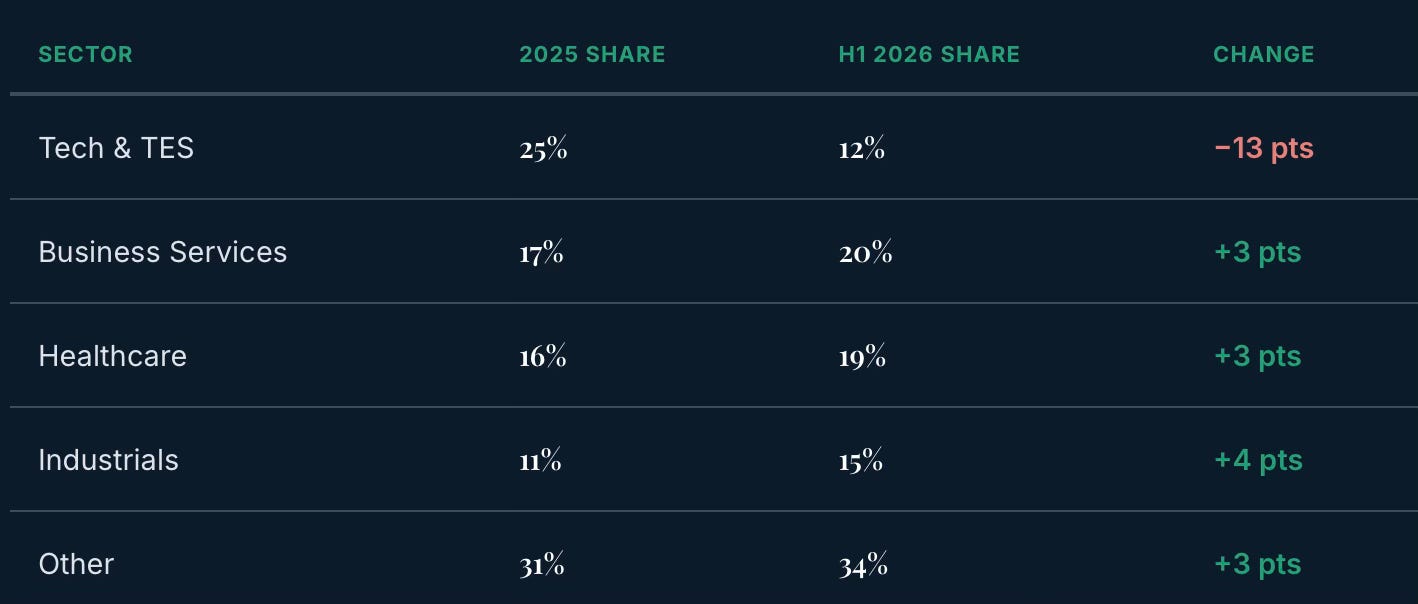
The math is nearly exact: tech’s 13-point loss is matched almost point-for-point by gains of 3, 3, 4, and 3 points spread across the other four buckets. It reads less like organic growth in healthcare or industrials dealmaking and more like tech’s share simply being reallocated elsewhere in the mix.
“Questions around the durability of software valuations amid accelerating AI disruption reduced buyer appetite for software-focused transactions.”
Jefferies, Global Secondary Market Review, July 2026
Jefferies’ own explanation, from the same section: “as technology activity slowed, other sectors including healthcare, financial services, industrials, and business services absorbed much of the volume displaced from software transactions.” That’s a direct, if brief, confirmation of the mechanism, buyers didn’t necessarily walk away from GP-led dealmaking broadly, they walked away from software specifically, and the same pool of capital that would have gone into a software CV went into a healthcare or industrials one instead.
NOT ALL SOFTWARE, AND NOT ALL AI
Jefferies’ framing draws a distinction worth keeping: this isn’t “AI is hurting secondaries,” it’s “AI-driven uncertainty is hurting traditional SaaS specifically, while AI-native or AI-beneficiary businesses are still commanding premiums.” On the LP side, the report notes demand was strongest for “non-SaaS buyout, direct lending private credit, infrastructure, and category-leading, AI-related businesses,” while it was weakest for “unfamiliar companies, SaaS exposure, tail-end funds, real estate, and early-stage venture.” On venture specifically, pricing actually rose 100 basis points to 79% of NAV in H1 2026, but stayed “bifurcated, with buyers continuing to pay premium valuations for category-leading, AI-related companies, while traditional SaaS-focused portfolios experienced greater valuation pressure.”
In other words: the sector chart shows tech’s GP-led share collapsing, but the underlying story is closer to a repricing within tech than an exit from it. Category leaders tied to AI are trading fine. Legacy SaaS is where the discounting is concentrated.