


StepStone Group closed its debut infrastructure secondaries fund at $1.7bn on August 26, a solid but unremarkable number by 2026 standards. What makes it worth a closer look isn't the size, it's the sequencing: infrastructure is now the fifth distinct secondaries strategy StepStone runs across private equity, venture capital and growth equity, real estate, private debt and infrastructure, built on top of a $913bn total-capital, $245bn-AUM platform that gives every one of those strategies its own primary-and-co-investment data feed.
The news: infrastructure secondaries closes at $1.7bn
StepStone Group Inc. (Nasdaq: STEP) announced last week that it has completed fundraising for StepStone Secondaries Infrastructure Fund (”SSIF”) and related separate accounts, reaching $1.7bn in total capital commitments. The commingled fund itself closed at $1.5bn, surpassing its original target and hitting the hard cap; the remainder came through separate accounts running alongside it.
SSIF is StepStone’s first closed-ended commingled fund dedicated exclusively to infrastructure secondaries. It buys LP interests in infrastructure funds and invests in GP-led secondary vehicles run by third-party infrastructure sponsors, with a stated tilt toward the middle market: the same less-efficient segment StepStone’s other secondaries strategies target. As of August 2026, the fund is roughly 50% deployed across 26 closed LP-interest and GP-led deals, the majority of them in the middle market.
“Secondaries are a relationship business. LPs come to us seeking liquidity or a way to reshape a portfolio, and GPs come to us seeking a partner who can support their funds and their assets over time.”
JAMES O’LEARY, PARTNER AND HEAD OF STEPSTONE INFRASTRUCTURE & REAL ASSETS
The fund follows the 2024 close of StepStone’s inaugural infrastructure co-investment vehicle, and the firm frames the two as complementary: StepStone Infrastructure & Real Assets invests across primary funds, secondaries and co-investments simultaneously, deploying an average of $13bn a year over the past three years, and the deal flow from all three feeds a proprietary data platform (SPI by StepStone) that the firm says gives its secondaries underwriters visibility into funds and assets before they hit the broader market. Latham & Watkins advised on the fund’s formation.
WHAT “SSIF” ACTUALLY BUYS
Two transaction types, standard for infrastructure secondaries: (1) LP interests — StepStone buys an existing investor’s stake in an infrastructure fund, typically at a negotiated discount or premium to NAV; and (2) GP-led secondaries — StepStone participates as a buyer in continuation vehicles and other GP-led restructurings run by third-party infrastructure sponsors moving assets out of an aging fund. StepStone itself is not the GP on the underlying assets in either case — it’s the secondary buyer, not the sponsor.
Why this is really a five-strategy story, not a one-fund story
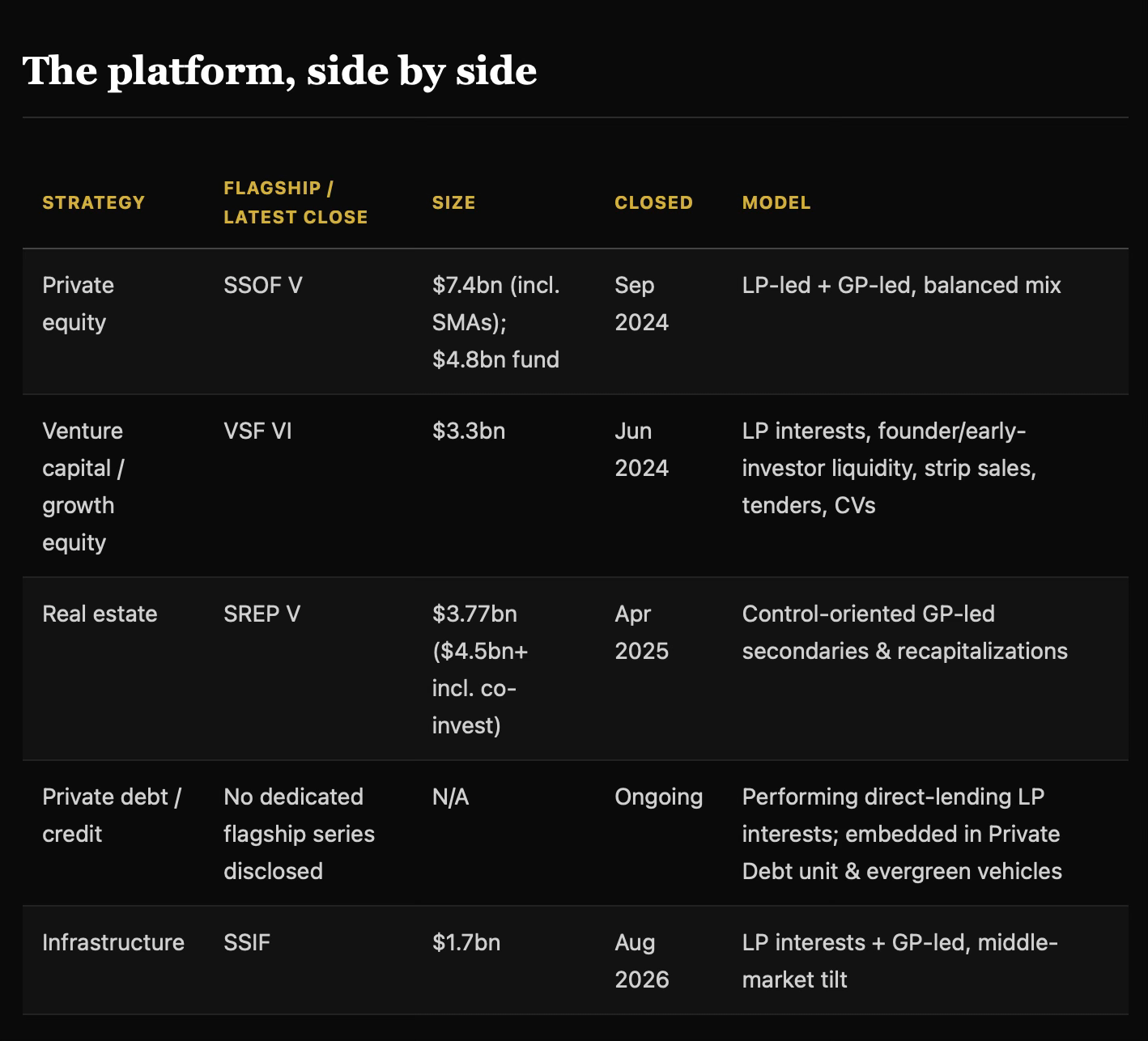
Read on its own, SSIF’s $1.7bn is a mid-sized fundraise in a year that has already produced a $3.77bn real estate secondaries close (StepStone’s own, in 2025) and a $9bn+ private equity secondaries program from Partners Group. What makes it worth a full platform piece is what it completes: StepStone now runs dedicated, multi-vintage secondaries strategies across five separate asset classes, each with its own flagship fund series, its own sector specialists, and, with the exception of the brand-new infrastructure line, a decade-plus track record.
1. PRIVATE EQUITY SECONDARIES: THE FOUNDING STRATEGY
StepStone’s PE secondaries program is the oldest and largest of the five. StepStone Secondary Opportunities Fund V (”SSOF V”) closed in September 2024 at $7.4bn including separate accounts, more than double the size of its predecessor, against $4.8bn for the commingled fund itself. Since inception, StepStone has deployed over $14bn across more than 210 PE secondaries transactions, split between LP-led and GP-led deals. The strategy is co-headed by Thomas Bradley and Mark Maruszewski, supported by a 37-person dedicated team.
2. VENTURE CAPITAL AND GROWTH EQUITY SECONDARIES: THE FASTEST-GROWING
StepStone launched its first VC secondaries fund in 2014, when the venture market was, in the firm’s own words, “an order of magnitude smaller.” StepStone VC Secondaries Fund VI (”VSF VI”) closed in June 2024 at $3.3bn, the largest fund StepStone says has ever been raised exclusively for venture capital secondaries. The strategy buys LP interests in venture funds, provides liquidity to founders and early investors in mature venture-backed companies directly, and structures portfolio strip sales, tenders and continuation funds alongside GPs. It’s run out of a 75-person venture and growth equity investment team, with John Avirett and Hunter Somerville as named partners on the fund.
3. REAL ESTATE SECONDARIES: THE LARGEST FUND ON THE PLATFORM
StepStone Real Estate Partners V (”SREP V”) closed in April 2025 at $3.77bn in primary commitments: StepStone’s own materials call it the largest real estate secondaries fund raised to date, ahead of a prior record held by Goldman Sachs. Including co-investments and discretionary vehicles, the total program exceeds $4.5bn. Unlike the PE and VC strategies, StepStone Real Estate’s approach, dating back to the unit’s 2009 founding by Jeff Giller, Josh Cleveland and Brendan MacDonald, has been control-oriented from the start: GP-led secondaries and recapitalizations rather than passive LP-interest purchases, a strategy the team says it pioneered coming out of the Global Financial Crisis. SRE’s advisory arm oversees roughly $170bn in real estate assets under advisement, conducting more than 1,000 manager meetings a year, which the firm frames as its primary secondaries deal-sourcing edge.
4. PRIVATE DEBT / CREDIT SECONDARIES: THE STRATEGY WITHOUT ITS OWN FLAGSHIP YET
This is the one line that doesn’t fit the same pattern. StepStone has been active in private debt secondaries since at least the early 2020s, buying performing direct-lending LP interests, a strategy the firm’s own research has described as a natural response to 2022’s denominator-effect selling, when private debt’s relatively strong performance made it a comparatively painless place for LPs to take a valuation haircut. StepStone has referenced a “Credit Opportunities Fund 1” with strong secondaries-driven performance, and private debt secondaries capability is embedded inside StepStone Private Debt more broadly, including within evergreen retail vehicles such as CRDEX. But StepStone has not yet announced a dedicated, numbered private-credit-secondaries flagship fund series on the scale of SSOF, VSF or SREP, worth watching given how aggressively Coller, Ares, HarbourVest and a wave of new entrants have built out credit secondaries as a distinct product line in 2026.
5. INFRASTRUCTURE SECONDARIES: THE NEW ARRIVAL
SSIF, as above: first dedicated commingled fund, $1.7bn total, closed August 26, 2026.
The pattern across all five
Every StepStone secondaries strategy sits inside a unit that also runs primary fund investments and co-investments in the same asset class. The firm’s stated thesis is consistent across PE, VC, real estate and infrastructure: deal flow and manager relationships built through primaries and co-investments feed proprietary insight (captured in its SPI platform) that informs how the secondaries teams price and source deals, an integrated-platform argument StepStone repeats nearly verbatim in each fund’s announcement.
Why the sequencing matters more than any single close
Multi-asset-class secondaries platforms aren’t new: Partners Group’s four verticals (PE, real estate, infrastructure, and private credit since April 2025) is the most obvious comparison this project has already profiled, and Ardian, Coller and HarbourVest have each pushed into credit or infrastructure secondaries from a PE base in the past few years. What distinguishes StepStone’s build is less the breadth than the depth in each vertical: SSOF V and VSF VI are both fifth-or-sixth-generation flagship funds with over a decade of vintage history, not first-time strategies bolted on to chase a hot market. SREP V’s control-oriented, GP-led-first approach, a genuine strategy differentiation dating to 2009, has already produced what StepStone calls the largest real estate secondaries fund ever raised. Against that backdrop, infrastructure secondaries isn’t StepStone experimenting with a new product; it’s the firm extending a repeatable playbook, primary-and-co-investment relationships feeding proprietary secondaries deal flow, into the one major asset class where it didn’t yet have a dedicated vehicle.
The gap that remains is private debt. Every other StepStone secondaries strategy above has a named, numbered fund series with a public close announcement. Credit secondaries, arguably the single fastest-growing sub-segment of the entire secondaries market this year, per the wave of BDC-redemption and direct-lending CV activity this project has tracked through Evercore, Jefferies, Ares and Coller data, does not yet have that at StepStone. Whether that’s a deliberate choice to keep the strategy embedded inside the broader Private Debt unit, or a flagship fund still being built, is worth asking StepStone directly.
Our Secondary Scoop take
The infrastructure close is a useful reminder of how secondaries has stopped being a single strategy and become a category that gets rebuilt, asset class by asset class, inside nearly every large private markets platform. StepStone’s version of that build is unusually legible because the firm names its funds sequentially and publishes a close announcement every time, which makes it easy to line five strategies up side by side and see that four of them share almost identical language about relationships, proprietary data and less-efficient market segments. That’s either a genuinely consistent institutional thesis applied five times, or a marketing template applied five times. Probably some of both. What’s harder to dispute is the deployment discipline: SSOF V, over 50% committed; SSIF, roughly 50% deployed across 26 deals within months of closing. For a strategy that keeps getting pitched to LPs as the market’s most reliable source of near-term DPI, showing the capital actually going out the door quickly is doing more work than another record-fund headline.