


StepStone Group’s fiscal first quarter of 2027 (the three months ended June 30, 2026) landed with fee-related earnings up 30% year-over-year to $105.6 million and fee-earning AUM up 21% to $153.6 billion. But buried inside the topline growth is a genuinely busy quarter for StepStone’s secondaries franchise: two flagship funds activated ahead of schedule, a new venture secondaries vehicle opening with a nine-figure-plus first close, a fee structure reset that’s now visibly working its way through the blended fee rate, and fresh vintages launched in both real estate and infrastructure secondaries. We pulled everything relevant to the secondaries market out of the transcript and the deck.
01
Two Flagship Funds, Activated Ahead of Schedule
The headline fundraising news is StepStone’s decision to activate both its flagship private equity secondaries fund and its GP-led secondaries fund in June, earlier than planned. Mike McCabe, StepStone’s Head of Strategy, laid out the quarter’s commingled fund closings on the call:
“Notable additions to our drawdown commingled funds included a billion-dollar first close in our newest venture capital secondaries fund, $500 million of closes in our infrastructure co-investment fund, $300 million of closes in our private equity secondaries funds, and $200 million of closes in our private equity co-investment fund.”
MIKE MCCABE, HEAD OF STRATEGY
The activation itself came with a meaningful balance-sheet effect. McCabe again, on fee-earning AUM growth for the quarter:
“We activated our two PE secondaries funds in June, which was on the early side of our expected range, resulting in nearly $3 billion of additions to our fee earning assets.”
MIKE MCCABE, HEAD OF STRATEGY
By quarter-end, CEO Scott Hart put approximate sizes on both vehicles and framed the pace of the raise as ahead of where StepStone was with the prior vintage:
“With some smaller closings that we had during the quarter that took the private equity secondaries fund to somewhere in the $2.5 billion range, the GP-led fund around 300 based on what had been raised to date, and with incremental closings post-quarter end, continued progress there.”
SCOTT HART, CEO
For context, StepStone’s prior flagship vehicle, Secondary Opportunities Fund V, a 2022 vintage, closed at $4.75 billion, according to the fund table in the presentation appendix. The current fund is running at roughly half that size so far and is still in market, so the “ahead of expectations” framing is a pace claim, not yet a final-size comparison. Asked directly by UBS’s Mike Brown about LP reception to the new terms, Hart didn’t attribute the strong start to any single factor:
“It’s hard to point to any one thing in terms of what is driving the activity and the fundraise, but would say that we are off to a very strong start there, probably ahead of expectations, certainly ahead of where we were last time around with this commingled fund.”
SCOTT HART, CEO
02
The Billion-Dollar Venture Secondaries Open
The other notable line item is that billion-dollar first close in what McCabe called StepStone’s “newest venture capital secondaries fund.” StepStone didn’t name the vehicle explicitly on the call. The fund appendix lists StepStone VC Secondaries Fund VI as a 2024 vintage with a current size of $3,325 million, described in the deck as “most recently closed fund for each category,” which suggests Fund VI is the prior, already-closed vehicle rather than the one that just opened.
The presentation’s “current drawdown funds in market” list separately confirms venture capital secondaries as an active, ongoing raise, consistent with a new, unlisted successor fund taking the $1 billion first close this quarter. We’d read this as the follow-on to Fund VI rather than late-stage closings into Fund VI itself, though StepStone’s disclosures don’t spell out the fund’s name or numbering, so treat that as an informed inference rather than a confirmed fact.
Either way, a $1 billion first close for a VC secondaries vehicle is a large number for a strategy that’s grown enormously in demand over the past two years, and it lines up with management’s broader comment that U.S. institutional strength this quarter was “driven by the strong initial closings we’ve had on our venture secondaries and private equity secondaries funds,” per commentary later in the call responding to a question on regional fundraising trends.
03
A Fee Structure Reset Is Muting the Blended Rate — On Purpose
StepStone flagged last quarter that it had changed the fee structure on its PE secondaries and GP-led secondaries funds, and CFO David Park confirmed on this call that the effect is now showing up in the numbers:
“Last quarter, we had mentioned in our prepared remarks that we did have a change in the fee structure for PE secondaries and GP-led secondaries funds, and that the impact would result in a relatively muted growth in the average fee rate. That’s exactly what you’re seeing right now.”
DAVID PARK, CFO
Park’s guidance is that this is a temporary drag while the funds are actively raising, not a structural repricing of the platform:
“You should expect to see the commingle fund fee rate stay relatively flattish over the next few quarters to a year as the secondaries funds continue to fundraise. And once that is fully raised, then you should see the resumption of the progress in fee rates as private wealth assets grow and as the fee rate steps up for the secondaries funds.”
DAVID PARK, CFO
WHAT THE NUMBERS SHOW
StepStone’s blended commingled-fund management fee rate sat at 1.02% on an LTM basis as of June 30, 2026, flat versus the 1.02% posted a year earlier, after several years of steady increases (0.85% in FY22, 0.93% in FY24, 1.06% in FY25). The overall blended rate across the whole platform (SMAs plus commingled) still ticked up slightly, to 0.65% LTM from 0.64%, because evergreen private wealth funds keep growing as a share of the mix and typically command higher rates than either SMAs or the newly-repriced secondaries vehicles.
Park’s framing, flattish now, stepping back up once the funds are fully raised, implies the new terms are lower during the fundraising and early-deployment period and reprice upward later, a structure increasingly common among GP-led and secondaries platforms trying to stay competitive on day-one entry pricing while preserving longer-term economics.
04
Real Estate and Infrastructure Get Fresh Vintages Too
Secondaries momentum wasn’t confined to private equity and venture. McCabe confirmed StepStone has launched next vintages in two more secondaries strategies:
“We have also launched the next vintages of our special situations real estate secondaries fund and our multi-strategy growth equity fund, with first closes expected in the coming quarters and activations to follow.”
MIKE MCCABE, HEAD OF STRATEGY
StepStone’s infrastructure secondaries fund — the prior vintage — was also still generating fee revenue this quarter through retroactive fees, called out by Head of Investor Relations Seth Weiss in his opening remarks:
“The quarter reflected retroactive fees primarily from our infrastructure secondaries fund. Retroactive fees contributed $1.1 million to revenue, which compares to retroactive fees of $2.9 million in the first quarter of the prior fiscal year.”
SETH WEISS, HEAD OF INVESTOR RELATIONS
The presentation appendix confirms infrastructure secondaries as one of nine strategies currently active “in market” for StepStone’s drawdown fund lineup, alongside PE secondaries, PE GP-led secondaries, VC secondaries, real estate secondaries, PE and infrastructure co-investment funds, and the multi-strategy vehicles.
05
Management’s Read on the Market: Record Pace, Thin Dry Powder
Asked about LP reception to the repriced PE secondaries fund, Hart used the moment to give his broader read on the secondaries market’s supply-demand balance, arguably the most quotable market color on the call for our audience:
“You’ve seen some of the first half statistics come out about the secondaries market. The first half was another sort of record first half and on pace for what very much looks to be another record year, yet at the same time, there’s not a tremendous amount of dry powder, only about a year’s worth of dry powder that’s available in the market there.”
SCOTT HART, CEO
That’s a notable data point on its own: a leading secondaries LP and GP-led investor is telling public-market analysts that dry powder in the broader secondaries market sits at roughly one year of deployment — thin enough, in StepStone’s own framing, to support continued pricing discipline and StepStone’s own fundraising momentum.
06
The Carry Backlog: $935 Million and the Partial-Realization Problem
Net accrued carry closed the quarter at $935 million, up 19% year-over-year, and the presentation breaks the balance down in useful detail: 71% of net unrealized carry by vintage sits in 2021-or-earlier programs, old enough, per StepStone’s own framing on prior calls, to be “ready to harvest.” By asset class, 80% of net unrealized carry is tied to private equity, 14% to infrastructure, and 6% to real estate. Gross accrued unrealized carried interest stood at $2.08 billion, of which $845 million (41%) sits in vehicles with American-style, deal-by-deal carry waterfalls, the remainder in European-style, whole-fund waterfalls. StepStone counts over 250 programs with carry or incentive fee structures and more than $120 billion of performance-fee-eligible capital as of June 30, 2026.
Asked how investors should think about the pace of conversion from accrued to realized carry, the answer (most consistent with CFO David Park, who owns this section of the deck) leaned heavily on a theme that will be familiar to anyone tracking GP-led activity — that a lot of what looks like realization activity in the market isn’t yet showing up as carry:
“A lot of the realization activity that you do see results in partial realizations as opposed to full realizations. Whether that’s through a continuation vehicle, a minority sale, the divestiture of a division, or selling to a strategic but receiving stock in return that needs to be exited over time, there have been a number of different forms of partial realizations that we’ve seen.”
STEPSTONE MANAGEMENT
“What that can mean in some cases is that it may not always translate into carry if those funds that have a European waterfall have not returned cost plus preferred return, or if those vehicles with an American waterfall have not returned cost plus preferred return on that individual company. I think we’re seeing a little bit of a disconnect right now between some of the improving realization activity that hasn’t yet flown through in terms of carry. We do think that is starting to improve.”
STEPSTONE MANAGEMENT
EXPLAINER: PARTIAL VS. FULL REALIZATIONS
A full realization is a clean exit: the fund sells 100% of a portfolio company for cash and the position is closed. A partial realization returns some capital and/or liquidity without closing out the position entirely: rolling equity into a continuation vehicle, selling a minority stake while retaining the rest, spinning off one division of a larger holding, or accepting acquirer stock instead of cash in an M&A exit.
Partial realizations return cash or mark-to-market liquidity to LPs, but they don’t necessarily clear a fund’s preferred-return hurdle on that specific investment.
Under a European (whole-fund) waterfall, carry only accrues once the entire fund has returned capital plus its preferred return, so partial exits across the portfolio can sit for years without triggering carry payments.
Under an American (deal-by-deal) waterfall, carry can trigger on an individual investment once that specific deal clears its hurdle, but a partial realization may still fall short of doing so if the return-of-capital-plus-preferred bar hasn’t been cleared on that position.
The upshot for GP-led and secondaries watchers: rising realization activity across the market (continuation vehicles included) doesn’t mechanically translate into rising realized carry for LPs sitting behind these structures. That lag is exactly what StepStone is describing here.
07
Performance: What StepStone’s Own Secondaries Track Record Shows
StepStone’s appendix discloses net IRRs by investment strategy across its platform, calculated on an inception-to-date basis through March 31, 2026, net of both underlying manager fees and StepStone’s own hypothetical fee-and-carry assumptions. The company is explicit that these are illustrative, not actual investor-level returns. Secondaries-relevant lines:
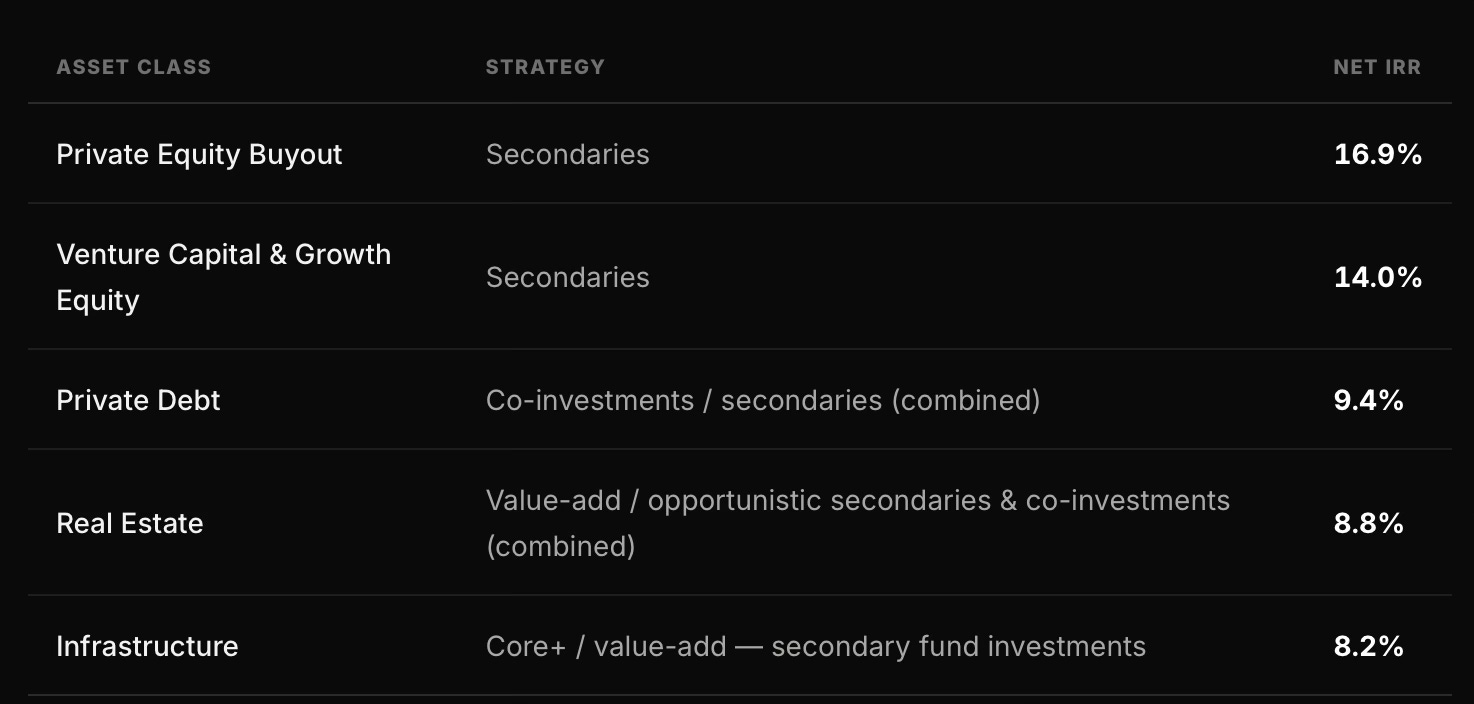
Net IRR as reported by StepStone, inception-to-date through March 31, 2026, net of underlying manager and hypothetical StepStone fees/carry. Real estate and private debt figures blend secondaries with co-investments in StepStone’s own reporting taxonomy; PE and VC report secondaries as a standalone line. Past performance is not indicative of future results. Source: StepStone FQ1’27 earnings presentation, slide 29.
Private equity buyout secondaries at 16.9% net IRR is the standout figure and the highest of any strategy StepStone discloses across its entire platform — ahead of PE co-investments (15.8%) and PE primaries (13.6%). Venture secondaries, at 14.0%, sits below venture directs/co-investments (16.6%) but well ahead of venture primaries (13.6%), a pattern broadly consistent with what the wider secondaries market has reported on vintage-adjusted return premiums versus primary commitments.
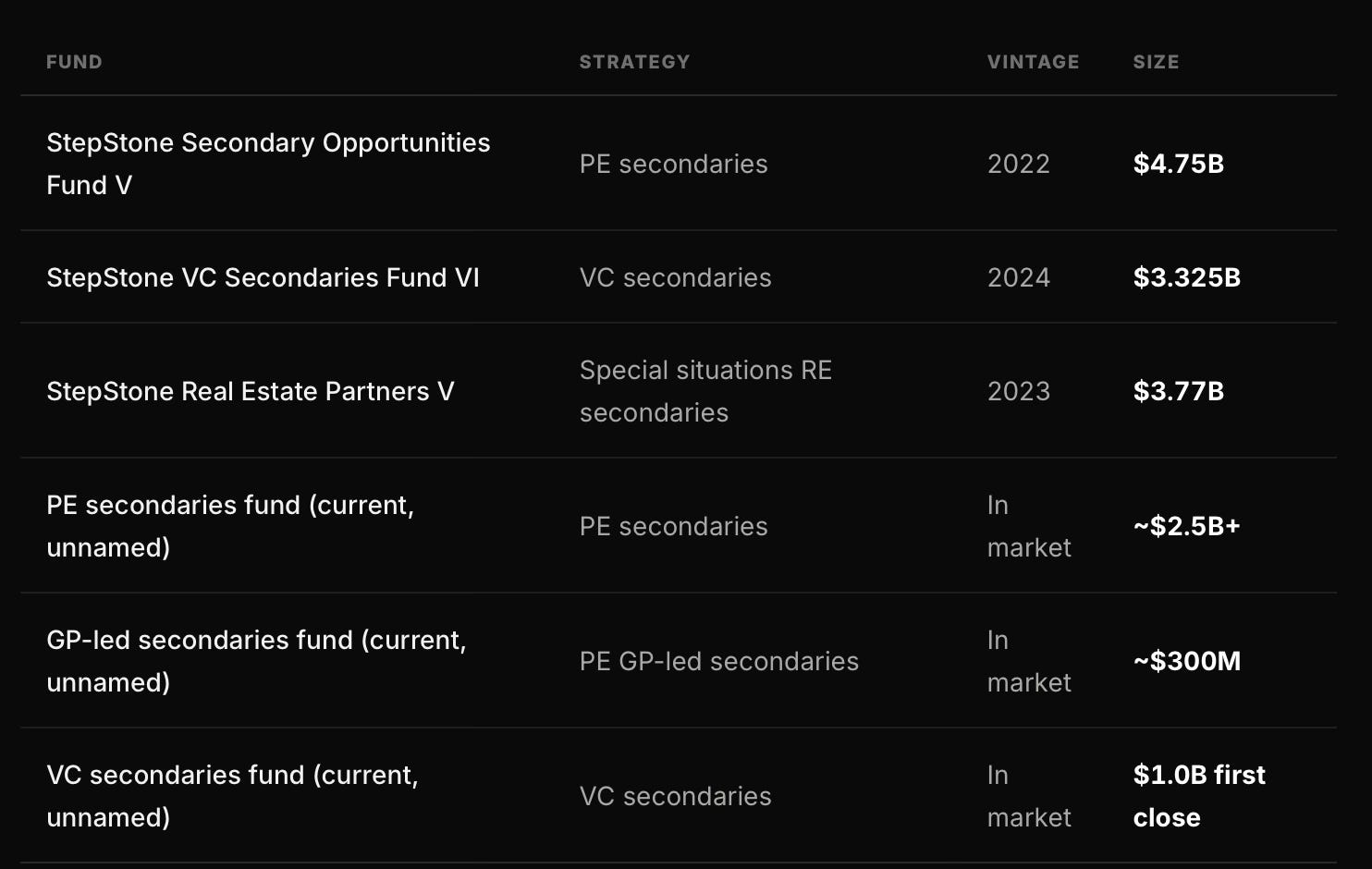
Closed-fund sizes and vintages per StepStone’s “Notable focused commingled funds” table (presentation, slide 30). Currently-fundraising fund sizes reflect figures disclosed on the FQ1’27 call as of the print date; StepStone did not disclose formal fund names or numbering for vehicles still in market.